


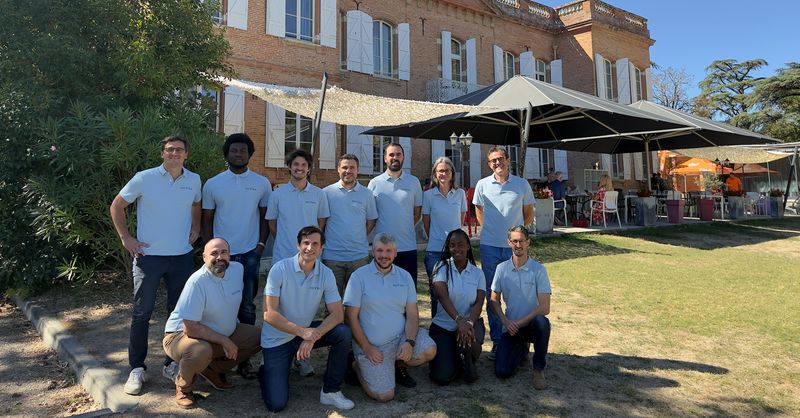
- Previsia, a Toulouse-based insurtech, has closed a €3.8 million seed round, backed by IRDI and ARIS.
- AI platform facilitates site visits, which normally cost around €3,000 each.
- Previsia has been a profitable business since 2025, and revenue has increased 2.5x over the last year.
When one of France’s biggest brokers asked them how you’d go about running risk prevention for a client with over 1,000 sites, the standard answer was to send an engineer to each one. Hélie Brouchet, co-founder and CEO of Previsia, puts the cost at around €3,000 per visit. By our reckoning, that’s around €3 million for a single round of surveys.
This Toulouse-based startup just raised €3.8 million in seed funding from IRDI and ARIS. The company was profitable before this funding round.
Turning a broker’s challenge into a platform
Previsia was founded in October 2023 by Brouchet, an HEC graduate previously at EY and JPMorgan, and David Salom, a physicist and former head of high-risk industrial sites. Its first customer was Diot-Siaci, which Brouchet describes as one of the biggest brokers in France, a major broker in Europe.
“The current solutions are outdated. It’s like it’s sending engineers on every site and it’s about €3,000 per visit, and it’s not scalable,” he says.
Instead, Previsia built a platform. Brouchet says the client asked to triple their contract about six months into the engagement. The insurer was happy to fund that expansion and the broker saw other clients with similar requirements. Previsia assessed 70 sites in under three months, giving the broker the data they needed to enter renewal discussions.
The timing is spot on for the industry. Brouchet cites recent European wildfires, the Louvre heist last year, lithium-battery fires, and the increased cost of repairing EVs as examples. The company points to a 74% increase in commercial property claims in France between 2014 and 2024 as reported by France Assureurs.
“Today, fewer than 5% of insured sites benefit from genuine risk prevention. Built on the expertise of our engineers, our AI platform makes it simple to identify, analyze and manage risks. Prevention is no longer the preserve of specialists: sales teams, brokers and business leaders can now carry it out themselves. It becomes accessible to everyone, with a clear promise, risks under control and fewer claims, in exchange for insurance tailored to each business,” adds Brouchet.
A human still approves the results
If the AI can make mistakes, then? Brouchet is very clear on that: “It’s always a human that has to validate the results that the AI gives. Our platform does not replace engineers because today it helps engineers do more visits.”
The platform covers the entire process, from setup through site surveys, reports, action plans, follow-ups, and portfolio analysis. A broker can set up a car dealership profile in minutes, go out and talk to the people, take photos, etc and the questionnaire then fills in automatically. An insurer-ready report gets sent to underwriting the same day.
Brouchet makes the point that generic tools such as ChatGPT or Claude aren’t sophisticated enough for the type of visit you’re doing in a prevention context, so Previsia has had its AI specifically tuned by its engineers.
Previsia is targeting jewelers, restaurants, and garages that simply can’t afford to have an engineer. Other companies are targeting different slices of the market. Nettle in London just raised a $4.8 million seed round to help commercial insurers with inspection backlogs that can be as long as six months. Stoïk in Paris is a different proposition entirely, combining real-time prevention with cyber insurance for SMEs.
Previsia distributes its platform via intermediaries. “It’s not about 40 businesses, it’s really 40 large customers,” Brouchet says. The customers are Groupama, Diot-Siaci, Verspieren, MSIG Europe and Helvetia, all of which use the platform across their sites.
Raising funds in a tougher market
Brouchet says this round was harder to raise than in previous years. “We’re not in 2020 when the money was easier to get for startups,” he says, adding that investors now look for profitable companies or experienced teams.
The money will go into three main buckets: a new app for the insured business; natural hazard analysis across Europe and adding prevention data to the underwriting tools; strengthening the sales teams and broker/insurer relationships; and international expansion.
Previsia has 15 people and an office in Hamburg, with an international director, and strong traction in Spain, Italy, Belgium, and Germany. Brouchet is looking at a Series A in about 2 years and says “risk has no borders,” with the same issues to be faced in Germany, the UK, Spain and Italy.
The open question is whether prevention data changes what insurers charge. One insurer told Previsia it could finance a larger deployment, but neither Brouchet nor the release says whether premiums have fallen at the sites Previsia assesses.



