


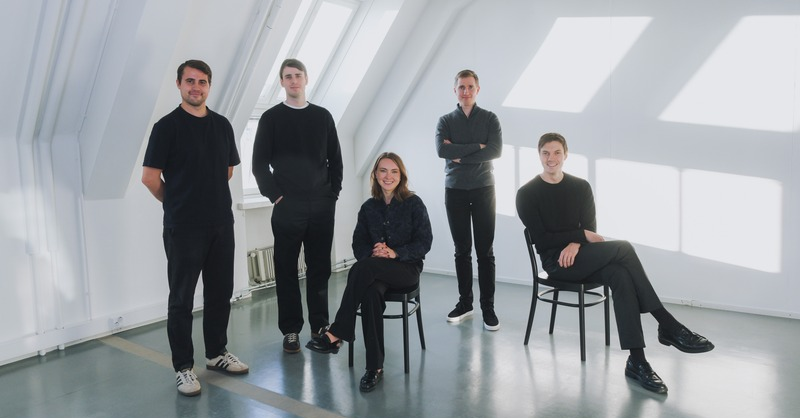
- Stoa, a female-led startup based in Helsinki, has raised a €3.5 million pre-seed round, led by Lifeline Ventures.
- Stoa brings all the drawings, schedules, and quality and safety reports together in one system, using AI to give the team a current view of the project.
- The new funds will be used for product development, international expansion and headcount.
Stoa, a Helsinki-based startup founded by Founders House co-founders, raised €3.5 million to build AI solutions for construction sites and data centres. According to Stoa CEO Johannes Korpela, the pre-seed round closed very quickly, in under a week.
Lifeline Ventures, which previously invested in Wolt, Aiven and Supercell, led the round. Illusian, the investment company of Supercell co-founder Ilkka Paananen and Wolt co-founder Miki Kuusi, also joined, as did Wave Ventures, a Helsinki-based fund run by investors under 25.
The angel investors in the round include former Nokia CEO Pekka Lundmark, Virala CEO Alexander Ehrnrooth and SRV board member Tuomas Kokkila. PlanGrid co-founders Tracy Young and Ralph Gootee also invested following Autodesk’s $875M acquisition of the company in 2018.
Often, existing information ends up stored in the wrong system
Stoa brings all the drawings, schedules, and quality and safety reports together in one system, using AI to give the team a current view of the project. That enables the team to track changes and make decisions much more quickly. According to the company, billion-euro facilities typically take 18 to 24 months to complete, so having that information flowing in real time is a necessity.
Stoa is in use on over 25 Nordic sites, with a wide range of Nordic contractors and data centre sites as customers, as per Komulainen. The company claims project engineers and site managers save between 2 and 8 hours per week.
“On a construction site, the information that would prevent most mistakes usually already exists. It’s just in the wrong system at the wrong time. AI can now read drawings, contracts and building information models, so we can get that information to the right person before the mistake happens,” says Taavi Paananen, co-founder and chief product officer of Stoa, who made the Forbes 30 Under 30 list in 2026.
McKinsey report showed that construction productivity increased by 10% between 2000 and 2022, compared to 90% in manufacturing. According to co-founder Camilla Komulainen, the timing is perfect: “Construction hasn’t been served with the tools it needs. This is the right time to bring AI into the construction workflows, and our customers are wanting and needing that.”
Human oversight remains essential
Mistakes are still very much a risk. Komulainen’s solution to this is that Stoa ensures people are always in control.
“The bottom line with [Stoa] and with bringing AI to construction is that humans always need to be in the loop. So everything we provide, all the answers we provide to the customer, there’s a citation to the original source, whether it’s a drawing or a schedule or an Excel or anything,” she says.
The product is also very upfront about its own limitations. If it doesn’t have the correct information, it will say, “I don’t have the correct information for this.” Korpela says the system is based on an ontology graph model. A key part of the approach is to build a bespoke data model for each customer in order to mitigate the risk of AI hallucination.
Data centres are just part of the business. Korpela adds the most value in the complex, larger projects, and data centres are the clients at the moment due to the boom. Stoa also works on smaller sites, and as he says, “we’re not just data centre people.”
Competing with global construction tech firms
Finland’s data centre investment is now at €67 billion, with Pure DC’s Seinäjoki campus alone potentially reaching €7.5 billion. The new funds will be used for product development, international expansion and headcount.
The competition has seen larger funding rounds. Trunk Tools closed a $40 million Series B in July 2025, and Conxai in Munich raised €5 million in April 2026.
“There will be a race to be the AI native operating system for construction, but we’re not worried,” Korpela concludes.
The team has experience at Supercell, AWS, SRV, and Peikko Group, and is close to 10 full-time employees. The bigger challenge is in Finland, where the global builders will be comparing a €3.5 million startup against US peers with access to vastly larger funding.



