


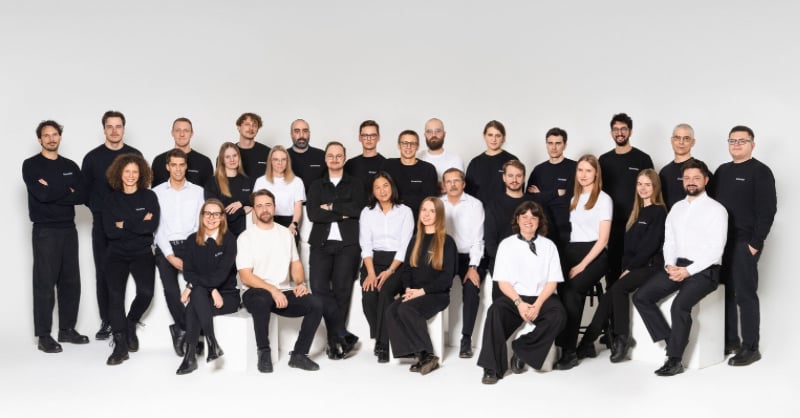
- Biomatter has raised $18M in an oversubscribed Series A led by Astanor.
- Existing investors UVC Partners, Inventure and Metaplanet also took part.
- The money funds a Vilnius lab, US expansion and a bigger commercial team.
Enzymes power processes across pharmaceuticals, food production, diagnostics and industrial manufacturing. However, developing a custom enzyme for a specific chemical reaction can take months or even years.
Biomatter, a Lithuanian biotech company using AI to design custom enzymes, has raised $18 million in an oversubscribed Series A round led by Astanor. Existing investors UVC Partners, Inventure and Metaplanet also participated. Biomatter did not disclose its valuation or total funding.
The funding will support a new 2,000-square-metre design-and-testing facility in Vilnius, opening in 2027, expansion of its commercial team and a stronger US presence, where roughly half its customers are based. The company aims to reduce enzyme development cycles from weeks to days by bringing more design and laboratory testing in-house.
Founded to design enzymes beyond nature
Founded in 2018, Biomatter is led by CEO and co-founder Laurynas Karpus. Its founders published one of the first demonstrations that generative models can produce functional enzymes far from anything found in nature, in Nature Machine Intelligence in 2021.
Unlike conventional enzyme engineering, which modifies existing natural enzymes, Biomatter starts with the chemistry a customer needs. Its AI models design enzymes around specific target reactions, including chemical processes that natural enzymes may not perform.
The approach relies on proprietary experimental data generated over several years. Every designed enzyme is tested in the laboratory, with results feeding back into the dataset to improve subsequent designs.
One example is a methylase developed for mRNA vaccine manufacturing that works without S-adenosyl methionine (SAM), an expensive additive required by natural methylases.
“Our goal is to make a custom enzyme as easy to order as a catalog product, including for reactions that don’t have one today. This funding round lets us design enzymes from the chemistry up at a larger scale and get them into customers’ products faster,” said Laurynas Karpus, CEO and co-founder of Biomatter.
From AI design to commercial products
Biomatter has delivered more than 50 custom enzymes to more than 25 enterprise customers across Europe, the US and Japan. Its customers include AstraZeneca, BASF, Kirin Holdings, Neogen, Sanofi and Tereos, spanning biopharmaceuticals, diagnostics, agriculture and industrial biotechnology.
Its technology has already reached commercial products. Biomatter worked with Thermo Fisher Scientific to improve the oxidation resistance of Invitrogen SuperScript V Reverse Transcriptase, an enzyme used in molecular biology and mRNA research. The improvement supports reagent stability, including ambient shipping and room-temperature storage for up to six months.
Several customer relationships have expanded from individual projects into multi-year programmes involving multiple enzymes.
Biomatter says its current development programmes take weeks, compared with months or years using conventional approaches. The new facility, expected to open in 2027, will bring more enzyme design and experimental testing under one roof and aims to shorten this further to days.
AI-powered enzyme design attracts competition
Biomatter operates in a growing field of companies applying AI and computational biology to protein and enzyme engineering.
Manchester-based Imperagen raised £5 million in seed funding in May 2026, led by PXN Ventures, to combine quantum simulation, AI models and laboratory automation for enzyme engineering. Spanish startup ZYMVOL raised €3 million in seed funding in February 2025, led by Faber Ventures, to advance computational enzyme discovery, particularly for green chemistry and industrial applications.
Amsterdam-based Cradle raised a $73 million Series B led by IVP in November 2024 for AI-powered protein engineering tools that help scientists design improved proteins, including enzymes, for pharmaceutical and industrial applications.
While these companies overlap in computational biology, Biomatter differentiates itself through its chemistry-first design approach, proprietary experimental dataset and custom enzyme programmes for large industrial customers.
A growing market for engineered enzymes
The commercial opportunity spans pharmaceutical manufacturing, diagnostics, food processing and industrial biotechnology. Grand View Research estimates that the global engineered enzymes market will grow from $3.3 billion in 2026 to $7.3 billion by 2033, representing an annual growth rate of 11.6%. This broader market includes engineered enzymes developed through approaches beyond AI.
Astanor, founded in 2017, has about 50 investments in agrifood technology across Europe, North America and beyond. UVC Partners manages more than €800 million and has backed Isar Aerospace, Proxima Fusion, Q.ANT and Aleph Alpha.
“AI is moving out of software and into the physical world, and biology is where that shift is accelerating. Most companies working on AI for biology are still proving it works. Biomatter’s enzymes are already in products shipping from some of the largest manufacturers in Europe and the United States, which is why we increased our investment in this round,” said Oliver Schoppe, partner at UVC Partners.
“Enzymes power hundreds of billions of dollars in food production and biomanufacturing. But because improving them takes months or years of trial and error, companies settle for suboptimal enzymes. The constraint has been data. Until now, the field has been limited to training on what exists in nature. Biomatter has spent years generating data beyond nature, which allows them to design enzymes that never evolved. They have world-class customers returning again and again, across an array of industries. That is the clearest signal there is,” added Harry Briggs, partner at Astanor.
The test now is whether weeks can become days, and whether customers keep coming back once the new lab is running.



