


- SE3 has raised $30M in Series A funding led by Accel.
- Its software links drones and ground vehicles from different makers into one 3D picture.
- It works with Ukraine and the Bundeswehr and eyes civilian markets from 2027.
AI has made significant advances in automating digital tasks, but enabling machines to understand and navigate the physical world remains a challenge.
SE3, a Munich-based spatial intelligence company, has raised $30 million in Series A funding led by Accel, with participation from Keen, Lakestar and Seedcamp. SE3 did not disclose its valuation or total funding.
Its software enables autonomous drones and ground vehicles to understand complex environments, coordinate operations and keep working when satellite navigation is jammed.
“Working in defence means our technology has to deliver under pressure in the field. Ultimately, today’s funding will get us closer to providing the spatial intelligence technology needed across Europe to protect a free and secure future,” said Lukas Köstler, co-founder and CEO of SE3.
The new funding will support SE3’s engineering, commercial and operations teams as it fulfils existing contracts and expands its customer base. The company plans to strengthen its presence in Germany and Ukraine while opening an office in the UK and pursuing further opportunities across Europe.
Building a shared intelligence layer for autonomous systems
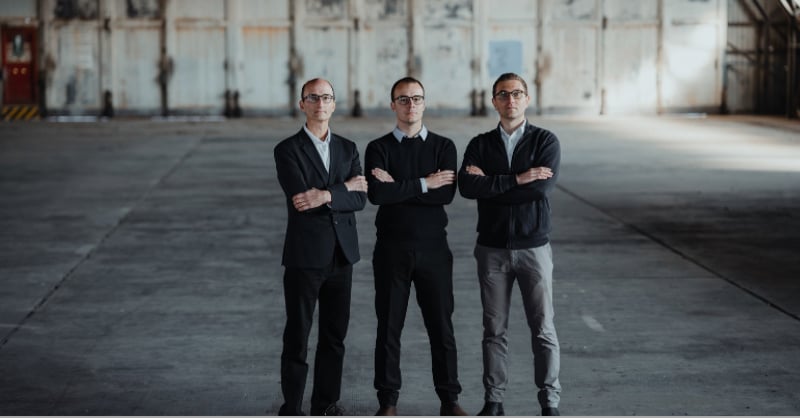
SE3 was founded by Köstler, Simon Klenk, and Professor Daniel Cremers. The company spun out of Cremers’ computer vision laboratory at the Technical University of Munich (TUM), where Köstler and Klenk were pursuing PhDs in computer vision and robotics.
Cremers holds TUM’s chair for computer vision and AI, serves as SE3’s chief science officer and received the Gottfried Wilhelm Leibniz Prize, one of Germany’s most prestigious research awards.
The company is developing the software layer that allows autonomous systems to perceive, reason and act in complex physical environments. Its technology combines computer vision and AI to turn sensor data into a shared understanding of the surroundings, helping drones and ground vehicles operate autonomously, including where GPS signals are unreliable or disrupted.
Unlike manufacturers that develop individual drones or unmanned ground vehicles, SE3 is building a platform-agnostic software layer designed to work across systems from different suppliers. It fuses sensor data from multiple vehicles into a three-dimensional picture of the operating environment, which lets the software optimise routes and positions as conditions change.
Operators can command the fleet by voice. The software runs entirely on edge devices, so systems keep operating without constant cloud connectivity. That matters in defence, where electronic warfare can interfere with satellite navigation and communications. SE3 aims to help military operators manage larger fleets with fewer personnel.
Köstler argues that if drone makers each control their own software, customers struggle to make systems from different vendors work together and face costly lock-in within two or three years.
European defence creates an immediate market opportunity
SE3 says the European Union aims to mobilise €800 billion in defence spending by 2030, alongside plans for a European Drone Wall to defend its eastern flank.
SE3 says it has shipped thousands of systems over the past two years and is working on multiple contracts with Ukraine and Germany’s armed forces, the Bundeswehr. Its customers and partners include defence electronics company HENSOLDT, autonomous systems software provider Auterion and scale-up ERC System.
Lorenz Meier, founder and CEO of Auterion, said SE3’s spatial intelligence runs on Auterion’s Skynode platform, “so our customers get that capability on the platforms they already operate, across manufacturers.”
The company has designed its technology around the Modular Open Systems Approach, which encourages armed forces to integrate equipment from different manufacturers. Germany’s MOSABw programme is part of this push, creating opportunities for independent software providers.
Matt Robinson, partner at Accel, said the team is “uniquely qualified to take on the challenge of building spatial AI for autonomous systems, something defence primes have found so difficult to do.”
Competition in autonomous defence software
SE3 operates in an expanding European defence technology ecosystem. Norwegian startup Six Robotics raised €12 million in its first institutional round, led by DTCP Defence, for software that lets one operator control a drone swarm. London-based Occam Industries raised a €3 million pre-seed round led by Presto Tech Horizons for onboard autonomy built for GPS-denied battlefields.
The scale of the sector is larger at the top. Germany’s Quantum Systems raised $1.2 billion in a Series D in July 2026 at a valuation of about $8 billion, while TFN reported in May that Destinus was in talks to raise around €200 million. Both build hardware, whereas SE3 sells a neutral software layer.
Grand View Research estimates that the global autonomous intelligence, surveillance and reconnaissance (ISR) systems market was worth $5.9 billion in 2025 and could reach $14.5 billion by 2033, growing at a compound annual rate of 11.9%.
The category is wider than SE3’s offering, but it shows the growing investment in autonomous sensing. The open question is whether armed forces will buy neutral software from a startup or take it from the hardware makers they already use.



