


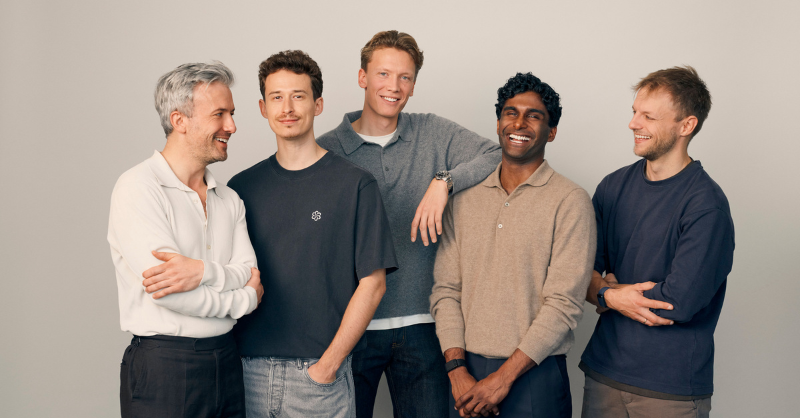
- Sumary raised $25 million in a seed round led by Singular, just under a year after its $4.2 million pre-seed round.
- The CEO and COO are both moving from Copenhagen to London, which will be the company’s main commercial centre.
- Sumary offers AI tools to accounting firms as the market sees a number of new AI-native competitors enter.
Copenhagen-based Sumary, which develops AI software for accounting firms amid a battle with AI-native firms, just closed a $25 million seed round, led by Singular.
Existing investors byFounders, Partech and Tenity also joining in. The angel investor list included Steve Anavi (Qonto), Tuomas Artman (Linear), Stanislas Polu (Dust), Steffen Tjerrild (Synthesia), Jannick Malling (Public.com), Ben Freeman (Omnea), and several others.
This round is nearly six times the $4.2 million pre-seed raised in November 2025, led by byFounders, bringing Sumary’s total funding to date to $29.2 million. Sumary claims it’s the largest seed round ever for accounting software in Europe.
Pascar Sivam, co-founder and CEO of Sumary, said, “Accounting firms are being asked to do more with fewer people. Software has to take on the preparation properly, so accountants can give their time to the people who depend on them: their clients and their own teams. That is what we have built. This round lets us bring that to firms across the UK and Europe much faster.”
Two co-founders move from Copenhagen to London
London is Sumary’s commercial hub, while Denmark remains the centre of its technology and AI research. Sivam and COO Frederik Skov Wacher are both moving to lead UK growth. The company is expanding into Europe, with the Benelux being the first market.
Sivam started Sumary with Bastian Schneider, Lucas Rantzau, Frederik Hvilshøj, and Skov Wacher. Sivam and Schneider are both former McKinsey consultants, and Hvilshøj was a lead ML engineer at Encord and has a PhD in explainable deep learning and generative models from Aarhus.
In a nutshell, Sumary is an AI operating system for accounting that automates workflows, checks transactions and provides insights. It handles the key tasks of the monthly close, VAT returns, and year-end for all clients and ledgers. Every step is set up for the accountant to review and approve. For example, a VAT return would be delivered as a draft for review and sign-off.
Sumary’s Copenhagen research team has created a benchmark based on actual accounting work, and they run all the top AI models against it before using them with clients. The company reports that after three months on the platform, firms are spending 50% less time on their monthly close and 75% less time on their VAT returns.
The startup says it has arrangements with most of the 20 largest accounting firms across the Nordics and contracts with several leading UK firms. Customers include Deloitte, Grant Thornton and Baker Tilly.
Sell to firms or become one
Since July, the AI accounting space has split. Some startups are selling AI to established firms. Basis landed $100 million at $1.15 billion in February, while Kabilio in Barcelona raised €10 million on 5th November and serves over 500 accounting firms. Ravical in Belgium secured a $17 million seed round on 29th October.
Other startups are operating as accounting firms in their own right. Skalar raised €12 million in July, Integral raised an €18 million Series A in September, Dougs raised €50 million in October, and Gradient came out of stealth with $4 million that same month. Each of them is an AI accounting firm.
Sivam has picked a side: “Dozens, and probably soon hundreds, of AI accounting firms are being built as we speak. We want to offer existing accounting firms the chance to deliver customer value that is as good as, if not better than, these new entrants, by adopting AI quickly across their operations. With the right technology, they can lead this transformation rather than be disrupted by it.”
Sumary says it will work with any ledger the accountant is currently using and aims to be the firm’s operational partner. The end game is for accountants to spend less time on drudgery and more time on advisory.
What $25M needs to prove
Grand View Research valued the European accounting software market at $5.4 billion in 2024 and forecasts it will reach $8.4 billion by 2030.
Jeremy Uzan, a general partner at Singular, added, “Sumary has one of the strongest founding teams we have seen in Europe at this stage and their commercial momentum is exceptional. They have combined deep AI research capabilities with an understanding of how accounting firms operate and are already winning the trust of some of the industry’s largest players. We believe Sumary has what it takes to become the defining AI platform for accounting in Europe.”
The big question is: will the profession trust tools that assist existing firms, or tools used to build entirely new firms around AI? Sumary has opted to support existing firms and now has $25M to demonstrate what it can do.



