


- Marble Imaging has raised another €6 million, led by Cherry Ventures.
- The company plans to ship its first satellite to California in December and aims to launch it via SpaceX by February.
- Marble has over 10 customers and a contract pipeline exceeding €20 million.
Marble Imaging, a German startup based in Bremen building a commercial Earth observation constellation, just raised an additional €6 million, led by Cherry Ventures.
This new funding marks the second seed-round close, following the €5.3 million seed round led by High-Tech Gründerfonds in December 2025. The total seed round now stands at €11.3 million. With a €650,000 pre-seed round closed in May 2024, Marble has raised around €12 million in equity. The company has also received over €10 million in non-dilutive funding from DLR and the ESA.
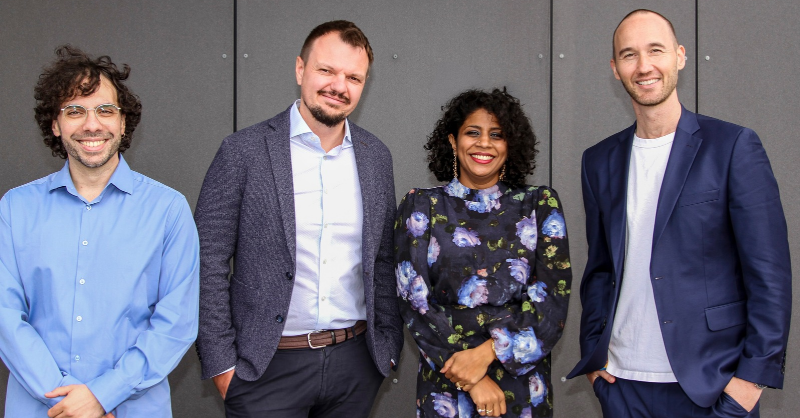
Founded in 2022 by Alexander Epp, Robert Hook, Dr Gopika Suresh and Dr Raul Scarlat, Marble pitches very high-resolution imagery as a core input for security and commercial intelligence. According to the company, Europe and many of its partners currently rely on non-European providers, which limits access to key conflict areas.
“To make better decisions, you need immediate and actionable data. That’s what Europe and many of its partners currently lack. We at Marble are absolutely committed to closing that gap and Cherry’s trust enables us to do so much more quickly,” says Hook, co-founder of Marble Imaging, in a conversation with Tech Funding News.
Hook tells TFN that rising demand has driven this funding round: “We wanted to ride that wave of momentum and grow our constellation as quickly as possible, and that requires capital.”
A sovereign satellite launched on an American rocket
Marble says it’s building Germany’s first commercial VHR satellite constellation. Marble Sat-1, nicknamed Morgana, is the first. Reflex Aerospace, a Munich and Berlin company, built the platform. It will capture sub-metre images in the visible, near-infrared and shortwave infrared bands. Marble hasn’t disclosed the exact resolution, just that it’s below one metre.
Hook says the satellite has completed all of its testing and is ready to go. It will be shipped to California in December for a planned February launch with SpaceX. It will then conduct a six-month in-orbit demonstration, during which Marble will test a laser data link from Odysseus Space, before commencing commercial operations.
Choosing SpaceX as the launch provider clearly indicates how difficult it is to achieve full sovereignty. “Currently and for next year we’ll still be using SpaceX prior to our transition to European launches. We do want to be focused on the European ecosystem, but the launch opportunities from Europe are very limited,” Hook explains.
TFN reported that Europe had fewer than 10 orbital launches in 2025 and has questioned whether Europe will actually make the most of its space opportunity.
HyImpulse, the rocket company based in Neuenstadt that raised over €50 million in September 2026, is meant to be Europe’s solution. Hook says Marble has purchased eight HyImpulse launch vehicles. The HyImpulse SL1 orbital rocket hasn’t flown yet, and a second flight of its smaller SR75 rocket is due before the end of 2026, ahead of the SL1 launch.
The first launch was due late 2026. The new plan is for 30 satellites by 2030, with the first launch now due in February 2027, according to Hook.
The satellite is just one element of what Marble is offering. The company is also building an AI analytics platform which takes data from a variety of sources and turns it into actionable insights for defence, civil security and critical infrastructure. At the moment it can detect ships and determine whether terrain is suitable for vehicles.
As more satellites come online, Marble envisages the satellites and the software working in concert to produce a “uniquely well-trained AI solution.” Hook confirms the customer portal, which delivers the data and provides the analytics, is already live and in use. Development on the next generation of satellites has already begun with partners, including a French supplier for the key payload.
Who is paying, and how Marble stacks up
Hook says revenue has grown from last year and is now in the several-million-euro range. Marble has over 10 customers, including several significant government clients that typically sign multi-million-euro contracts. Several commercial users also use the analytics.
The company also has data contracts in the pipeline worth over €20 million and expects several more contracts over the coming months. A major commercial contract for critical infrastructure and civilian security analytics is due very shortly. The team has more than doubled from 17 to just under 40.
“Europe needs its own eyes in space, and Marble Imaging is building them. They are using AI to turn pixels into answers, exactly what government and defense customers need. This team has spent their careers in the industry and knows what it takes to build something very big. The product Marble will deliver doesn’t exist in Europe yet, but we’re convinced it has to,” says Filip Dames, founding partner at Cherry Ventures.
The field is very competitive and well funded. Planet Labs and Vantor are the established US players. In Europe, ICEYE raised €450 million in June 2026 at a valuation well over €10 billion. Other competitors are Xoople, based in Madrid, which secured $130 million in April 2026, and Open Cosmos UK, a satellite maker, which landed €300 million in September 2026, led by Lightrock.
European defence, security and resilience startups raised a record $8.7bn in 2025, up 55%, according to Dealroom and the NATO Innovation Fund. The US remains the clear leader in defence tech venture funding for NATO, accounting for around 85% of funding since 2019.
Sat-1 will be the key test. If it reaches orbit in February, delivers sub-metre imagery, and converts Marble’s pipeline into paid contracts, the company will show that a startup can provide the imagery Europe currently lacks.



