


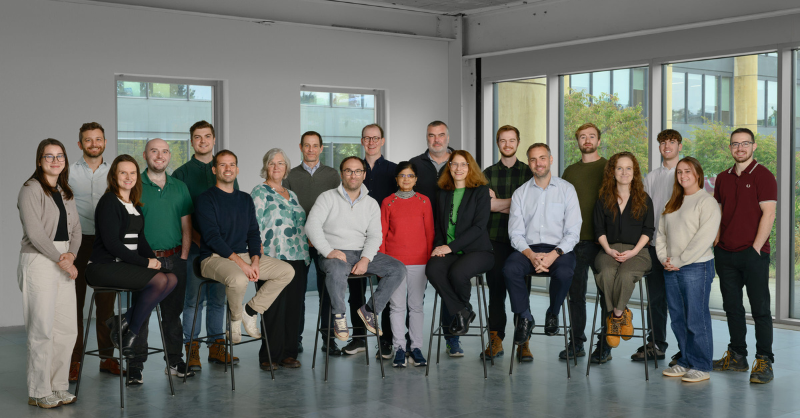
- FluoRok has raised $30 million in a Series A round led by Orano’s venture fund and Supernova Invest.
- The Oxford spinout aims to make battery and pharma chemicals without toxic hydrogen fluoride.
- The new funding will support demonstrator facilities for reagents and battery electrolyte salts, further hiring, customer validation at scale, and expanded commercial partnerships.
The vast majority of Li-ion batteries use lithium hexafluorophosphate (LiPF6), and China produces roughly 85-90% of it, according to Fastmarkets. The conventional process uses hydrogen fluoride (HF), a highly toxic chemical that limits where new plants can be sited.
FluoRok, an Oxford spinout founded in 2022 by Oxford chemistry professor Véronique Gouverneur and Gabriele Pupo, closed a $30M Series A round to prove out its HF-free process at industrial scale.
Orano Venture Fund, the venture fund of Orano, the French nuclear fuel group, led the round along with its manager, Supernova Invest. The round was oversubscribed and well above its original target.
Bidra Innovation Ventures also participated. Oxford Science Enterprises, BGF, Green Generation Fund, Volta Energy Technologies and the University of Oxford all returned from previous rounds.
CPI Enterprises, a scale-up partner, joined, along with EverQuest Capital Partners, WS Investment, and several angel investors. The round included about $1.3M in Innovate UK grant funding through its Investor Partnerships programme.
FluoRok previously raised $14 million and had received over $13 million in UK and European public funding. With this latest round, total equity funding is now at around $44 million.
From postdoc to chief executive
Pupo trained in Turin, earned his PhD at the Max Planck Institute for Coal Research in Germany under Nobel Prize winner Ben List, and then did a postdoc in Gouverneur’s Oxford group in 2017. He subsequently held a Junior Research Fellowship at Corpus Christi and taught at Merton College. Gouverneur is a Royal Society fellow and won the 2021 Moissan Prize for fluorine chemistry.
Pupo attributes the company’s early success to having the right people and the right expertise. Oxford Science Enterprises provided the initial £3 million investment, announced in July 2023. Meanwhile, BGF and the Green Generation Fund led a £7.7 million round in September 2024.
“Closing another oversubscribed round, backed by both new and existing investors from around the world, is a testament to the strength of our technology, the incredible commercial traction and the speed of execution of the FluoRok team. This funding will ensure FluoRok can swiftly move from start-up to scale-up and take a further step towards becoming a large-scale industrial manufacturer,” said Pupo.
The distance between a pilot and a plant
The main competition comes from established players rather than startups. Orbia’s Koura operation is building a LiPF6 plant in Louisiana with a capacity of up to 10,000 tonnes per year. The Chinese and South Koreans are also well established in the market, with Do-Fluoride, Tinci, Capchem, and Foosung.
FluoRok says its mechanical activation process can be run on standard equipment and can use lower-grade fluorspar or fluoride recovered from industrial waste.
Florian de Beauchaine, investment Manager at Orano Venture Fund, said: “We back companies whose technologies support a sovereign, sustainable industrial transition. FluoRok has already shown its process works at pilot scale, and taking hydrogen fluoride out of fluorochemical production tackles a safety and supply problem the whole industry shares. We are pleased to join a strong group of investors supporting the team as it moves to industrial scale.”
Policy is working in FluoRok’s favour. The EU’s ReSourceEU plan commits up to €3 billion in 2026 to critical raw materials, and FluoRok’s European Innovation Council project aims to make it the first EU-based LiPF6 producer.
Tech Funding News‘ reporting from the Munich summit on The Business Booster highlighted the same trend: the calls for European independence in the various pitches all focus on reducing our reliance on foreign components, processing, and equipment.
The new funding will support demonstrator facilities for reagents and battery electrolyte salts, further hiring, customer validation at scale, and expanded commercial partnerships.



