


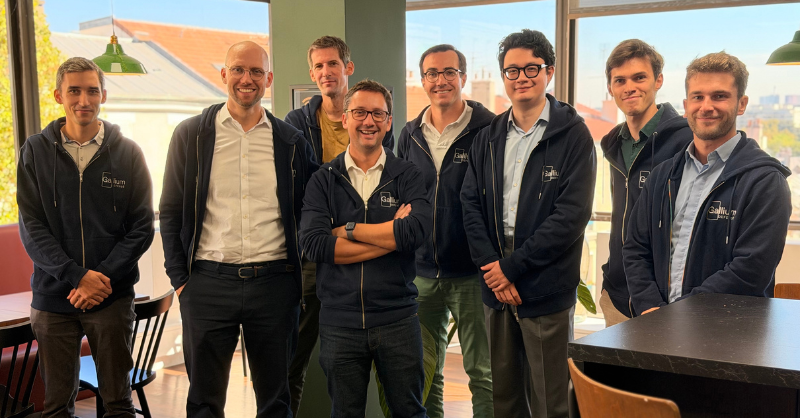
- Gallium Defense has raised a €7.1 million seed round, led by Keen Venture Partners and 360 Capital.
- Its GDS-10 radar can detect small drones out to 10 kilometers at a cost comparable to alternatives with much shorter ranges.
- The Paris-based startup has not yet generated revenue, is in talks with six potential customers, and aims to reach € 6 million in orders by 2027.
Gallium Defense emerged from stealth with a €7.1 million seed round led by Keen Venture Partners and 360 Capital, and aims to become “the Dacia of the radar,” its founder, Eric Fournier, told Tech Funding News. Omnes Capital and Polytechnique Ventures also participated.
The funds will fund production of the first radars, team growth, AI model training, and demos for both civil and military customers.
Why a budget radar, and why now
Fournier spent 17 years in defence, waiting for the right moment to set up his own company in April 2026 with Florian Lemoine and Robin Mandel. In a conversation with TFN, he points to NATO studies before 2020 that identified a gap between what an integrated air defence capability required and what was actually available.
Radar was the harder thing to develop. Fournier had worked on several radar projects in France, and it took time to find partners who could build the sophisticated antennas. Real R&D began in 2024, with the goal of proving the system worked in the real world under adverse conditions, not just in a presentation.
Gallium’s solution uses cheaper antenna components and adds processing power directly onto the antenna. The company says it has worked with strategic partners from the outset, including radar design and prototyping specialists from the French Microwave Valley.
The GDS-10 is an X-band AESA radar with a software-defined, AI-based architecture. It’s available in two variants: one for critical infrastructure and one for the military. The company claims it can detect Class 1 drones and FPV drones out to 10km.
It offers 360-degree azimuth and 90-degree elevation coverage and can track multiple targets simultaneously, including drone swarms. It operates day and night, in all weather, and can operate in the presence of electronic jamming.
Pre-revenue, six prospects, and a €6M target
“As drones proliferate, traditional radars are reaching their operational and economic limits. At Gallium Defense, we started from a blank sheet with a simple question, asked by operators in the field: how do you meet 80% of the need at 20% of the price? Our answer: a radically rethought AESA radar architecture that makes extensive use of commercial off-the-shelf components and the power of embedded computing. Yes, high-performance radar detection at scale is possible!” said Fournier.
Fournier confirmed the product already works, and the main thing left is machine learning. That takes time in the field to train the algorithms. Gallium is pre-revenue and has six potential customers in the pipeline. If those discussions go well, they could land orders worth around €6 million in 2027, according to Fournier.
The next stage is production. Fournier says Gallium currently has 15 people on the books and expects to grow to 17 by the end of the year. They’re looking at 30 to 50 by 2027, depending on sales.
Market competition and what’s next
Several options already exist. Dutch Robin Radar Systems won a defence ministry contract in December 2025 for 100 IRIS drone detection radars. In the US, Echodyne raised $135 million in a 2022 round co-led by Baillie Gifford and Bill Gates, while Chaos Industries secured $510 million in November 2025 at a $4.5 billion valuation.
In Europe, Alta Ares raised €50 million in June 2026 to combine interceptors with detection and tracking. Egide raised an €8 million seed round in March 2026 for low-cost interceptors. Stendr raised a $5.4 million pre-seed round in April 2026 for AI-based drone detection. Cambridge Aerospace raised $300 million at a $3.4 billion valuation in August and is working on its own radar.
“Great defence starts with superior visibility. Gallium Defense has the team, the industrial partners and the cost model to make drone detection a standard layer at every critical site — the kind of European capability our fund is proud to back,” said Alexander Ribbink, general partner at Keen and former COO of TomTom.
360 Capital’s partner Alexandre Mordacq noted, “Drones have turned air security and air defense into a need for thousands of sites, and today’s radars were never designed for this paradigm. Eric, Florian and Robin have moved at remarkable speed since founding Gallium, and we are proud to support them in bringing the GDS-10 as quickly as possible to the operators and armed forces who need it most.”
The data supports assertions about capital flows. European defence tech startups raised $7.4 billion in 2026, with Helsing’s $1.8 billion Series E alone accounting for over 85% of that total. Laser is another area of significant investment, with Ground A raising €9.1 million in a pre-seed and INLEAP Photonics securing €20 million. MarketsandMarkets has a much more optimistic view of the counter-drone market, forecasting $9.17 billion in 2026 and $29.70 billion by 2031.
The real test is 2027. Six of the prospects need to turn their memos into actual orders; the first units have to be shipping by June, and the monthly outdoor demos will be the true test of whether a company that launched in April 2026 can perform to the level of Robin Radar, Echodyne and Chaos at the price Fournier has promised. Until someone buys, the ‘Dacia of radar’ is still just that: an idea.



