


Europe’s defence funding is increasingly concentrated in late-stage rounds: late-stage investment tripled to $4.7 billion in 2025, making up more than half of the record $8.7 billion raised by European defence, security and resilience startups last year.
Early-stage activity hasn’t disappeared, with pre-Series B startups having already raised €556 million so far in 2026, nearly matching the €635 million raised across all of 2025. In the munitions-adjacent strike, air-defence, and counter-UAS segment, VC funding jumped to just under $250 million through Q3 2025, up from $5.1 million in 2024, the fastest-growing slice of Europe’s defence tech market.
Tech Funding News asked leading European investors which defence tech companies they are watching right now. Here are their picks, listed alphabetically.
3YOURMIND

Founders: Aleksander Ciszek, Stephan Kühr
Founding year: 2014
Total raised: $35.8M
Nominated by: Johannes von Borries, managing partner, UVC Partners
After 11 years and two pivots, 3YOURMIND focuses on making spare parts for critical infrastructure through decentralised production.
Its software helps companies find, price, and make parts that work with additive manufacturing. The AI digital inventory turns 3D scans into production-ready data, helping to fix weak spots in defence, energy, and heavy engineering supply chains.
Investors include EnBW New Ventures, UVC Partners, AM Ventures, TRUMPF Venture, Coparion, LBBW VC, Verve Ventures, Aramco Ventures, and public grant funders like the European Regional Development Fund. The company joined several accelerators, such as StartX, German Accelerator, EIT Digital, and Sixth Sense.
Johannes von Borries, managing partner at UVC Partners, points out that 3YOURMIND moved from a manufacturing marketplace to enterprise software, and now to decentralised production. The company even sold to the US Department of Defence before defence tech became popular, going against its investors’ advice.
Agon

Founders: Tristam Constant, Junaid Hussain
Founding year: 2026
Total raised: $30M
Nominated by: Julie Forel, deep tech investor at Speedinvest
Agon believes the main challenge in autonomous warfare is training the systems, not building them. Testing drones or counter-drone systems against real opponents is usually slow, expensive, and hard to do before deployment. To solve this, Agon created a synthetic “battle arena,” a simulated environment where autonomous defence systems can train and be tested against realistic, adaptive opponents.
Earlier this month, Agon raised $30 million in seed funding, with Lakestar and XYZ leading the round. Other investors include Bessemer Venture Partners, Speedinvest, Global Founders Capital, Lux Capital, Northzone, 201 Ventures, D3, Ora Global, and Never Lift.
The team has experience from Anduril, Applied Intuition, Cambridge Aerospace, and Unity. Constant led Anduril’s European business and later ran European defence at Applied Intuition. Hussain co-founded Cambridge Aerospace and the world-building platform Iconic. David Helgason, founder of Unity Technologies, is the board chair.
Julie Forel, a deep tech investor at Speedinvest, points out a key problem in defence AI: there isn’t enough scalable, high-quality training and testing data for autonomous systems, since real-world trials are slow, expensive, and limited. She believes Agon’s team is well suited to solve this, thanks to their rare mix of skills in defence, autonomy, and simulation.
Hypersonica

Founders: Dr. Philipp Kerth, Dr. Marc Ewenz
Founding year: 2023
Total raised: $28.4M
Nominated by: Alan Poensgen, partner at Antler
Hypersonic strike capability has usually been limited to a few countries and takes years and significant funding to develop. Hypersonica wants to offer a European solution on a faster, private timeline. They use a modular, software-driven missile design that goes from concept to flight-ready hardware in months, not years.
In February 2026, Hypersonica successfully tested an unarmed missile prototype at Andøya Space in Norway. The missile reached speeds above Mach 6, which is over 7,400 kilometres per hour, and flew more than 300 kilometres.
The company also closed a €23.3 million Series A led by Plural, with SPRIND, General Catalyst, and 201 Ventures joining in. General Catalyst led the earlier €2.5 million seed round. PitchBook reports that Hypersonica grew from its founding team to about 50–60 employees in just over two years, matching its technical and organizational growth with its test-flight campaign.
Alan Poensgen, partner at Antler, says Hypersonica is filling a major gap in European defence at a time when political support matches operational needs.
Isembard

Founder: Alexander Fitzgerald
Founding year: 2024
Total raised: $59M
Nominated by: Julie Forel, deep tech investor at Speedinvest
Alexander Fitzgerald moved from the civil service and a successful exit at broadband challenger Cuckoo to tackle a big problem: Britain’s aging and fragmented manufacturing base, which can’t scale fast enough to meet the defence sector’s urgent need to rebuild stockpiles.
Isembard tackles this with MasonOS, its AI-powered factory software, and a network of owned and franchised factories that make precision parts for defence, aerospace, and robotics clients.
TFN has covered Isembard twice: a $9 million seed round in April 2025 led by Notion Capital, and a £37.5 million Series A in March 2026 led by Union Square Ventures, bringing total funding to $59 million.
PitchBook data shows the team grew from just a few employees at seed to over 60 by mid-2026. They built a six-factory network across the UK and US and count Anduril, Tekever, ARX Robotics, and Allen Control Systems as customers.
Julie Forel, a deep tech investor at Speedinvest, says Isembard is solving a big problem in defence and advanced manufacturing: an aging, fragmented supplier base that can’t scale quickly. She pointed out that Isembard’s mix of AI-driven factory software and a distributed manufacturing model allows it to expand faster than traditional manufacturers.
LiveEO

Founders: Sven Przywarra, Daniel Seidel
Founding year: 2018
Total raised: $101M
Nominated by: Jonas Sommer, principal at DTCF
LiveEO stands out from most dual-use companies by focusing on infrastructure monitoring first, before moving into defence applications. Its platform now monitors over one million miles of grid, rail, and pipeline assets on five continents using high-resolution satellite images. Through its Twinspector program, LiveEO is building a European satellite constellation that can deliver images with up to 35-centimetre resolution.
TFN has tracked the company through three funding rounds: a €19 million round in 2022, a €25 million Series B in 2024, and a first closing of over €28 million in May 2026, bringing total disclosed funding to more than €72 million. Defence-focused investor Helantic, b2ventures, and the European Innovation Council joined the latest round, alongside continued support from existing investors.
PitchBook also reports that LiveEO received large non-dilutive grants from the European Space Agency, the European Union, and the European Innovation Council, bringing total capital close to $100 million.
“LiveEO is dual-use done right,” said Jonas Sommer, principal at DTCF. While most defence tech companies start with a military use case and search for commercial demand, he noted, LiveEO built a global infrastructure-monitoring business first and is now applying the same platform to ISR and border-monitoring challenges facing European governments.
Since 2018, Przywarra and Seidel have built the company with patience and technical discipline, according to Sommer. He said they have created a unique data advantage by monitoring more than a million miles of infrastructure.
TYTAN Technologies
Founders: Balázs Nagy, Batuhan Yumurtacı
Founding year: 2023
Total raised: $58.4M
Nominated by: Jonas Sommer, principal at DTCF
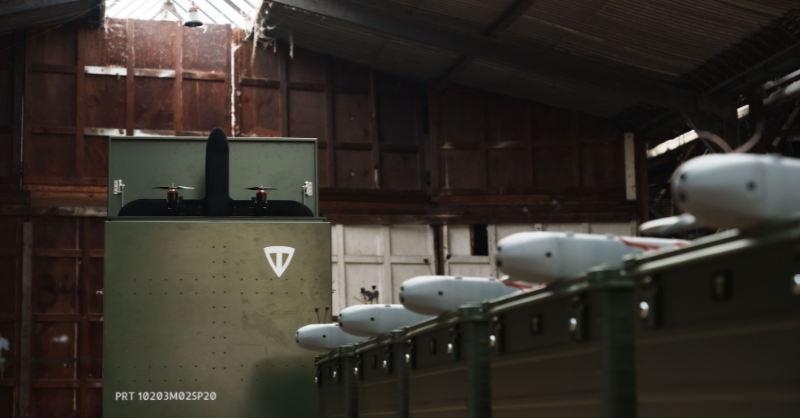
TYTAN’s founders believe that affordable, mass-produced interceptor drones are the key to modern air warfare, not the high-profile missile systems that usually get more attention.
The company makes two types of interceptor drones: METIS, which targets Shahed-class attack drones from a distance, and EOS, which protects bases and other fixed sites up close. The 3D-printed airframes operate autonomously using radar and vision systems.
Germany’s defence procurement agency, BAAINBw, has hired TYTAN to provide AI-based command-and-control systems for Bundeswehr sites. TYTAN also has agreements to deliver thousands of interceptors to armed forces.
A new facility in Bavaria plans to make 3,000 interceptors per month starting in August 2026. TYTAN’s €30 million all-European Series A, co-led by Armira and the NATO Innovation Fund, and supported by Visionaries Club, OTB Ventures, Lakestar, Magnetic, D3, and 10x Group, brought total funding to $58.4 million.
Jonas Sommer, principal at DTCF, backed TYTAN for both its technology and its business model. He stressed that interceptors need to be affordable, integrated, and quickly replaced. TYTAN’s focus on speed, battlefield feedback, and industrial know-how meets these needs, which are key for a successful European counter-UAS platform.
Voltrac

Founders: Thomas Hubregtsen, Francisco Infante Aguirre
Founding year: 2024
Total raised: $11M
Nominated by: Alan Poensgen, partner at Antler
Thomas Hubregtsen, who worked at Google X and BMW Research, and aerospace engineer Francisco Infante Aguirre, who has experience at Volocopter and Destinus, redesigned the tractor from scratch instead of updating an old model.
The result is Thor, a fully electric, software-controlled unmanned ground vehicle. It has 70% fewer parts than other machines, three times the battery capacity, and fully swappable battery packs. Thor is built to carry cargo over rough terrain for both farming and frontline logistics.
TFN reported in November 2025 that Voltrac raised €7 million in seed funding led by Extantia, with FoodLabs, Antler, PUSH, and Prototype Capital also joining. With earlier seed rounds from FoodLabs, Antler, and Gin Venture Capital, PitchBook estimates total funding at about $11 million.
“Voltrac is solving hardware’s hardest problem — cost — without cutting corners on capability,” said Alan Poensgen, partner at Antler, highlighting the founders’ unique combination of hardware and software expertise. He noted that the company’s dual-market approach in agriculture and defence logistics helps balance demand while addressing two urgent challenges: labour shortages and the risk of frontline resupply.


