


It’s been a breakout year for quantum computing in the UK, with startups closing record-breaking funding rounds and, in some cases, even heading to the Nasdaq.
Oxford Quantum Circuits closed a £260 million Series C in June, which was the largest private funding round ever raised by a European quantum computing company. In May, industry peer Quantinuum filed for a US IPO, later debuting with a valuation of around $15 billion.
From startups building the qubits themselves to the networks connecting them together, here are 10 UK companies turning decades of British physics research into working technology.
Quantum Motion

Founder/s: John Morton, Simon Benjamin
Founded: 2017
Total funding: $223.48M
Quantum Motion, a UCL and Oxford spinout founded in 2017 by John Morton and Simon Benjamin, builds qubits, the building blocks of a quantum computer, using ordinary silicon chips found in smartphones and laptops.
In 2025, it became the first company to deploy a full-stack quantum computer built entirely on standard silicon, at the UK’s National Quantum Computing Centre. It closed a $160 million Series C in May, co-led by DCVC and Kembara, with a £40 million anchor from the British Business Bank, the bank’s largest single investment in a quantum computing company to date.
Parkwalk was among the returning backers in this round, alongside Oxford Science Enterprises, Inkef, Bosch Ventures, and Porsche’s investment arm. The funding will deepen a manufacturing partnership with GlobalFoundries and support new offices in Spain and Australia, in addition to the company’s advancement to Stage B of DARPA’s Quantum Benchmarking Initiative.
Oxford Quantum Circuits (OQC)

Founder/s: Peter Leek, Brian Vlastakis
Founded: 2017
Total funding: $512.3M
OQC, a University of Oxford spin-out founded in 2017 by Peter Leek and Brian Vlastakis, builds superconducting quantum computers using its own Coaxmon design, a 3D chip layout that simplifies wiring and improves performance compared with conventional designs.
Parkwalk was OQC’s original backer, investing in the company’s £2 million seed round in 2017 and remaining a shareholder ever since.
Rather than staying in the lab, OQC deploys its computers directly inside commercial data centres, including the first quantum computer in New York City. It was installed inside a Digital Realty facility in Chelsea.
The startup closed a £260 million Series C in June 2026, led by Bullhound Capital, which OQC and independent outlets alike have called the largest private funding round ever raised by a European quantum computing company.
Nu Quantum

Founder/s: Carmen Palacios-Berraquero
Founded: 2018
Total funding: $87.19M
Nu Quantum, founded in Cambridge in 2018 by Carmen Palacios-Berraquero, builds the network that connects separate quantum computers into a single system.
Its core product, called the Entanglement Fabric, uses photons to link processors with high accuracy. The design is modular, meaning it can connect different types of qubits, including superconducting, trapped-ion, and neutral-atom systems, rather than being limited to a single type.
The UK startup, which counts Parkwalk among its earlier backers, announced a $60 million Series A in December 2025, led by National Grid Partners. It was reported as the largest Series A in the UK’s quantum sector and the biggest funding round to date for a pure-play quantum networking company.
Quantum Dice

Founder/s: Ramy Shelbaya, Wenmiao Yu, George Dunlop, Marko von der Leyen, Zhanet Zaherieva
Founded: 2020
Total funding: $8.86M
Quantum Dice is an Oxford spinout founded in 2020 by Ramy Shelbaya, Wenmiao Yu, George Dunlop, Marko von der Leyen, and Zhanet Zaherieva.
It builds a processor called ORBIT that uses quantum photonics to generate “p-bits”, which are probabilistic bits that fluctuate between states rather than sitting fixed at 0 or 1.
Unlike fully quantum computers, which need extreme cryogenic cooling, it runs at room temperature and is designed to solve complex optimisation problems faster and with less energy than conventional processors.
Quantum Dice has raised funding from institutional investors and grants including IP Group, European Innovation Council, Innovate UK, Cloudberry Ventures, Wispville Group, Digital Security by Design, A15, Elaia, and Motie.
Riverlane

Founder/s: Steve Brierley
Founded: 2016
Total funding: $127.24M
Riverlane, a Cambridge University spinout, builds the error-correction technology that quantum computers need to run reliably. Today’s machines lose accuracy fast as more qubits are added; Riverlane’s software and chips catch and fix those errors in real time.
It raised a $75 million Series C in August 2024, led by Planet First Partners, becoming Europe’s first quantum computing company to close a Series C round.
Its technology already runs alongside hardware from OQC, Rigetti, and Infleqtion, and in September 2025 it installed its error-correction system at Oak Ridge National Laboratory, connected to the Frontier supercomputer.
Phasecraft

Founder/s: Toby Cubitt, Ashley Montanaro, John Morton
Founded: 2019
Total funding: $61.55M
Phasecraft, a UCL and Bristol spin-out founded in 2019 by UCL professors Toby Cubitt and John Morton, as well as University of Bristol professor Ashley Montanaro, is a quantum software company that writes algorithms for machines.
The company’s THRIFT algorithm reduces the number of operations required to run simulations, enabling Phasecraft to tackle large-scale quantum chemistry problems that other approaches can’t yet handle.
It closed a $34 million Series B in September 2025, co-led by Playground Global, Plural and Novo Holdings, taking its total funding past $50 million. Parkwalk, a founding shareholder, has backed the company across four investment rounds over seven years.
Quantinuum

Founder/s: Ilyas Khan
Founded: 2021
Total funding: $22.97M
Quantinuum was formed in 2021 when Honeywell merged its quantum division with Ilyas Khan‘s Cambridge Quantum Computing. It builds trapped-ion quantum computers and its own software, known as TKET.
It announced a $600 million raise at a $10 billion valuation in September 2025, backed by IBM, Nvidia’s venture arm, Quanta Computer, and QED Investors, alongside existing shareholders JPMorgan Chase and Mitsui.
It has since debuted on the Nasdaq, pricing its IPO at $60 a share and closing its first day of trading at a valuation of roughly $15.6 billion — one of the largest quantum computing listings to date.
ORCA Computing

Founder/s: Richard Murray, Josh Nunn, Ian Walmsley, Cristina Escoda
Founded: 2019
Total funding: $25.36M
ORCA Computing is an Oxford spinout founded by Richard Murray, Josh Nunn, Ian Walmsley and Cristina Escoda in 2019.
It builds photonic quantum computers running at room temperature, rather than requiring the extreme cooling most rivals need. Its rack-mounted PT series runs on standard telecoms-grade optical fibre components and integrates with NVIDIA’s CUDA-Q platform for hybrid quantum-classical workflows.
Its systems are deployed at the UK’s National Quantum Computing Centre and Poland’s Poznań Supercomputing and Networking Center, with the UK Ministry of Defence and Montana State University also among its customers.
ORCA has raised its funding in smaller, staged rounds rather than the mega-rounds seen elsewhere on this list, including a $15 million Series A and a 2024 acquisition of the integrated photonics division of Texas-based GXC.
Oxford Ionics
Founder/s: Chris Ballance, Tom Harty
Founded: 2019
Total funding: $42.23M
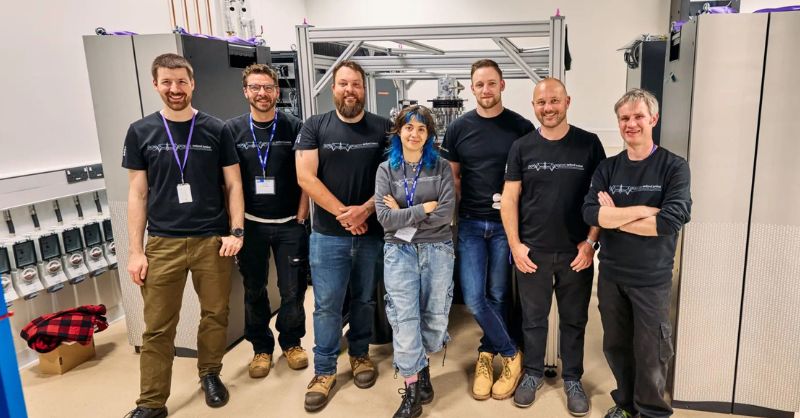
Oxford Ionics was a UK quantum computing startup that spun out from the University of Oxford in 2019 by Chris Ballance and Tom Harty.
Unlike traditional quantum systems that rely on thousands of highly sensitive lasers, the company found a way to control its qubits with microwave signals on standard silicon chips – a partnership with Infineon Technologies helped get that architecture into commercial-grade semiconductor fabrication.
Backers along the way included Oxford Science Enterprises, Braavos, Lansdowne Partners, Prosus Ventures, and Arm co-founder Hermann Hauser. In September 2025, US-based IonQ acquired Oxford Ionics for $1.075 billion, marking one of the largest acquisitions of a UK quantum computing company.
PQShield
Founder/s: Ali El Kaafarani
Founded: 2018
Total funding: $65.12M
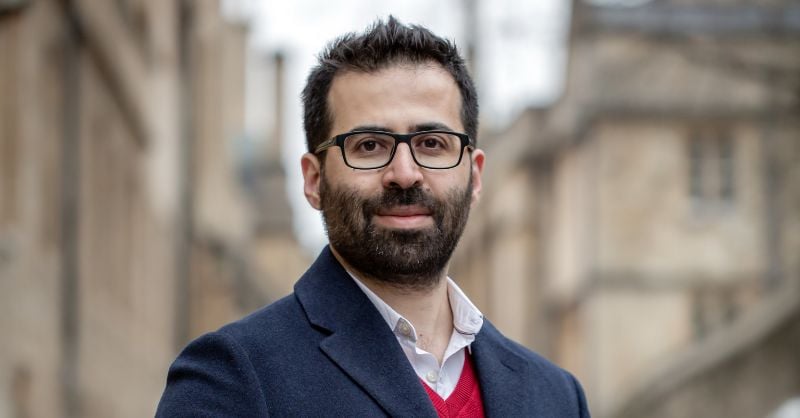
PQShield, an Oxford spin-out founded in 2018 by Ali El Kaafarani, builds encryption designed to withstand a future quantum computer capable of breaking today’s standards.
The company uses quantum-resistant mathematics to replace current encryption standards before large-scale quantum computers render them obsolete.
It closed a $37 million Series B in June 2024, led by Addition, with new investors Chevron Technology Ventures, Legal & General, and Braavos Capital joining existing backer Oxford Science Enterprises. That brought its total funding to around $65 million.
This article is part of our editorial partnership with Parkwalk, leading UK investors focused on university spinouts and deep tech innovation.



