


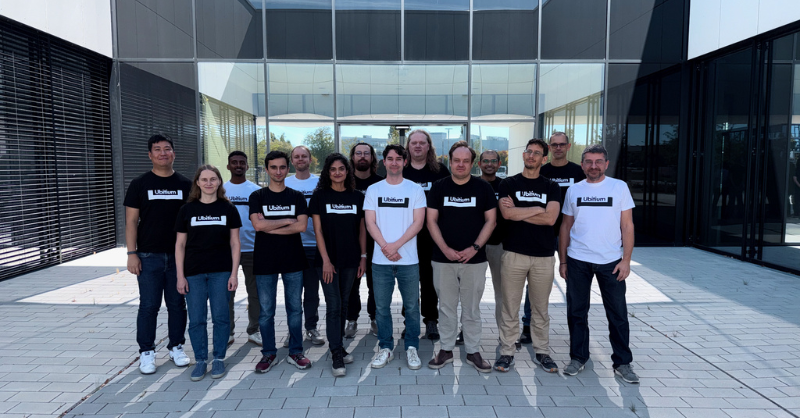
- Düsseldorf-based semiconductor startup Ubitium has raised a €14 million seed round led by Ibex Investors, bringing its total seed capital to €18 million since its 2024 launch.
- The financing round saw participation from OpenOcean, KBC Focus Fund, Runa Capital, and Inflection, along with a strategic personal investment from Quantum Systems co-founder and co-CEO Florian Seibel.
- With its initial silicon, the UB108, already demonstrated, the firm plans to roll out evaluation units for its next-generation commercial chip, the UB410, in 2027.
The co-CEO of an $8 billion defense technology firm has backed a semiconductor startup, arguing that autonomous machines urgently require a streamlined chip architecture.
Founded in 2024 in Düsseldorf, Ubitium is developing a unified processor designed to manage perception, intelligence, and control. The company secured $14 million in a seed investment round led by Ibex Investors.
OpenOcean joined the round alongside existing backers KBC Focus Fund, Runa Capital, and Inflection, with Florian Seibel, co-founder and co-CEO of Quantum Systems, joining as an individual investor.
This latest injection brings Ubitium’s total seed funding to $18 million since its inception in 2024, building on an earlier $4 million raise.
Why the drone executive backed the venture personally
Seibel explained that operational necessity, rather than speculative return, prompted his backing.
“An autonomous machine operating in the real world must keep working when communications are unavailable. It has to process its surroundings, make decisions and control itself on board, within strict limits on power and weight. Today that means integrating a stack of chips that were not designed to work together, and every one of them costs weight, power and integration time we don’t have. Ubitium is building the one processor that does that whole job. That’s why I invested,” said Seibel.
Quantum Systems stands among Germany’s leading defence technology players. Ubitium indicated that its early client engagements centre on sensing applications within physical AI, including advanced radar and acoustic platforms that require complex signal processing alongside onboard AI. The technology targets established embedded hardware markets.
For robotic platforms like drones, the long-term objective spans the full perceive-think-act sequence. The team declined to disclose commercial client identities, company valuation, or current head count.
Replacing three distinct processors with a unified architecture
Currently, engineering teams segment workloads across discrete hardware: digital signal processors handle perception, neural processing unitexecute AI tasks, and central processing units (CPUs) manage system control. Ubitium contends that this fragmented setup creates data bottlenecks, multiplies coordination overhead, and increases system complexity.
To address these constraints, Ubitium designed a single reconfigurable processing array capable of executing signal processing, inference, and real-time operations dynamically as workloads shift. Featuring unified memory architecture and leveraging native RISC-V toolchains, the platform minimises off-chip data transfers while simplifying software integration.
“We are not competing with massive cloud AI clusters. Our goal is to complement cloud infrastructure at the physical edge by consolidating traditional DSPs, NPUs, and MCUs into a single, unified architecture that handles perception, intelligence, and real-time execution natively,” explained Hyun Shin Cho, co-founder and CEO of Ubitium, to Tech Funding News.
Technical development is spearheaded by co-founder and CTO Martin Vorbach, a reconfigurable computing pioneer with three decades of industry expertise. Supported by 17 issued core patents alongside additional pending applications, the engineering team brings together over 250 combined patents, 350-plus peer-reviewed papers, and alumni experience from semiconductor leaders including Intel, Nvidia, Apple, and Texas Instruments.
The foundational platform represents more than 15 years of continuous R&D alongside Vorbach and Chief Architect Peter Weber, who adapted reconfigurable hardware concepts for production-grade silicon.
Built on Samsung’s 8nm node, Ubitium’s early demonstration silicon, the UB108, integrates 256 processing elements to run perception, AI, and control algorithms simultaneously across a single array. The company is now engineering its flagship UB410 commercial chip, featuring 4,096 elements, with evaluation silicon scheduled for client sampling in 2027.
A modest seed round compared to larger chip investments
The $18 million seed round obtained by Ubitium is considerably less than the $97 million raised by Efficient Computer at a valuation of $650 million or the €200 million raised by the Samsung-backed Euclyd. While Nuvacore had set its aim at a $2.5 billion valuation without having a product, Ubitium already has working silicon and has raised a small amount of money.
Since Europe’s Physical AI sector is beginning to place greater emphasis on hardware, investors are attracted by this actual progress.
Rudi Severijns, investment director with the KBC Focus Fund, said, “When we first invested, Ubitium’s universal processor was a bold bet. First silicon in a single year turned that bet into proof. We’re proud to keep backing the team, and we look forward to working with Ibex Investors and OpenOcean as Ubitium brings one processor for Physical AI to market.”
Tom Henriksson, a general partner at OpenOcean, described the change as being due to a hardware issue: “Physical AI requires a ground-up hardware revolution. Ubitium’s team has spent decades building exactly that architecture, and with the technology now in silicon they have created the foundational processor for this new era.”
According to Cho, building a semiconductor startup in Düsseldorf requires navigating a European venture landscape that demands patient capital. “But being rooted here grants us direct access to world-class European engineering talent and deep industrial partnerships across embedded markets,” Cho concludes.



