- TQ Ventures leads a Series B of more than $97M for Efficient Computer at a $650M valuation.
- Its Electron E1 chip is in volume production, but the company has not disclosed revenue.
- Total funding reaches $173M, seven months after a $60M Series A led by Triatomic Capital.
Speed up the part of a program that an AI accelerator handles brilliantly, and the rest of the program still sets the ceiling. That is Amdahl’s Law, and it is the argument behind Efficient Computer, a Pittsburgh chip startup that has just announced more than $97M in Series B funding at a $650M valuation.
The round was led by TQ Ventures, with Eclipse, Union Square Ventures (USV), Giant Ventures, Triatomic Capital, TO Capital, TF Capital, Mana Ventures, Toyota Ventures, Overmatch and Borderless also participating. It takes total funding to $173M, according to the company. The Series A, reported by Technical.ly at $60M, closed only seven months ago.
Efficient will use the money to ship its Electron E1 processor in volume to lead customers and to scale its Fabric architecture to data-centre-class performance, targeting more than 10x better energy consumption than current systems. Fabric is a spatial dataflow design, paired with a compiler called effcc that lets developers run C, C++ and common AI frameworks without rewriting code.
“Every customer we meet has a version of their product they cannot build, because the compute power budget makes the new capabilities they want infeasible. Efficient makes it possible,” said Brandon Lucia, CEO and co-founder.
The case against AI-only chips
Efficient’s pitch is a pointed one. Most of the money in AI silicon has gone to chips built to do one thing very well. Efficient says that approach leaves out most software and risks quick obsolescence as models change. Its alternative is a general-purpose processor that the company claims cuts energy use by 10x to 100x for general-purpose computation, AI included.
The company says the E1 is already in volume production for physical AI and autonomy, critical infrastructure observability, space and defence, and wearables. It has not said how many units it has shipped or what it earns. For a chip company, that gap matters more than the valuation.
“What convinced us was Brandon, Graham and Nathan’s ability to build both the hardware and the software, and turn that breakthrough into a business. Not only have they taped out four times, but they’re already shipping chips to customers at volume,” said Andrew Marks, co-founding partner at TQ Ventures.
He added that “as AI agents do more work in software and in the physical world, the demand for energy-efficient computing extends far beyond running the models themselves.”
Founders, customers and backers
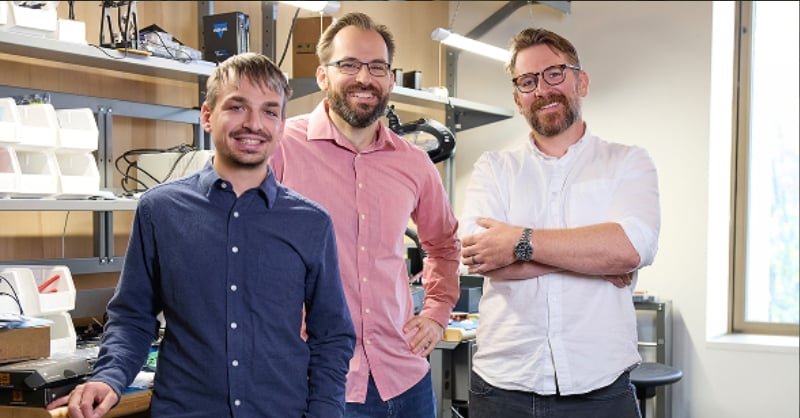
The technology has a long academic runway. Lucia, a Carnegie Mellon University professor, started working with Graham Gobieski, the company’s CTO and a CMU PhD from 2022, and Nathan Beckmann, chief architect and also a CMU professor, almost 10 years ago, to work out why computers waste so much energy. The team page also lists Alex Hawkinson, founder of SmartThings and BrightAI.
Several backers have followed the team since then.
“Eclipse backed Efficient from the very beginning because we believed solving AI’s energy problem would require rethinking computing from the ground up. Today, that vision is becoming reality: Electron E1 is shipping, customer demand is accelerating, and the same architecture is scaling from physical AI to the datacenter,” said Greg Reichow, partner at Eclipse.
Rebecca Kaden, general partner at USV, framed it as a rethink of first principles. “The biggest technology shifts happen when companies like Efficient Computer rethink fundamental constraints and transform what’s possible. Efficient’s ability to bring dramatic energy-efficiency gains across the performance spectrum will fundamentally change how computing is built and deployed, from physical AI to the data center.”
Zenetta Burger, USA lead partner at Giant Ventures, pointed to the team’s research: “We backed Brandon and the team because they aren’t chasing a trend, they’ve spent years at Carnegie Mellon solving the hard architectural problems that make energy-efficient compute actually work. As AI and edge workloads push power demand to a breaking point, that’s exactly the kind of deep, patient engineering the world needs right now.”
A crowded field, and a different proof point
Efficient is entering a market where energy efficiency has become the selling point. EnCharge AI raised $100M for analogue in-memory chips, and Axelera AI took in $250M for edge inference. SiMa.ai secured $150M to power humanoids, drones and cars, while Euclyd, Fractile and Positron are chasing Nvidia in inference with rounds of more than €200M, $220M and $230M respectively.
Most of those companies build AI-specific designs. Efficient is arguing that the bigger prize is the workload that never fits an accelerator, and that a single programmable chip can cover sensing, control and AI together. That is a harder claim to prove, and the E1 is the test.
The open question is whether Efficient can turn volume production into disclosed customers and revenue before the data-centre chip follows, because that is where the $650M valuation will be judged.