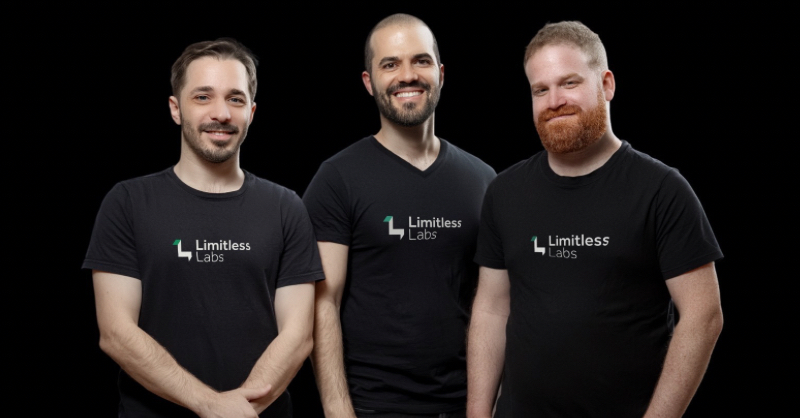
- Limitless Labs raises $20 million Series A, co-led by Dell Technologies Capital and Square Peg, to expand its Physical AI Foundation Model.
- The platform is already in full production with Blue Origin, Sandvik, and Iscar, cutting CNC programming time by up to 50%
- Founded in 2024, the startup is tackling manufacturing’s growing expertise gap by capturing and scaling the knowledge of veteran machinists
Most AI startups at Series A are still running pilots. Limitless Labs is programming parts for rockets and Formula One cars.
The Tel Aviv-based startup, founded just two years ago, has moved from stealth to full production deployments with Blue Origin, Sandvik, and Iscar, some of the most demanding manufacturers on earth.
Today, it announced a $20 million Series A co-led by Dell Technologies Capital and Square Peg, with participation from Grove Ventures, Meron Capital, and Kinetica, bringing total capital raised to $27.3 million.
The company builds what it describes as the world’s first agentic Physical AI platform for mechanical manufacturing, software that runs within the computer-aided design and manufacturing systems engineers already use, automating key parts of computer numerical control programming while keeping humans in control of the workflow.
Across its production customers, it has cut CNC programming time by up to 50%.
Turning machinists’ expertise into AI
Nearly a quarter of US manufacturing workers are 55 or older. Some 97% of manufacturers cite knowledge retention as their top concern. There are currently 409,000 unfilled manufacturing positions in the US alone, a gap projected to reach 1.9 million by 2033.
Programming complex aerospace, defence, medical, and industrial parts relies on what the industry calls “tribal knowledge”. When those engineers retire, that knowledge walks out the door with them.
Limitless Labs was founded in 2024 by David Priev, Assaf Peleg, and Shahaf Finder specifically to address that problem. Rather than replacing engineers, the platform is designed to capture, standardise, and scale their expertise across entire organisations.
“The manufacturing world doesn’t just need more automation, it needs a better way to capture and scale the expertise that still lives inside the heads of a relatively small number of experienced machinists,” says Priev.
He adds, “We believe the next major AI platform will be built for the physical world, and that starts with giving manufacturers a way to scale their best knowledge across every new part and every new engineer.”
What makes its Physical AI different?
At the core of the platform is a Physical AI Foundation Model, trained not on text or generic code, but on the physics of metal cutting, CAD geometry, machining processes, tooling requirements, and real machine constraints. This is what separates it from general-purpose AI tools being retrofitted for industrial use.
Its CAM Agent integrates into Mastercam, Siemens NX CAM, and PTC Creo. Given a CAD file, the system identifies features, recommends tooling, sequences operations, generates toolpaths, and helps produce a production-ready CNC program, all while the engineer stays in control of the final output.
Landing production contracts with Blue Origin at Series A is unusual by any measure. Both operate in environments where programming errors are catastrophic. Rocket components and F1 parts are manufactured to tolerances measured in microns, under certification regimes that leave no room for trial and error.
The fact that both organisations have moved Limitless Labs beyond pilots and into live production suggests the platform is doing something meaningfully different from the wave of industrial AI tools that have struggled to get past the proof-of-concept stage in regulated manufacturing environments. The platform is ITAR-compliant and deployable on AWS GovCloud, meeting the security requirements of defence and aerospace customers.
Competition
Limitless Labs operates in a fast-growing industrial AI market, though its CNC-specific focus sets it apart from most rivals.
Bright Machines raised $126 million in a Series C in June 2024, led by BlackRock with participation from Nvidia, Microsoft, and Jabil, bringing total funding to over $400 million, but focuses on software-defined assembly automation for electronics manufacturing rather than CNC programming.
Instrumental, which raised $55 million for AI-powered visual inspection, competes for AI budgets within factories but focuses on defect detection rather than programming workflows. PhysicsX raised $135 million to develop physics-simulation AI for aerospace and automotive design, adjacent to, but not directly competing with, CNC automation.
Why investors are betting on Physical AI
While much of today’s AI investment focuses on digital productivity, factories remain heavily dependent on manual processes and specialised human expertise.
“Limitless Labs represents the next wave of enterprise AI, moving beyond digital workflows and into the physical world of precision manufacturing,” says Yair Snir, managing director at Dell Technologies Capital.
“Eighteen months ago, we backed Limitless Labs’ vision that agentic AI could transform the factory floor. What the team has achieved since then has exceeded expectations. They are combining deep technical innovation with practical software in a way that could reshape how the world’s most critical parts are made,” adds Lior Handelsman, general partner at Grove Ventures and co-founder of SolarEdge.
The company plans to use the new funding to expand its US commercial operations, grow its deep-tech research lab in Tel Aviv, advance its Physical AI Foundation Model toward closed-loop CNC automation, and nearly double headcount over the next year.
The bigger picture
The new funding will go toward building out US commercial operations, growing the deep-tech research lab in Tel Aviv, and advancing the Physical AI Foundation Model toward closed-loop CNC automation. Headcount is expected to roughly double over the next 12 months.
Total funding to date stands at $27.3 million from Dell Technologies Capital, Square Peg, Grove Ventures, Meron Capital, and Kinetica.