


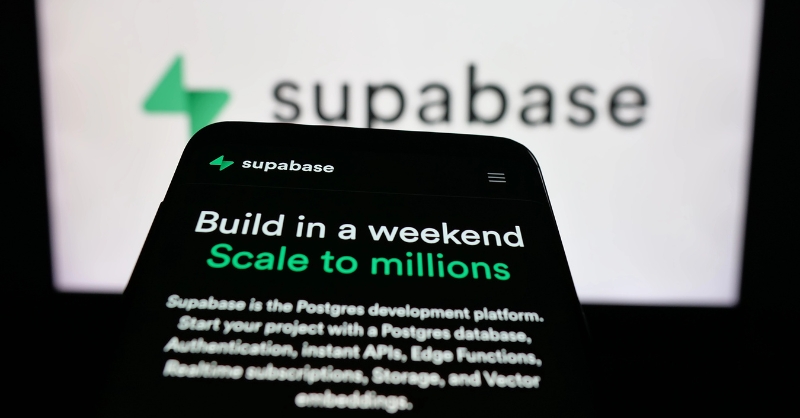
- Supabase has raised $500 million in a Series F led by Singapore’s GIC at a $10.5 billion valuation — more than quintupling from $2 billion just 15 months ago, bringing total funding to over $1 billion.
- AI agents now deploy the majority of databases on the platform, with Claude Code named as the single largest contributor in 2026 — a direct signal that agentic AI has become Supabase’s primary growth engine.
- The company also launched Multigres today, an open-source horizontal scaling layer for Postgres designed to handle workloads “up to the size of OpenAI or even larger,” per CEO Paul Copplestone.
In 2014, Paul Copplestone pitched a database idea to an investor in New Zealand. Nobody wanted it. Six years later, after dealing firsthand with the scaling limitations of databases at another startup, he built it anyway — put it on the internet, watched it go viral, and decided this time it was worth betting on. Today, that bet is worth $10.5 billion.
San Francisco-based Supabase, the open-source Postgres development platform co-founded by Paul Copplestone (CEO) and Ant Wilson (CTO), has raised $500 million in a Series F led by GIC, Singapore’s sovereign wealth fund. All existing investors participated, including Accel, Y Combinator, Craft, Felicis, Peak XV, and Coatue. Stripe is making its second investment in the company. Salesforce Ventures joins as a new investor. The round values Supabase at $10.5 billion post-money — up from $5 billion at the Series E just seven months ago in October 2025, and from $2 billion in March 2025. Total capital raised now exceeds $1 billion.
Copplestone grew up in Christchurch, New Zealand, before ending up at Y Combinator in Silicon Valley. Wilson is from Liverpool, UK, and serves as CTO. The pair launched Supabase in 2020 as an open-source alternative to Google’s Firebase — with the tagline “build in a weekend, scale to millions.” What started as a developer tool has become the default backend infrastructure for the vibe coding wave. Supabase now employs approximately 350 people and serves more than 250,000 customers. Its developer community has grown from 4 million at the Series E in October 2025 to more than 9 million today — more than doubling in eight months.
Why agents are Supabase’s biggest growth driver
The most striking line in Copplestone’s announcement is not the valuation. It is this: AI agents now deploy the majority of databases on the Supabase platform. Claude Code — Anthropic’s terminal-based agentic coding tool — is the single largest contributor since the start of 2026. OpenAI’s Codex is also a major driver, per CNBC. Supabase has seen a 600% increase in databases year-over-year, and its user base has more than doubled since the Series E. Its Supabase for Platforms product — which powers most of the top AI app builders — has seen 370% customer growth in the past six months.
This puts Supabase at the centre of the vibe coding wave. Lovable, which raised $330M at a $6.6 billion valuation, uses Supabase as its backend infrastructure. So does Bolt, another fast-growing AI app builder. When an agent on Lovable spins up a new application, it is almost certainly creating a Supabase database to go with it — making every new AI app a new Supabase customer, automatically.
Multigres — Postgres at OpenAI scale
Alongside the funding, Supabase is releasing a preview of Multigres — an open-source horizontal scaling layer for Postgres. Today, when teams outgrow a single Postgres instance, they typically have to migrate to a different database system entirely, sacrificing the Postgres ecosystem and tooling they have built on. Multigres solves this by bringing sharding, zero-downtime migrations, and high availability to Postgres natively — so companies never have to leave. Copplestone told CNBC the goal is to scale “up to the size of OpenAI or even larger.” It is available now under the Apache 2.0 licence.
“Demand for Supabase is exploding. Our user base has more than doubled since the Series E and we’ve seen a 600% increase in databases year-over-year. Claude Code is the largest contributor since the start of the year. Agents are now deploying the majority of databases on our platform.” — Paul Copplestone, co-founder and CEO, Supabase
The competitive landscape
Supabase’s most notable serverless Postgres competitor was Neon — until Databricks acquired it for approximately $1 billion in May 2025. Neon, which had raised $130.6 million in total funding, now operates as part of Databricks rather than as an independent startup — a development that hands Supabase a cleaner run as the dominant independent open-source Postgres platform for the agentic era. Firebase, owned by Google, remains the dominant incumbent in the broader backend-as-a-service category but is built on a NoSQL architecture that increasingly conflicts with the relational data models AI agents prefer. Amazon’s Aurora Postgres and MongoDB also compete for enterprise database workloads, but neither offers the open-source, developer-first positioning that has made Supabase the default for the AI app building community.
Market context
According to Grand View Research, the global database management system market was valued at $100.58 billion in 2024 and is projected to reach $285.05 billion by 2030, growing at a CAGR of 18.9%. Supabase’s 600% year-over-year database growth on its own platform outpaces even that projection — a sign that the agentic coding wave is not just expanding the database market but restructuring who wins it.
The question Supabase’s $10.5 billion valuation forces the infrastructure market to answer is deceptively simple: if AI agents are now the primary creators of new software, and those agents default to Supabase for backend infrastructure, what does the database market look like in five years — and is there still room for Amazon, Google, and MongoDB to defend the positions they built for a world where humans wrote the code?


