


Years of support cases, deal histories and engineering records show how a business makes decisions. SourceX wants to license that history for AI.
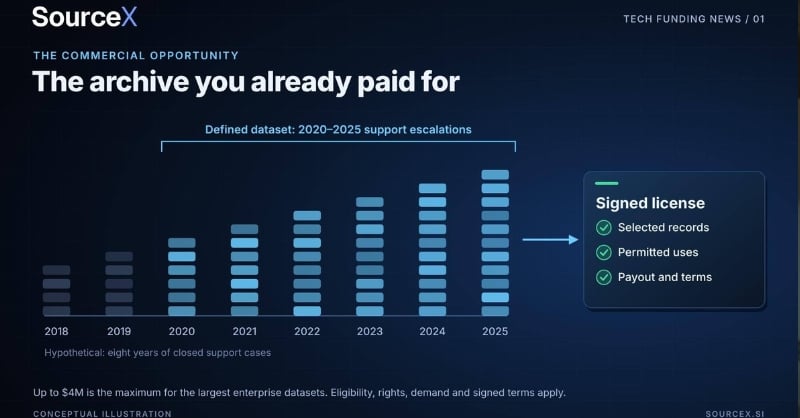
Hypothetical example: a defined slice of eight years of support history, selected for a signed license.
Take a hypothetical software company with 300 employees and eight years of support history. Its help desk holds tens of thousands of closed cases: the customer’s problem, the policy an agent checked, the escalation to an engineer, the fix that shipped and whether the customer came back. The company paid for every one of those cases in salaries, software and mistakes.
Most businesses treat that archive as a retention cost. For AI developers building systems that are expected to do real work, it can look like something else: a record of how experienced people made decisions and what happened next. That is rarely visible in public web text.
SourceX is built around that gap. It licenses business data directly from companies for AI training and evaluation, and manages the transaction from assessment through preparation and payment.
What makes an archive worth assessing
Volume is the wrong first question. A finished knowledge-base article shows the approved answer. The escalation thread behind it shows the uncertainty, the missing evidence and the specialist who resolved it. A CRM history can preserve how a complicated deal progressed. Engineering records can link a bug report to its fix and the review that approved it.
What gives those records value is connection. Ten thousand cases with intact context and a recorded outcome can tell a buyer more than a million disconnected messages. So the useful founder question is not how much data the company holds, but where it has built repeatable, documented expertise. A mature support operation is a different proposition from an inbox of short sales emails.

Ten thousand connected cases can tell a buyer more than a million disconnected messages. Illustrative example.
The economics for founders and investors
A license brings in cash without issuing shares. It also grants contractual rights, and those deserve the same scrutiny as the fee. Weigh the proposed payout against preparation cost, management distraction, and the license’s scope and duration.
Investors should track which milestone a company has actually reached. An indicative estimate, an accepted inventory and a paid transaction are three different things, and only the last is revenue. One sale is not a recurring line, and an advertised ceiling says nothing about what a particular company’s records are worth.
The same test applies to data licensing businesses themselves. A large supplier network creates access. The investment case rests on converting suitable records into accepted, paid transactions, and rights, preparation quality and buyer fit decide how much of the apparent supply is usable.

An estimate and an accepted inventory are milestones. Only a paid transaction is revenue.
Do the work before anyone exports a file
A first inventory fits on a page. List the source systems, the years retained and the work they capture. Note the gaps: missing attachments, overwritten policies, outcomes stored somewhere else. Those details separate a coherent collection from an archive that only looks large.
Then settle authority. Who can sign a license, and which customer contracts, third-party materials and personal information limit what can be offered? Access to a system is not a right to license its contents, and privacy preparation is a separate job from confirming commercial rights.
A company that can explain a collection’s provenance and limits gives a buyer something concrete to evaluate. It also negotiates from a stronger position.

A hypothetical one-page inventory. It describes systems and gaps without submitting any raw records.
Where SourceX fits
SourceX’s public offer is up to $4M for licensing company data. That figure is the ceiling for the largest enterprise datasets, not a typical payout, and offers depend on eligibility, licensing rights, data quality and buyer demand. The company focuses on businesses with 50 or more full-time employees at peak and several years of operating history.
The first assessment asks for company and system information, not raw records. Applying commits the business to nothing, and qualifying does not guarantee an offer. Any transaction requires signed terms that define the dataset, payout and rights.
The question worth putting to a management team is simple: which of our records capture expertise another organisation could use? The answer may reveal a collection worth assessing, or show that the records are too incomplete to license. Either result is more useful than guessing a price for the whole archive.
Owners and authorised leaders can start an assessment with SourceX. Begin with the systems and history your business holds, and review the proposed scope before deciding whether to proceed.



