


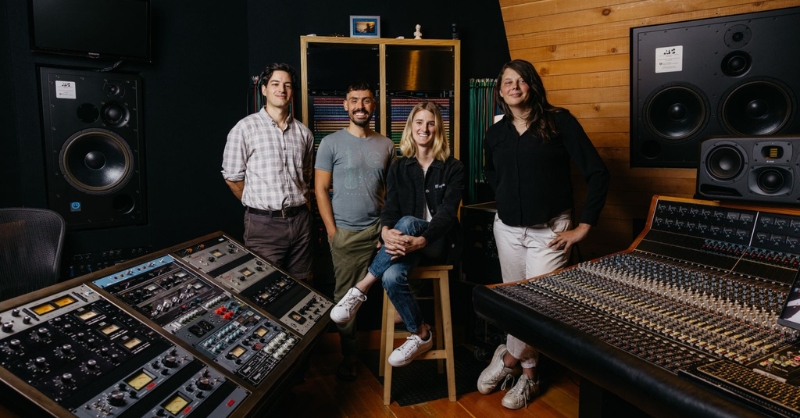
- San Francisco-based Rime has raised $24 million in a Series A led by M13, with participation from Twilio Ventures, Corazon Capital, Cadenza Ventures, and Unusual Ventures.
- Rime is developing speech-to-speech foundation models that make AI conversations sound natural, responsive, and trustworthy.
- Rime’s voice models already power nearly 100 million phone calls a month for enterprise clients, including Mayo Clinic, Dialpad, Upstart, and Asurion, and the new funding will accelerate research and product development.
San Francisco-based Rime has raised $24 million in a Series A led by M13, with participation from Twilio Ventures, Corazon Capital, Cadenza Ventures, and Unusual Ventures. Morgan Blumberg, Partner at M13, joins Rime’s board as part of the deal.
Founded in 2022 by Lily Clifford, who left a Stanford linguistics PhD to start the company, alongside Brooke Larson, a PhD linguist and former Amazon Alexa engineer, and Ares Geovanis, a Stanford engineer, Rime is building speech-to-speech models that understand, generate, and respond in real time.
Rather than building another chatbot, Rime is developing speech-to-speech foundation models that make AI conversations sound natural, responsive, and trustworthy. Rime’s voice models already power nearly 100 million phone calls a month for enterprise clients, including Mayo Clinic, Dialpad, Upstart, and Asurion, with the new funding accelerating research and product development.
The company also announced the appointment of Rafael Valle as Chief Science Officer. Valle previously led audio research at Meta’s Super Intelligence Lab and worked on NVIDIA’s Applied Deep Learning Research audio team, and joins to accelerate Rime’s research and product innovation.
A linguistics-first wager on how AI should sound
Large language models have transformed what AI can say. They haven’t necessarily transformed how it feels to talk to. Today’s voice assistants often interrupt users, pause unnaturally, misread emotion, or struggle in noisy environments. In regulated industries such as healthcare, banking, and customer support, those shortcomings quickly erode trust.
While many voice AI companies chase generic signals of naturalness, Rime is betting that linguistic precision, not raw model size, will define the category.
“The things that matter most in conversation are the hardest to pin down. Response relevance is hard to specify; speech appropriateness is hard to verify. There’s no unit test for sounding like you care,” says Clifford.
“That’s exactly why this is a design problem, not just an engineering one. We’re building voice interaction models, systems where our linguistic judgment and taste become research instruments, not afterthoughts,” she adds.
That approach has already been tested at scale. An independent study by Miravoice, which evaluated 12 voices from three vendors across 100,000 calls, found that Rime’s voices produced statistically significantly lower “Hung Up During Intro” rates than major competitors, alongside the fastest median time to completion among all providers tested.
The company’s traction in regulated sectors is also part of its pitch. “In financial services, the stakes for voice AI are exceptionally high and accuracy is a requirement for customer trust. Rime’s ability to handle complex financial use cases with precision allows us to build experiences that truly serve our customers’ needs,” says Shiv Indap of Upstart.
Voice is becoming AI’s next interface
The opportunity extends far beyond virtual assistants. According to Grand View Research, the global conversational AI market is expected to grow from approximately $17.6 billion in 2025 to more than $49 billion by 2030, driven by enterprise demand for intelligent customer service, healthcare automation, financial services, and AI-powered workplace tools. As AI becomes capable of completing increasingly complex tasks autonomously, the interface itself may become the next competitive battleground.
Rime is entering one of AI’s fastest-growing infrastructure markets. ElevenLabs, valued at more than $3.3 billion following its latest funding round, has become one of the leading AI voice generation platforms, while Hume AI has raised more than $100 million to develop emotionally intelligent voice models. Cartesia recently secured $64 million to build real-time speech foundation models, and Deepgram has raised more than $130 million for enterprise speech recognition infrastructure.
“Lily, Ares, and Brooke are building Rime with the rare combination of world-class AI research and deep linguistic expertise to deploy real-time voice people can trust in complex, regulated environments,” says Morgan Blumberg, partner at M13.
Rime is building speech-to-speech models designed for real-time enterprise conversations where latency, trust, and linguistic precision matter as much as voice quality, and where staying focused strictly on the modelling layer, rather than the application layer, has helped it win business in healthcare and financial services, where HIPAA compliance and pronunciation accuracy for complex terminology are non-negotiable.
Voice might be AI’s default interface
The latest funding will support frontier speech research, expand Rime’s engineering team, and accelerate deployment across enterprise applications. For the founders, the opportunity isn’t simply making AI sound more natural.
If ChatGPT turned language into infrastructure that developers could build on, Rime believes voice is next. As AI increasingly works alongside people instead of waiting for typed prompts, the companies shaping conversations, not just generating text, could define the next era of human-computer interaction.



