


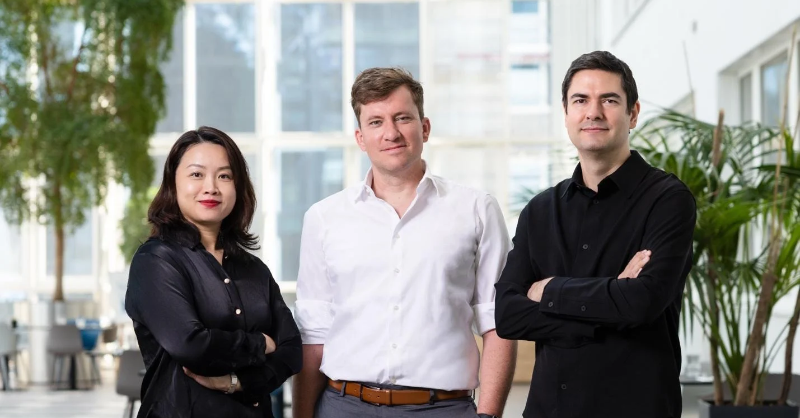
- RhymeQ has secured a $2.2 million pre-seed round, led by Ground State Ventures.
- The company acts as an abstraction layer: developers write code in standard Python, and RhymeQ’s compilers translate it into instructions that quantum hardware can run.
- The funds will expand its engineering team, develop an enterprise platform for Rhyme, and build a global community of Rhyme developers.
Daniel Volz began his career as a freelance journalist, earned a PhD in chemistry, and worked on quantum computing projects at McKinsey and BASF before co-founding Kipu Quantum. After leaving Kipu over a dispute with his co-founders, he set up RhymeQ.
The company secured $2.2 million in pre-seed funding to solve a problem Volz has noticed for years: very few people know how to program a quantum computer.
Ground State Ventures led the fundraising effort, with Vanagon Ventures, Plug and Play, and Freiraum Ventures also participating. The funds were raised in several weekly stages and involved both angel investors and the various funds, Volz tells Tech Funding News.
Volz founded RhymeQ in 2026 together with chief technology officer Tamás Varga and chief operating officer Christina Wu. Varga, the inventor of Rhyme, had worked as a software engineer at Swiss Re and UBS for over 15 years. The company is headquartered in Karlsruhe, Germany, and Zürich, Switzerland.
Why a chemist went back to quantum software
“I am not a physicist, but a chemist, and as a result I have been involved in this field for 10 years from the outside,” Volz tells TFN. He became interested when IBM made its qubits, the basic units of a quantum computer, available via the cloud.
A decade years ago, those machines had around 10 noisy qubits. Today, the hardware consists of hundreds of physical qubits, and error-corrected logical qubits are coming soon. Volz views this as another turning point, and the key issue now is software.
“There’s a mismatch since the software isn’t accessible unless you have a good understanding of physics. It wouldn’t be the case that only about 1,000 people in the world could actually code for it,” he says.
Evidence from recruitment firms supports this: the World Economic Forum states that McKinsey found only one qualified candidate for every three quantum jobs. Grand View Research forecasts that the quantum computing software market will reach $2.51 billion by 2030, growing at an annual rate of 18.5% from 2024.
Kris Kaczmarek, a partner at Ground State Ventures, added, “While the gap between quantum algorithms and hardware is closing fast, we keep hearing ‘who cares if no one knows how to use them’. This is the gap RhymeQ is closing. And there’s no one who understands this better than Daniel Volz, who’s seen both sides of the equation, whether it was implementing quantum for chemistry at BASF or providing quantum solutions at Kipu Quantum.”
What Rhyme does, and how it differs
Rhyme functions as an abstraction layer: developers write code in ordinary Python, and RhymeQ’s compilers convert it into instructions quantum hardware can understand. The company says the same code can run on different types of quantum processors without tying users to a particular system.
Volz describes Rhyme as operating in two stages: a reasoning stage, where developers work through the problem, and a compiler stage that transforms it into quantum circuits, the instructions a quantum computer executes. For instance, a software engineer employed by a chemicals company could write a simulation in Python, test it on a simulator, and then run it on actual quantum hardware.
Rhyme can compile directly to CUDA-Q, NVIDIA’s platform for programming quantum processors and graphics chips, so the same code can run on GPU-accelerated quantum simulators and processors from various hardware manufacturers.
The idea has research origins: in a January 2024 paper co-authored by Varga, a high-level quantum programming language also named Rhyme was described, extending classical data types to include quantum ones.
Volz regards Horizon Quantum, based in Singapore, and Classiq, based in Tel Aviv, as the most pertinent quantum software companies, yet he views them as partners. Another player in the field is ColibriTD, which raised a €4 million seed round with Earlybird leading the investment.
Who backed it, and what traction looks like
Ground State Ventures is an Amsterdam-based fund focused on early-stage quantum technology, with over 18 companies in its portfolio, including QuantWare and the Swiss cryogenic startup Rhonexum.
The other investors are early-stage experts. Vanagon Ventures, a pre-seed and seed fund based in Munich, focuses on AI and deep tech startups. Freiraum Ventures, also based in Munich, is associated with the Strascheg Center for Entrepreneurship at the Munich University of Applied Sciences and invests in pre-seed teams. Plug and Play, based in Sunnyvale, California, was an early investor in PayPal and Dropbox.
The public markets have opened: IQM began trading on the Nasdaq on July 2 at a valuation of around $1.9 billion, and Pasqal has agreed to a similar listing. TFN has also published information about private rounds, including OQC’s £260 million raise, Quantinuum’s $600 million raise at a $10 billion valuation, and Universal Quantum’s Series A raise of more than $100 million.
RhymeQ employs six full-time people, and a seventh will begin work on November 1. Volz states that all team members hold a science or technical degree, except Wu, who has experience in business, finance, and HR. The company intends to use the funds to expand its engineering team, to develop an enterprise platform for Rhyme, and to establish a global community of Rhyme developers.
The key point lies in timing. Volz believes the hardware is now ready for the software to advance, and RhymeQ aims for Rhyme to become the primary way developers program quantum computers “as error-corrected hardware arrives.”



