


- Swedish Rebaba has raised $4.6 million in order to produce energy storage systems using used EV batteries.
- The company, founded by former Northvolt engineers, intends to offer an alternative to the gigafactory model.
- The startup, which has 16 people on its staff, states that each of the systems it has installed is already profitable and that it intends to employ four more individuals.
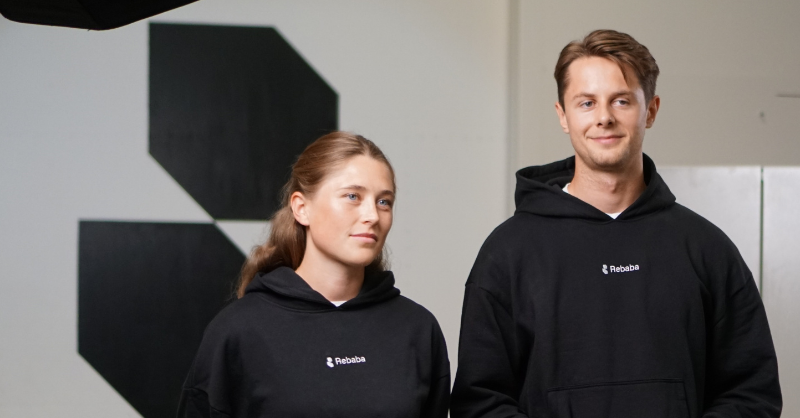
Paula Runsten spent many years at Northvolt, contributing to the development of the gigafactory model, which resulted in $5.8 billion of company debt. However, the unofficial motto of her new company runs counter to this notion, stating, “We don’t need gigafactories.”
The Stockholm-based startup Rebaba, which Runsten co-founded in 2023, has now completed a seed financing round of $4.6 million, with Sistafund and EIT Urban Mobility as the lead investors, and additional support from the company’s existing shareholders as well as new European investors.
Rebaba converts retired electric vehicle batteries that still retain 70% to 80% of their original capacity into stationary energy storage systems for use in homes, businesses and industrial facilities.
The usual view is that a new kind of battery has to be developed for each energy storage system that is deployed, but that is not actually the case, says Runsten, co-founder and CEO of Rebaba, to Tech Funding News.
We don’t need gigafactories
While on a gap year, Runsten became interested in electric vehicles, and afterwards she studied mechanical engineering with a special focus on transportation. She took part in building a self-driving carbon-fibre electric Formula car, worked on prototype batteries at Northvolt, tested vehicles at Tesla during the Scandinavian winters, and later went back to Northvolt to help with the digitalisation of production.
While she was studying, she met her co-founder, Felix Kruse, who is now the chief technology officer at Rebaba. At Northvolt, they realised there was a large gap: there were many retired electric vehicle batteries and a global demand for stationary storage, but no solution linking the two.
Their first move wasn’t to carry out a funding round but instead to make an unpaid presentation to bus operators in Indonesia, suggesting that they convert retired fleet batteries into energy storage for islands and remote communities which do not have reliable access to a grid.
Runsten defines the company’s aim as narrowing the gap between battery availability and access to clean energy, particularly in areas where a reliable energy supply is needed to support essential services such as healthcare and education.
“I will always be grateful to Northvolt — they taught me so much and have been vital to establishing Sweden’s position as a battery hub in the global landscape,” she says.
Since making cells, Runsten states, is more complicated than manufacturing cars, Northvolt needs gigafactories to do so. Rebaba’s method is simpler in that it involves taking used battery packs, placing them in cabinets or containers, rewiring them with their own control software, which is compatible with various battery types, and then connecting them to grids, solar panels, or EV chargers via an inverter.
The company carried out its first pilot projects and sold systems even though it didn’t have a completed product, financing, or even a factory. In some cases, it used a converted electric truck because it didn’t have sufficient meeting space.
The real competition isn’t other second-life battery companies
The Rebaba system is used by industrial and commercial sites, operators of EV charging stations, and an increasing number of residential customers that use the tech to reduce peak demand, store solar energy, back up their EV chargers, and participate in energy markets.
According to Runsten, the company does not regard other second-life battery companies such as Moment Energy in Canada and Connected Energy in the UK as competitors
“The market is still too big for us all to deal with,” she says. “Our true competitor is the virgin battery cells coming from China, which are continuously driving prices down. We do not believe in green premiums, and we also want to compete on price, performance, and warranties.”
This method aligns Rebaba with other battery storage companies in Europe such as FION Energy in Berlin and ZE Energy based in Paris, but what sets Rebaba apart is its focus on reusing batteries rather than producing new ones.
Scaling up from a workshop
Rebaba shifted to its current production plant at the beginning of 2025 and is now handling all its manufacturing in-house. Runsten states that each of the systems they have installed has proven profitable. Since the company is receiving more demand than it can satisfy, it has decided to conduct this funding round. The company has 16 employees, intends to hire four additional ones, and expects its growth to continue.
The round ended with greater interest than the number of shares available.
Marie Geneste, a partner at Sistafund, which earlier in 2026 had also led the seed round for the battery recycling startup Recupere Metals, states that the deal was secured on the basis of circularity without compromise.
“Europe’s energy transition depends on scaling storage fast, without creating new dependencies on scarce raw materials or costly imports. Rebaba turns retired EV batteries into high-performance storage systems that can be built locally and compete on price. That is what convinced us to lead this round: circularity without compromise, and a team with the potential to build a European leader in energy storage,” said Geneste.
Runsten believes that actual deployments will determine the course of the next few years as demand for AI power, EV charging, and renewable energy converges. It will be evident in the next funding round whether Rebaba’s no-gigafactory approach can grow fast enough to meet this demand without once again making the same industry mistakes.



