


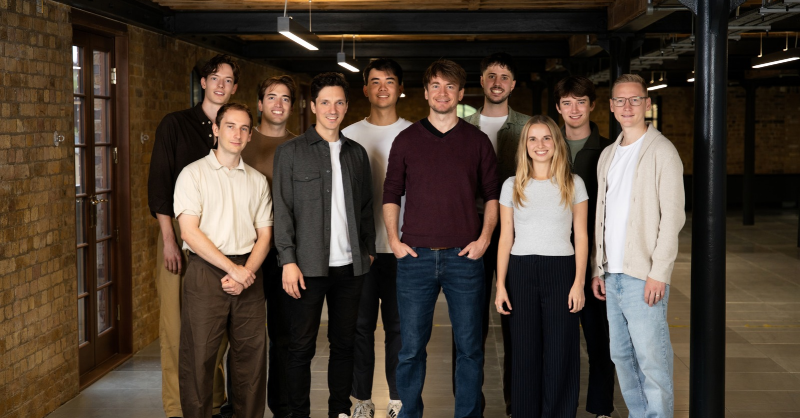
- Machenta has raised $40M in seed funding, co-led by Creandum and Union Square Ventures.
- The 11-person London startup says its robot is trained completely in simulation.
- The seed round will fund team growth, increased computing power, and more simulated data.
Edward Johns’ early work at Imperial College London showed that a robot needed about 30 minutes of additional data collection after being walked through a task before it could operate autonomously. Six years later, Johns leads an 11-person startup that is trying to eliminate that delay.
Machenta, a London robotics startup founded in 2025, announced a $40 million seed round, co-led by Creandum and Union Square Ventures.
Teaching robots without real-world data collection
Machenta is building a foundation model, a large AI system trained once and then used for many different tasks. The idea is that if you show a robot a task once, the model can perform it immediately without further training. The startup has demonstrated this in packaging, assembly and tidying tasks.
The company claims one model has learned everyday tasks on a range of different robots, including humanoids.
Most competitors do it a completely different way. Machenta says learning a robot a new task typically takes days or weeks: you end up with hundreds or thousands of human demonstrations, train a model, and wait for the results. That, in turn, has kickstarted a race for real-world data, with a number of companies now paying people to film themselves at work.
Tech Funding News reported on 23 October that Maxinsights had raised $30 m to pay out over 5,000 contractors to film real work for robots
Machenta trains its models in simulation, letting them learn how to learn, so they need only one example for a new task. As a result, the robot can learn a new task from just one or two real demonstrations.
“Intelligence is not so much about what you can already do, it’s about how quickly you can learn to do something new. Humans don’t need to see the same thing over and over before they can do it. If you take some objects, and show somebody what to do with them, they’ll probably then be able to do the same task immediately. We’ve spent years trying to understand what it would take for robots to learn at the speed of a human. That is what instant robot learning is about,” said Johns, Machenta’s co-founder and CEO.
A small team competing with billion-dollar rivals
Machenta faces some very big players. Physical Intelligence and FieldAI are principal competitors. Skild AI is another competitor with similar capabilities, valued at over $14 billion after a $1.4 billion January round led by SoftBank.
Machenta is still very much in the early stages. It’s a research company and has no plans to go commercial anytime soon. While the model can learn some tasks quickly, more precise tasks and complex motions remain very difficult.
Two investors, two perspectives on the data challenge
The seed round will fund team growth, increased computing power, and more simulated data. The aim is to help robots learn more sophisticated, precise tasks. The company is also moving into a new office and lab in King’s Cross, London. Machenta currently has 11 people on the books and has not disclosed how many more it plans to take on.
“Very few teams in robotics can point to a body of work like this, which has repeatedly changed what people thought was possible. The team at Machenta has spent years breaking through this extremely hard problem, long before there was a company around it. They’re not starting with just a theory of how robots can learn like humans; they’re building on years of experience actually making it happen,” said Kathi Wilhelm, a partner at Creandum.
“Robots become so much more useful when they can instantly pick up a new task and get to work right away. The industry is pouring enormous amounts of capital into collecting real-world data and training robots one task at a time, but Machenta is changing this. Whether this is for a robot in the factory or at home, we need general-purpose AI which can adapt quickly in the same way that humans can,” added Rebecca Kaden, managing partner at Union Square Ventures.
This funding is part of a broader investment wave. Crunchbase’s physical AI category saw global venture funding hit $47.4 billion across 521 deals in H1 2026. By late July, humanoids had raised $8.6bn according to a TFN ranking based on Dealroom data.
The big challenge is precision. Machenta says one demo is enough, but that fine movements are still very difficult, and Skild AI already has a model with comparable capabilities. If simulation is all that’s required, then robot training may not need quite as much real-world data. If it isn’t, investors in both approaches will find out which one actually works.



