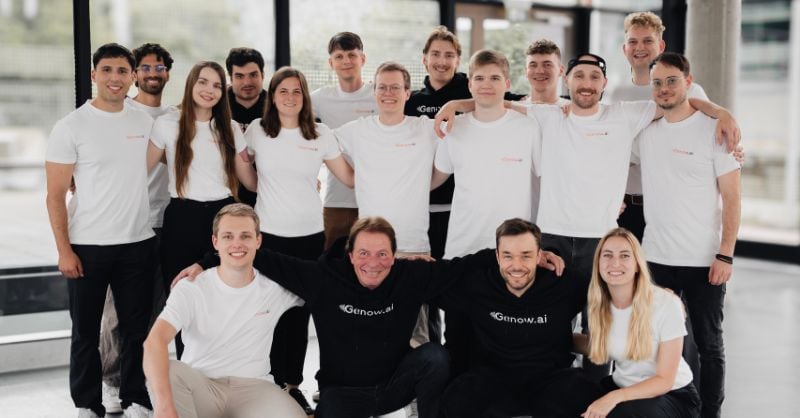
Enterprise knowledge may be digital, but for most large organisations, it remains fragmented and challenging to navigate. The Darmstadt-based deep‑tech startup Genow is determined to overcome these barriers.
Sara Jourdan, CEO and co-founder of Genow, comments: “Knowledge management remains one of the biggest hurdles to successful processes and decisions. Many employees spend 20 to 30 per cent of their day searching for information in unstructured data sets.”
Today, Genow raised €1.65 million in seed funding to roll out its platform designed to help companies manage their scattered internal knowledge more efficiently. The round was led by High-Tech Gründerfonds (HTGF), with participation from BMH and angel investors including Markus Becker, Sebastian Mönnich, and Dr. Mario Lenz.
The new funding will be used to develop the platform further, with a focus on expanding its capabilities for managing more complex workflows, as well as scaling sales across Europe and beyond. Genow is already working with enterprise clients in the US and sees potential for significant growth there.
From research to real-world impact
Genow was founded in 2023 as a spin-off from TU Darmstadt by Dr. Sara Jourdan, who previously worked in consulting and software development, CTO Dr. Timo Koppe with a background in information systems and manufacturing, product lead Adrian Glauben, and advisor Prof. Peter Buxmann.
The team saw firsthand that knowledge management is a persistent, cross-industry challenge, with employees struggling to access critical information scattered across multiple systems. Despite years of digitalisation, many large organisations still struggle with knowledge that is trapped across various tools like SharePoint, Jira, or Confluence. Genow aims to solve this core problem by consolidating knowledge from multiple sources into one accessible platform called Wingman.
The vision took form in Wingman, Genow’s Knowledge Operations AI platform. Now utilised by major international enterprises, it transforms how organisations access, comprehend, and scale their internal knowledge.
What makes Wingman different?
Wingman pulls data from different systems and enriches it by adding company-specific details and context. This approach enables organisations to deliver accurate answers to queries while also identifying knowledge gaps.
Companies can configure the platform to serve different departments such as HR, sales, compliance, and customer service. The software can be run as a cloud service or deployed securely within a company’s private cloud.
The contextual layer is applied during user query interpretation and retrieval, ensuring each specialised Knowledge Agent delivers exact and reliable support. Jourdan underscores, “In practice, this means knowledge from different sources can be connected and understood in context, creating a unified knowledge layer across the organisation.”
Furthermore, Sara highlights Wingman’s enterprise readiness: “The platform can be delivered as a SaaS model or deployed fully within a customer’s own Google Cloud environment, ensuring maximum control, transparency, and data security.”
What’s next for Genow?
Jourdan concludes, “Over the next three to five years, Genow’s focus is on scaling its technology, customer base, and international presence. A key milestone in the near term is the launch of our Agent Suite, which will make it even easier for enterprises to configure and scale specialised Knowledge Agents on top of their existing and often proprietary data systems.
At the same time, we are continuing to strengthen our data integration capabilities, ensuring that Wingman becomes the most flexible and precise platform for enterprise knowledge operations.”
On building the team and company culture, Jourdan highlights the importance of diversity: “I still find it striking how low the representation of women remains in both technical and leadership roles. This imbalance makes it all the more important to actively promote female talent, which I have set as a personal goal at Genow, not only in tech and engineering roles but also in leadership positions as the company grows.”
Her advice to women entering the field is clear: “Don’t let yourself be defined by stereotypes or average numbers. In fact, in the startup world, it is often decisive to deviate from the average, and many women in tech bring exactly this ability, not to be guided too much by benchmarks but to trust their path.”