


- Edgify raised $9 million from Rank Ventures and Mangrove Capital, taking total funding to $25 million.
- Its edge AI links supermarket cameras, scales and checkouts without new hardware or cloud uploads.
- The startup is live with grocers across the US and Europe and expanding into QSR and apparel.
A supermarket already has dozens of machines watching every transaction: cameras above the aisles, scales at the self-checkout, scanners at the till. Almost none of them talk to each other. London-based Edgify has built a business on closing that gap, and it has just raised $9 million to advance the idea.
The Series A+ round comes from Rank Ventures and Mangrove Capital, the latter a returning backer from Edgify’s 2020 seed round, and brings the company’s total funding to $25 million, according to Edgify.
“A store is a fleet of machines that can see, decide and learn together, without a single byte leaving the building. Retail is just the beginning,” said Nadav Israel, CEO and co-founder of Edgify.
The London-based startup is chasing a slice of the retail computer vision market, which it puts at $15.8 billion, amid a much larger shift in AI investment from the cloud to physical infrastructure. The global edge AI market is projected to grow from roughly $46.96 billion in 2026 to $445.75 billion by 2034, as retailers, factories and warehouses look to process data on-site rather than ship it to a data centre.
From a failed photo app to store-floor AI
Edgify traces back to Pixoneye, an earlier venture co-founded by Israel that analysed personal photo galleries on smartphones. When that business struggled to find a market, its engineering team in Israel repurposed the underlying edge-computing technology for a different problem: training AI models directly on hardware that retailers already own, rather than in the cloud.
Edgify launched out of that pivot in 2019. It works by running its software across a store’s existing self-checkouts, cameras, scales, and point-of-sale terminals, regardless of manufacturer. Each device trains a model locally and shares what it learns across the network, without sending raw video or transaction data to a central server.
Edgify said this cuts cloud costs and latency while keeping customer data inside the store. If one checkout learns to catch a new scan-avoidance trick, for example, that pattern can spread to every other till on the network without the underlying footage ever leaving the building.
“Retail is the ultimate testing ground for edge AI. The real breakthrough is the underlying platform: translating isolated in-store hardware into a unified system for future AI applications,” added Mitchell Goldman, Edgify’s chief operating officer, pointing to how densely stores pack smart devices into a small space with strict cost, latency and privacy demands.
It is not the only company chasing this. Trigo and AiFi both sell computer vision systems for cashierless stores, and Everseen focuses specifically on loss-prevention analytics at checkout. Edgify’s point of difference, per the company, is avoiding the dedicated servers and lengthy installs that those approaches typically require, instead using spare compute on hardware that hardware stores have already paid for. Whether that is a durable edge or just a cheaper on-ramp isn’t tested at scale yet.
Part of a bigger vision on physical AI
Edgify’s raise lands alongside a run of similar European deals on physical AI.
Tech Funding News has covered SuperSeed’s 50 million pound Physical AI fund, which backs seed-stage startups automating manufacturing and energy infrastructure; Berlin’s Almetra, which raised 16.3 million euros to turn factory-floor camera feeds into real-time production data; and Kristiansand’s HIVE, which raised $15 million to retrofit AI onto existing wheel loaders and forklifts rather than sell new hardware. Different verticals, same wager: AI’s next value pool sits on the shop floor, not in a data centre.
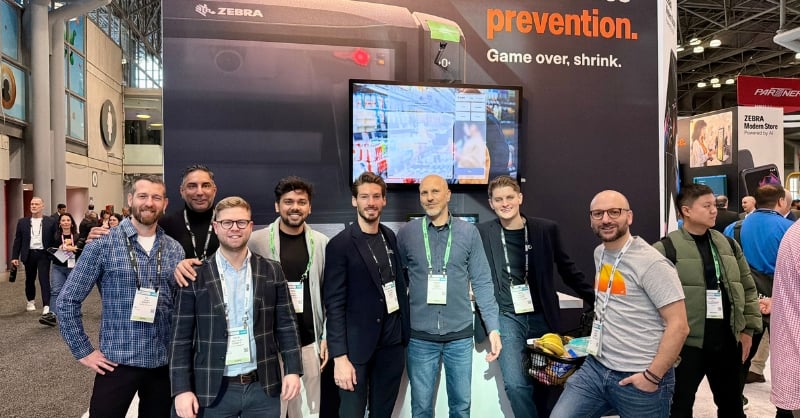
“The winners in AI will be the companies that own the point where data is created, and in physical retail, that point is at the edge. Edgify has spent years building technology that trains and runs models on ordinary in-store hardware, and its traction with major grocers and partners like Zebra shows the market is more than ready,” noted Rajan Dosanjh, managing partner at Rank Ventures.
Edgify will use the new capital to accelerate its platform rollout with existing grocery retailers and hardware partners, and to expand beyond loss prevention into quick-service restaurants, distribution centres and apparel.
As AI moves out of data centres and into stores, factories and warehouses, Edgify says the next valuable AI infrastructure layer could be right where the data is created.



