


- Daytona raised a $60M Series B at a $1B valuation, taking its total funding to $91M.
- FirstMark led, with the founders of Stripe, Shopify, Perplexity and Zoom investing.
- Revenue run rate is up about 25-fold since January, the company says, from an undisclosed base.
When Ivan Burazin and his co-founders decided AI agents would need computers of their own, Daytona did not add a feature. Burazin told Fortune the company handed its customers to competitors, rebuilt the product and relaunched with roughly three months of revenue left in the bank.
On October 20, that gamble became a $60M Series B at a $1B valuation. Daytona, a San Francisco-based startup with Croatian founders, said the round was led by FirstMark Growth and takes its total funding to $91M.
The round includes seven tech founders investing as angels: Patrick Collison of Stripe, Tobi Lütke of Shopify, Aravind Srinivas of Perplexity, Eric Yuan of Zoom, Olivier Pomel of Datadog, Adam D’Angelo of Quora and Brendan Foody of Mercor. Qualcomm Ventures, Samsung Next and Okta Ventures joined as strategic investors, alongside Evergreen Fund, Alumni Ventures and Torch Capital.
Existing backers returned. According to Daytona, E2VC is now in its fourth round with the company, Upfront Ventures in its third, and Pace Capital and FirstMark in their second. Burazin told Fortune about $50M of the round came from existing investors. FirstMark also led a $24M Series A in February, after a $5M seed led by Upfront in 2024 and a $2M pre-seed in 2023.
From developer tools to a cloud for agents
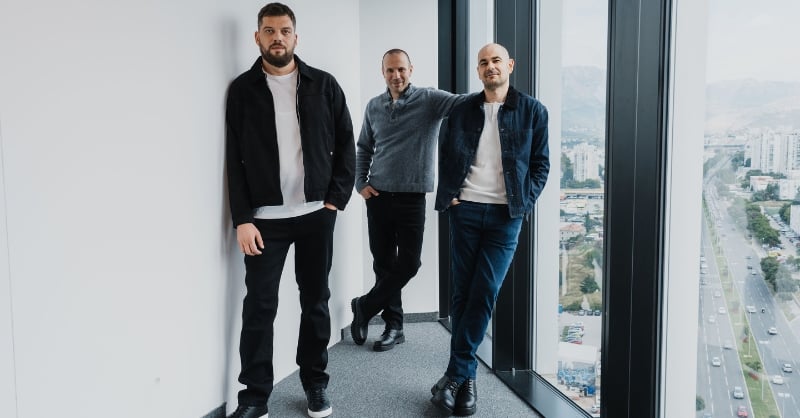
Daytona was founded in 2023 by Burazin, its CEO; Vedran Jukić, CTO; and Goran Draganić, chief architect. They set out to automate software development environments for large companies. Burazin co-founded the cloud coding tool Codeanywhere in 2009 and later served as chief developer experience officer at Infobip.
The startup works by giving every AI agent a sandbox: a virtual computer where it can run code, browse the web or operate software without reaching a company’s wider systems. Burazin says Daytona can start one in 60 milliseconds. Agents can pause a sandbox, resume it or copy it to try several approaches at once. Daytona says its platform runs Linux, Windows, macOS and GPU environments.
Daytona says it supplies infrastructure to Anthropic, OpenAI, NVIDIA, Cursor and Cognition, and counts Meta, Cohere, Mercor, Handshake, Surge AI, SambaNova, Postman, Bolt.new, n8n and Clay among its customers. Many use the sandboxes to let AI models practise tasks over and over during training and testing.
Security is the other half of the pitch. Tech Funding News has reported on the risk of autonomous agents that already hold enterprise credentials. Burazin said, “Recent agent security incidents are not edge cases. They are previews. The agents aren’t going rogue; they are doing their job without any morals or fear of consequences. Companies are going to manage thousands of digital employees, and each one needs a safe place to fail. Daytona ensures one rule breaking agent doesn’t spill into company wide chaos.”
Fast growth with undisclosed revenue
Daytona says its revenue run rate, the current rate of revenue projected over a year, has grown about 25-fold since January. The company adds customers it had six months ago are spending nearly three times as much with it today. It did not disclose absolute revenue, so the base behind those multiples is unknown.
That makes the $1B price a bet on trajectory. Two neighbours give a yardstick. Temporal’s $12.55B valuation is no more than about 50 times its reported run rate of more than $250M. Modal’s $15.75B is no more than about 16 times its reported run rate of more than $1B. Daytona has not given enough to run the same sum.
Matt Turck, a partner at FirstMark who joined Daytona’s board with the Series A, repeated the thesis he gave in February almost word for word: “We believe the next infrastructure shift is from human-centric cloud primitives to agent-native ones. Daytona’s breakthrough is making ‘a computer for every agent’ practical: instant startup, persistent state, and the tooling agents need to write code, use Git, and execute safely at scale. That’s a foundational building block for the agentic economy.”
Quinn Li, senior vice president at Qualcomm Technologies and global head of Qualcomm Ventures, added: “AI agents need secure environments to run code, call tools, browse the web and learn through reinforcement learning. We believe Daytona’s platform gives each agent its own environment to do all of it at scale.” He added that what began as an agent sandbox is now a full platform for running agents in production, and that the firm was “glad to invest in Daytona as they build critical infrastructure for the agentic era.”
Qualcomm’s interest in AI software is not limited to its venture arm. TFN reported that the engineer who built Swift and LLVM sold his AI startup to the chipmaker for $4B.
A crowded layer of the agent stack
Daytona’s best-funded neighbours are raising much larger rounds. Modal, which also sells a sandbox product, raised $750M at a $15.75B valuation on October 14, led by Accel, up from $4.65B in May. E2B, an open-source sandbox provider, raised a $21M Series A led by Insight Partners in July 2025. Temporal works a layer above: its open-source software keeps long-running work going when parts fail. It raised a $550M Series E at $12.55B on September 14, seven months after a $300M Series D at $5B.
AWS, Azure and Google Cloud already rent out virtual machines. Burazin says investors asked him why they could not do this too. He told Fortune the big providers could, but argued that rebuilding their infrastructure for agents rather than human users would not be easy.
Gartner forecasts that spending on enterprise cross-functional AI agents and assistants will exceed $23B in 2030, a compound annual growth rate of 59%. That covers the agents themselves rather than the infrastructure under them, so it measures demand, not Daytona’s addressable market. Demand also has to show up: TFN has reported on why enterprise AI agent projects have so far fallen short of expectations.
Burazin told Fortune most of the new money will go on sales hires, plus some engineers. Daytona has 35 employees, up from 20 in February, he said on X, and plans to recruit in San Francisco, Croatia and Singapore while building a platform that goes beyond sandboxes.
In February, announcing its Series A, Daytona said it was hardware-constrained. Eight months later Burazin predicts a wider shortage of conventional processors, which he expects to take a bigger share of AI spending than the graphics chips used to train models. If he is right, chip supply may cap Daytona’s growth before customer demand does. Whether it can hold its speed advantage once the cloud giants decide to compete is the harder test.



