


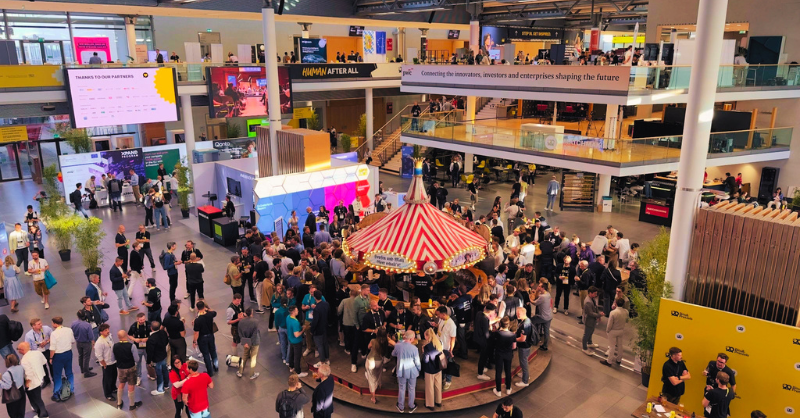
Bits & Pretzels launched in September 2014 as a breakfast gathering for founders in Munich, created by Andreas Bruckschlögl alongside Bernd Storm. 12 years later, organisers state that the festival welcomed 7,500 participants, including founders, investors, and industry players between September 28 and 30, matching the overall attendance Tech Funding News noted at the 2025 event.
TFN returned to the conference floor for a third consecutive year. The agenda on the main stage centered heavily on AI, with sessions including “Funding the trillion-dollar decade: venture in the age of AI” and “Bavaria’s AI moment: building Europe’s next tech powerhouse,” featuring keynote presentations from former Google CEO Eric Schmidt and Bavarian Minister-President Markus Söder.
However, in conversations with early-stage founders, the focus shifted to operational hurdles including securing regulatory clearance for hardware, importing essential parts from China, and obtaining sufficient growth capital.
None of the entrepreneurs identified AI as their primary bottleneck.
These observations align with insights shared by Claire Houry, general partner at Ventech, who highlighted in an interview with TFN that the core challenges facing founders remain far more practical in nature.
Founders are more concerned with day-to-day challenges
Jonas Dengler, co-founder and CFO of Ottobrunn-based electric cargo drone developer Maple Aviation, tells TFN: “The only bottleneck we have in this field is actually regulation, and we took that already because we have European certification.”
According to Dengler, initial flights alongside launch partner LMU Klinikum are scheduled for December 2026, with plans to initiate a Series A transaction in H2 2027.
Growth-capital hurdles often emerge at this juncture for regional deep-tech ventures. When Uplift Ventures launched a €100 million fund targeting the seed-to-Series A transition gap, TFN highlighted that domestic capital backers participate in merely 54% of European rounds exceeding $15 million, compared to an 80% domestic backing rate in the US.
Polingo, a Frankfurt-based edtech startup, addresses regulatory requirements from a distinct angle. Founder Nicole Spielmann noted that its conversational device for children aged three to eight operates via Bluetooth phone connectivity rather than direct internet links, executing AI processing locally.
Nonetheless, separate compliance filings are still required for the outer shell, electronic assemblies, and power units. “We have three registrations,” Spielmann explains.
While compliance requirements serve as a defensive barrier for Maple Aviation, they present operational friction for Polingo.
The Series A gap depends on where you stand
For aembiance co-founders Tino De Paoli and Leon Debatin, who are halfway through a year-long public grant, pursuing venture capital remains premature.
“A lot of it is just coming from China, and if you are not allowed to order from China, it’s not so easy to build a product that actually works,” De Paoli explains, adding that securing capital presents further difficulties. “The amount of money you can raise and what you have to give for it is not so easy in Europe. I would say Europe is left behind so far.”
In contrast, Philipp Reißel, CEO of Aachen-based enterprise software firm amber, offered a more optimistic outlook after securing a €7 million Series A round backed by Ventech and NRW.Venture.
“Startups raising decent rounds now see more and more a shift towards also staying in Europe at first,” Reißel tells TFN.
Though anecdotal feedback varies, broader market data tempers Reißel’s positivity. Findings from the German Startup Monitor 2026, which surveyed 1,803 founders, show that sentiment favoring Germany over the US dropped to 31%, down from 40%. Capital deployment reached €8.0 billion through September, surpassing the €7.5 billion total recorded across 2025, though transaction volumes remain nearly 25% below 2021 heights.
This dynamic reflects larger allocations across fewer transactions, benefiting ventures that have successfully navigated initial validation milestones.
Talent, AI, and capital across borders
Reißel further emphasises the advantages of scaling beyond dominant tech hubs.
“It’s two different worlds,” he explains, drawing a contrast between major innovation centres like Berlin or Munich and smaller regions. Setting up in Munich forces companies to “fight 10 other startups for the talent,” whereas operating out of Aachen or Cologne provides a significantly less crowded recruitment landscape.
Data from recent surveys reinforces this perspective: only 15% of entrepreneurs currently view talent acquisition as their primary hurdle, down from 30% two years ago. Reißel’s insights highlight tactical hiring efficiency rather than a widespread shortage of skilled labor.
In a similar vein, SouthwestX venture director Matthias Schmitz fosters international collaboration by connecting academic institutions across Saarland and Rhineland-Palatinate with ecosystem partners in France and Luxembourg.
Schmitz underscores the urgency of expanding domestic financing options: “We need to create a mechanism by which we can do our own investment.” His perspective outlines a broader push to link academic research, commercial entities, and funding sources across European borders.
Who was missing
Echoing TFN’s earlier reporting on capital disparities across the ecosystem, female representation on the conference floor remained sparse throughout the 2026 event.
Statistics from the Female Founders Monitor 2025 indicate that female entrepreneurs account for nearly 19% of German startup creators, while all-male executive teams command 91% of total venture capital funding. Earlier this year, we highlighted seven female-led German startups driving innovation across various sectors.
While AI continues to dominate headline discussions at major gatherings like Bits & Pretzels, European startup founders remain focused on grounding their ambitions in reality. As TFN noted at HTGF Family Day 2026, European markets must cultivate self-sustaining financial mechanisms to secure lasting expansion.
Disclosure: TFN’s coverage of Bits & Pretzels 2026 was supported by SereneDB. Editorial coverage remains independently produced by TFN.


