


- Bristol-based Mykor has raised £4M led by Clean Growth Fund and The FSE Group to scale a fungi-grown structural insulation panel that delivers 60% less embodied carbon than conventional alternatives, bringing total funding to £7.5M.
- The female-founded startup has already secured £337M in commercial agreements with UK and European contractors, and is establishing a joint-venture production facility in Belgium ahead of commercial launch.
- Buildings account for approximately 39% of global carbon emissions, 11% from materials, 28% from operational energy, putting construction materials at the centre of Europe’s net zero regulatory agenda.
Construction has a materials problem that no one wants to talk about. Concrete and petrochemical insulation dominate every building site in Europe, regulators are tightening embodied carbon rules faster than the industry can respond, and the sustainable alternatives that do exist largely fail on fire safety, cost, or the ability to manufacture at scale. Two architects decided fungi could solve all three at once.
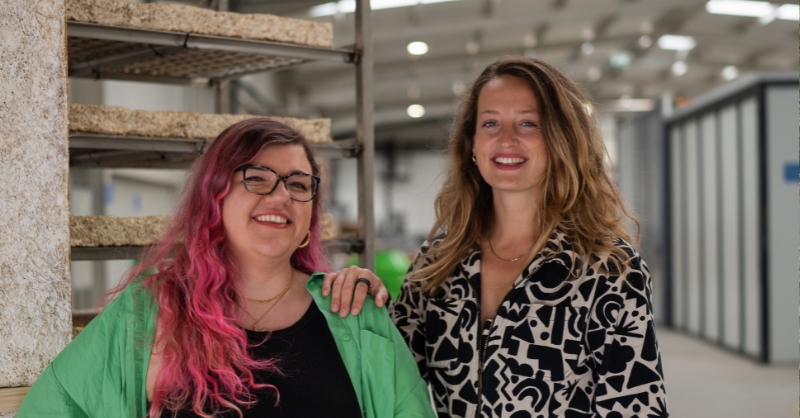
Mykor, the Bristol-headquartered biotech founded in 2021 by Olivia Page and Valentina Dipietro (Forbes 30 Under 30 and UN Young Champion of the Earth) has raised £4M in a round co-led by Clean Growth Fund and The FSE Group, with participation from returning investor Green Angel Ventures and grant support from Innovate UK. The raise brings total funding to £7.5M, following a £2M seed round led by Green Angel Ventures and Sustainable Ventures. The company employs 22 people across its Bristol R&D base and its pilot manufacturing facility in Montemor-o-Novo, Portugal.
What Mykor builds and why conventional sustainable materials keep failing
Mykor grows construction materials rather than extracting or synthesising them. Its core product, MykoSIP, is a structural insulated panel that combines structure, insulation, and cladding in a single prefabricated element, grown from engineered mycelium, the root-like structure of fungi, combined with industrial and agricultural waste streams. The process takes days rather than centuries, uses 90% less water and 40% less electricity than polystyrene-based alternatives, and produces 60% less embodied carbon than conventional insulation systems.
The panel carries a Euroclass B fire rating and produces zero toxic emissions: the two performance thresholds that have historically blocked bio-based materials from mainstream construction procurement. Most competing sustainable insulation products either fail fire certification at commercial scale or carry a cost premium that contractors will not absorb. MykoSIP is designed to integrate into existing prefabricated building supply chains rather than requiring new construction methods, which is what has generated £337M in commercial agreements with UK and European developers before the company has reached full commercial production.
Page said, “Decarbonising construction cannot come at the expense of cost or performance. The challenge has been scaling biomaterials industrially and integrating them into real construction supply chains.”
The investors
Clean Growth Fund, the UK climate tech VC founded in 2020 by Beverley Gower-Jones OBE, with £101M under management, backed by UK pension funds and the British Business Bank, previously backed Sunswap, the zero-emission transport refrigeration developer supplying Tesco and DFDS, and Rendesco, the low-carbon heat network operator serving 10,000 homes across the UK, which it exited in 2026. Susannah McClintock, Investment Partner at Clean Growth Fund, said, “Mykor addresses one of construction’s biggest challenges: reducing embodied carbon without adding cost or complexity. Their solution integrates into existing building practices while delivering meaningful carbon savings.”
Green Angel Ventures is a returning investor from the seed round. The FSE Group and Innovate UK are new to the cap table.
The competitive landscape
Ecovative, the Albany-based mycelium pioneer with $184M raised across 27 rounds, focuses on packaging, fashion textiles, and food — not structural construction panels, and not the European regulatory environment Mykor is specifically targeting. Biohm, the London mycelium construction startup with $8.32M raised, overlaps more directly but remains at prototype scale without Mykor’s Euroclass B fire certification or commercial agreement pipeline. TFN has previously covered Carbonaide’s €3.7M raise to scale carbon-negative concrete and Material Evolution’s £15M raise to scale low-carbon cement from industrial waste — both targeting a different part of the embodied carbon problem, in structural materials rather than insulation systems.
Theglobal green building materials market exceeded $300B in 2024 and is projected to surpass $600B by 2032, according to Fortune Business Insights. The UK’s Future Homes Standard, requiring highly energy-efficient new builds from 2027, and the EU’s Energy Performance of Buildings Directive, pushing developers toward zero-emission buildings and large-scale retrofits, are creating a regulatory forcing function that is accelerating procurement decisions across the sector.
Mykor is establishing a joint-venture-backed production facility in Belgium to serve European demand ahead of commercial launch. The capital funds manufacturing scale-up and expansion across additional European markets.
What comes next for Mykor
The new funding will support manufacturing scale-up and deployment across additional European markets as developers face tighter emissions standards and growing pressure to reduce whole-life building carbon.


