


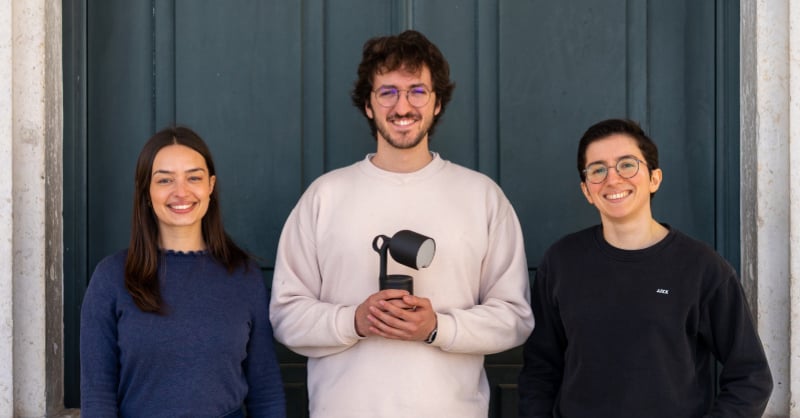
- Lampsy raises €1.1 million for its European launch.
- Its AI lamp monitors for seizures during sleep.
- More than 7,500 people across 20 countries are on its waiting list.
Portuguese healthtech startup Lampsy Health has raised €1.1 million to bring its AI-powered seizure-monitoring lamp to families across Europe and the UK.
The round was led by the Ageas Foundation and Portugal Ventures, with participation from Angels Way, Phira Ventures and strategic business angels. The funding also includes support from the European Union through the European Innovation Council’s Pre-Accelerator programme.
It follows a €230,000 round led by the Ageas Foundation in April 2025.
Why night-time seizures often go unnoticed
Epilepsy affects around 50 million people worldwide, according to the World Health Organization (WHO). For people living with the condition and their families, seizures during sleep can create particular anxiety because they may happen without anyone nearby noticing.
Lampsy’s announcement cites estimates that 86% of night-time seizures go unnoticed. It also highlights the challenges faced by families who cannot continuously monitor someone while they sleep.
In Portugal, the need is significant. The EpiPort study, published in September 2025 by the Portuguese League Against Epilepsy, estimates that around 100,000 people in the country live with epilepsy. That is more than double earlier figures, which came from a study carried out about 30 years ago in the north of the country only. The study puts prevalence at 9.76 cases per 1,000 inhabitants and reports that 43.7% of people with epilepsy receive no medical follow-up.
The WHO also estimates that people with epilepsy face a risk of premature death up to three times higher than the general population. A neurologist at the Portuguese League Against Epilepsy has said that around one-third of people with epilepsy have refractory epilepsy, meaning seizures continue after two different medicines have been tried.
A bedside lamp designed to detect seizures
Lampsy Health was founded by Vicente Mayer Garção, Leonor Pereira and Joana Pinto, who previously co-founded Clynx Health. The company is a spin-off of Instituto de Telecomunicações and Instituto Superior Técnico in Portugal, drawing on research and development in telecommunications, engineering and artificial intelligence.
Lampsy combines a small camera with infrared illumination and an AI-powered computer vision system that runs on the device. It monitors movements during sleep, including in darkness, and identifies patterns that may indicate tonic-clonic seizures.
The company plans to begin commercial operations in the first quarter of 2027, initially targeting a waiting list of more than 7,500 people across 20 countries.
When the system detects a potential seizure, it automatically contacts people selected by the user and sends an alert through its app. The product does not require sensors to be attached to the body, making it a contact-free alternative to wearable monitoring devices.
The company says its technology was developed in response to a request from a medical team at Lisbon’s Hospital de Santa Maria, which wanted a way to monitor patients during sleep without connecting them to equipment.
The startup says its technology detects specific movements associated with tonic-clonic seizures with more than 97% accuracy and automatically alerts emergency contacts. It has been tested on more than 9,200 hours of hospital data.
“This project began with a request from a medical team at Hospital de Santa Maria: to know what happens to these patients during the night without making them sleep connected to a device. Bringing that answer into families’ homes now is the step that gives meaning to all the work we have done in the lab and in hospitals,” said Vicente Mayer Garção, co-founder and CEO of Lampsy.
From hospital research to home monitoring
Lampsy’s technology was validated in collaboration with the epilepsy monitoring units at Santa Maria and Egas Moniz hospitals in Lisbon. A study involving more than 2,200 hours of video was published in the scientific journal IEEE Access.
According to the company, the results showed more than 97% accuracy in detecting movements associated with tonic-clonic seizures and 18 times fewer false alarms than existing alternatives. The startup says its broader testing programme has covered more than 9,200 hours of hospital data.
The distinction between hospital validation and home use will be important as Lampsy moves towards commercialisation. Its next challenge will be demonstrating reliable performance across different home environments and sleep conditions.
Who is competing in seizure and sleep monitoring?
Lampsy is entering a wider market for technologies that monitor neurological activity and health conditions during sleep.
French medtech company BioSerenity, which raised €24 million from Jolt Capital in November 2023, develops connected medical devices, smart clothing and AI-powered analysis tools for monitoring chronic conditions, including epilepsy.
Mountain View-based NextSense, which raised a $16 million Series A led by Ascension Ventures in November 2025, is developing wireless earbuds with EEG sensors to monitor brain activity and sleep, although its initial focus is on sleep quality and cognitive health rather than seizure alerts.
What’s next?
The €1.1 million investment will support Lampsy’s commercial launch in Europe and the UK, beginning with the people already on its waiting list. The company is also considering the US as a medium-term market.
Beyond epilepsy, Lampsy sees potential to adapt its contact-free monitoring technology to other chronic conditions, including sleep apnoea, which affects close to one billion adults worldwide, according to estimates cited by the company.



