


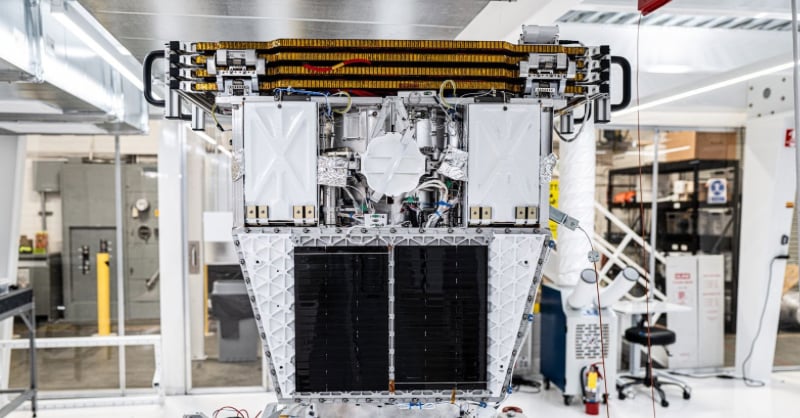
- Reflect Orbital has raised $73.5M, taking its total funding past $100M.
- Sequoia, Lux, and Starship Ventures returned, and Salesforce Ventures joined.
- Its first demonstration launch is planned for the second quarter of 2027.
Reflect Orbital, a Hawthorne, California, startup building satellites that redirect sunlight to Earth, has raised $73.5 million in new funding. The November 10 announcement takes its total funding to more than $100 million. It follows a $20 million Series A in May 2025 led by Lux Capital, and a $6.5 million seed round led by Sequoia Capital in September 2024.
Existing investors Sequoia Capital, Lux Capital, and Starship Ventures took part, alongside new backers including Buckley Ventures, Convective Capital, The Uncommon Group, and Salesforce Ventures. Reflect Orbital did not say how it will split the money. Its release points to launches booked for 2027 and a demonstration mission due in the second quarter of that year.
The company wants to supply sunlight where and when it is needed, using satellites with large, lightweight mirrors. The light could extend solar farms’ output after sunset and help search-and-rescue teams working in the dark.
Building satellites to redirect sunlight
Founded by Ben Nowack, a former SpaceX and Zipline engineer, and Tristan Semmelhack, Reflect Orbital is developing a constellation of satellites in low Earth orbit with deployable mirrors.
Each satellite launches folded, then opens a square mirror about 60 feet across. It steers sunlight onto a spot roughly five kilometres wide at about the brightness of a full moon, according to investor Convective Capital. A single satellite can light a spot for about four minutes as it passes overhead.
Emergency responders could use the system to illuminate disaster areas at night, while construction crews and industrial operators could gain extra lighting without ground infrastructure.
“Lighting on demand can make an enormous difference in supporting emergency responders and we’re excited to back that work,” wrote Bill Clerico of Convective Capital in a post announcing the investment.
“We’ve made substantial progress on our journey to deliver net new, clean solar energy to a world that urgently needs it. This includes several firsts, from numerous technological breakthroughs to our upcoming test missions,” said Nowack, co-founder and CEO of Reflect Orbital.
The company says it builds a large reflector quadrant, 28 times thinner than a human hair, every 3.5 days. It also says it delivers a four-boom deployable structure each week and builds a 12,000-part satellite from scratch every two months.
First demonstration mission planned for 2027
Reflect Orbital says its inaugural demonstration mission, which has FCC approval, will launch in the second quarter of 2027. The mission is meant to test how the reflectors deploy and perform in orbit.
The Federal Communications Commission (FCC) licensed its first demonstration satellite, Eärendil-1 and Universe Today reported that a launch could occur as early as late 2026. The company has also filed with the FCC for a developmental satellite to test its spacecraft and communications payload, subject to approval.
On October 14, it bought two dedicated launches from India’s Skyroot Aerospace. The first will use the Vikram-1 rocket and the second the larger Vikram-1U.
The plan has drawn opposition. The American Astronomical Society said it was dismayed by the licence. The FCC said astronomy and environmental concerns were unlikely to arise from a single satellite and declined to rule on the larger constellation, Payload reported.
The company says it works with the dark-sky community and offers permission-based service. It has said it aims to operate as many as 50,000 satellites by 2035.
TerraSpark and ORiS are exploring energy from space
Reflect Orbital is part of a wider group of startups using space infrastructure for energy. Luxembourg-based TerraSpark raised more than €5 million in pre-seed funding in March 2026, co-led by daphni and Sake Bosch, to beam clean energy from orbit to Earth.
Turin-based ORiS is developing laser-based power transmission to recharge satellites in orbit. It raised €5 million in pre-seed funding in July 2026, including a €0.5 million grant. US rival Star Catcher Industries raised $65 million in a Series A round in May 2026 for a similar orbital power grid.
These companies are not direct competitors. TerraSpark and ORiS transmit energy, while Reflect Orbital redirects natural sunlight with mirrors. All three are testing whether space infrastructure can create new energy services.
Solar tech must prove itself
Terrestrial solar is growing fast. According to the International Energy Agency, solar photovoltaic additions surpassed 600 GW for the first time in 2025 and made up more than three-quarters of new renewable capacity worldwide. That is the industry Reflect Orbital hopes to extend.
Can mirrors in orbit earn a place beside panels that keep getting cheaper? The 2027 demonstration will give the first answer.



