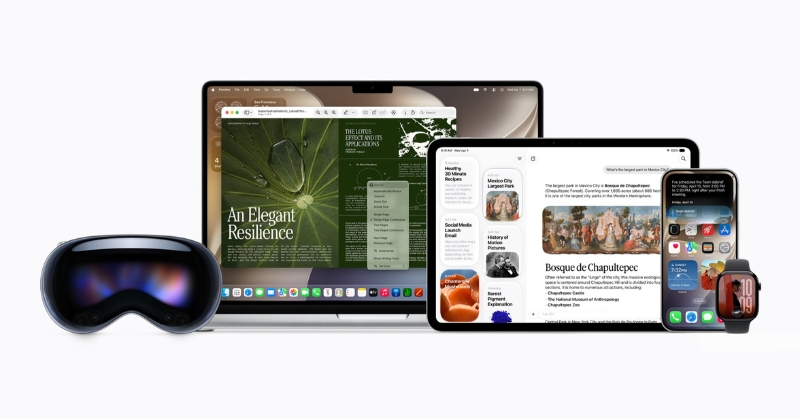
- Apple unveiled WWDC26 on 8 June — its most consequential developer conference in years, centred on a rebuilt Siri powered by a custom Google Gemini model costing Apple roughly $1 billion per year.
- For founders and developers: App Intents is now mandatory for Siri integration, SiriKit is on a deprecation clock, and small app developers get free access to Apple’s Foundation Models AI via Private Cloud Compute.
- Tim Cook’s final WWDC as CEO ended with a personal farewell — John Ternus takes over on 1 September 2026.
Apple held its Worldwide Developers Conference at Apple Park on 8 June 2026. The keynote ran 90 minutes. It was Tim Cook’s last as CEO before John Ternus takes over in September. And it was, by most measures, the most consequential WWDC in years — because Apple finally shipped the rebuilt Siri it first promised in 2024 and spent two years being embarrassed for not delivering. Here is everything that was announced and why it matters if you are building on Apple’s platform.
The big one: Siri AI, powered by Google Gemini
Apple’s headline announcement was Siri AI — a completely rebuilt version of its assistant, now powered by a custom 1.2-trillion-parameter Google Gemini model that Apple is paying roughly $1 billion per year to license. The deal was confirmed publicly by Google Cloud CEO Thomas Kurian and is approximately eight times larger than the largest cloud model Apple had previously built in-house. Apple’s most advanced cloud version, AFM Cloud Pro, runs on Nvidia GPUs inside Google’s data centres.
Siri AI can now draw on personal context — searching across messages, emails, photos, and calendar — answer questions about whatever is on the user’s screen, browse the web for live information, and take actions across apps. A standalone Siri app syncs conversation history across devices via iCloud. The assistant is deeply integrated into iPhone, iPad, Mac, Apple Watch, and Apple Vision Pro. The Google deal puts Anthropic — valued at $965 billion and generating $47 billion in annualised revenue — in an interesting position: its Claude models, including Claude Code, are the dominant AI tool on the developer side of Apple’s ecosystem, yet it is Google’s Gemini that powers the consumer-facing Siri experience.
The EU and China catch: Siri AI will not be available in the EU at iOS 27 launch on iPhone, iPad, or Apple Watch. Apple cited the Digital Markets Act. Mac and Vision Pro users in the EU will get access. It will also not launch in China. EU developers cannot test the new Siri AI features during development. The Foundation Models API itself is not geographically restricted.
For developers: the four things you actually need to act on
1. SiriKit is deprecated. Migrate to App Intents now. Apple gave SiriKit a formal deprecation notice at WWDC26. Apps using the older framework will still compile under iOS 27 — generating deprecation warnings — but they will not surface in the rebuilt Siri experience. Siri AI routes exclusively through App Intents. Any app that has not migrated by the time iOS 27 ships this autumn is effectively invisible to the AI assistant that will land on billions of devices. Apple’s migration window is roughly two to three years before SiriKit is removed entirely — around the iOS 29 cycle in 2028 — but the visibility impact is immediate.
2. Foundation Models framework — free AI for small developers. Apple introduced the Foundation Models framework as a single native Swift API for accessing AI models both on-device and via Private Cloud Compute. The significant commercial detail: if your app has fewer than 2 million total first-time App Store downloads, you can access Apple’s Foundation Models running on Private Cloud Compute at no cloud API cost. This is a meaningful subsidy for early-stage developers building AI-native features who would otherwise be paying Anthropic, OpenAI, or Google API costs. The on-device models run locally with no data leaving the device.
3. Xcode 27 ships agentic coding. Xcode 27 now includes agentic coding capabilities — connecting planning, implementation, execution, UI verification, localisation, crash analysis, and fixing within a single workflow. Apple has embedded a corpus of Apple engineering and designer knowledge into the tools, functioning as specialists for SwiftUI, accessibility, universal sizing, testing, and performance. Third-party AI agent integrations are also supported. This directly competes with Claude Code, whose run-rate revenue has more than doubled since the start of 2026 and is currently the dominant AI coding tool among Apple platform developers.
4. Spotlight semantic index — new discoverability surface. By contributing app content to the Spotlight semantic index and adopting App Intents schemas, developers can make their app’s content and actions available through Siri AI with natural language — no specific phrases required, no code changes needed as Siri’s language understanding evolves. This is a new distribution channel: your app’s content, surfaced directly in the most-used AI interface on the planet.
Performance numbers worth knowing
Apple’s own testing on prerelease iOS 27 found: iPhone and iPad apps launch up to 30% faster. Photos load up to 70% faster after being taken. AirDrop transfers are up to 80% faster. Browsing and transferring files between external drives and iPad is up to 5x faster. These are Apple-tested figures on specific hardware configurations — real-world variance applies — but the direction is clear: iOS 27 is the performance reset Bloomberg’s Mark Gurman flagged last November, described internally as Apple’s “Snow Leopard” moment.
macOS 27: Golden Gate
macOS 27 is named Golden Gate. Design updates reincorporate what Mac users have always expected: a more uniform toolbar across apps, edge-to-edge sidebars, coloured sidebar icons. The Liquid Glass design language from last year now has a user-adjustable opacity slider — “ultra-clear to fully tinted.” App icons have been updated to be sharper and more defined. Developer documentation for all platforms is available at developer.apple.com/wwdc26.
New parental controls — and why they matter for consumer apps
Apple is introducing a significant overhaul to Screen Time and child account management. Parents can now set daily time allowances across three specific categories — Entertainment, Games, and Social Media — with recommendations from clinical and child development experts. They can require approval for each new contact a child connects with, and enable automatic interventions if explicit or violent content is being shared.
If you are building consumer apps in any of these three categories, this is not optional reading. Time limits will now be enforced at OS level against Entertainment, Games, and Social Media as specific buckets. App Store category classification matters more than it did yesterday.
What else was announced
Image Playground now includes photorealistic image generation. Apple Maps Flyover uses AI to combine aerial imagery into detailed visual experiences. iCloud Shared Albums gains cross-platform photo sharing with full-resolution support. Health app adds perimenopause and menopause tracking. AirPods get custom EQ. Apple Vision Pro Wi-Fi connection is up to 3x faster.
The CEO transition
This was Tim Cook’s final WWDC keynote. He has led Apple since Steve Jobs’s death in 2011. Cook ended the keynote with a personal farewell to the developer community. John Ternus — who Apple named as Cook’s successor in April — was not featured in the keynote. Ternus takes over on 1 September 2026. Developers are watching his first product cycle: the foldable layout APIs quietly added to iOS 27 point to an iPhone Fold as his likely first hardware launch.
The three things founders and operators should do this week
1. Audit your SiriKit usage today. If you have any voice assistant feature built on the old framework, it is on a formal deprecation clock. Inventory it and plan the App Intents migration before September’s App Store submission deadlines.
2. Apply for the Foundation Models free tier. If your app has under 2 million downloads, you qualify for free access to Apple’s on-device and cloud AI models at developer.apple.com. This directly offsets AI API costs that are a material line item for most early-stage consumer apps.
3. Check your App Store category classification. The new parental controls enforce time limits against Entertainment, Games, and Social Media as specific OS-level buckets. If your app is miscategorised, act before iOS 27 ships this autumn.
“We’re delivering the next generation of Apple Intelligence across our platforms; introducing Siri AI, a profoundly more intelligent, knowledgeable, and capable Siri; expanding child safety features with intuitive new tools for families; and making our software platforms faster, more reliable, and more delightful than ever before,” said Craig Federighi, SVP of Software Engineering, Apple.
Developer betas for iOS 27, iPadOS 27, macOS Golden Gate, watchOS 27, visionOS 27, and tvOS 27 are live from today. A public beta follows next month. The full release lands this autumn as a free software update.