


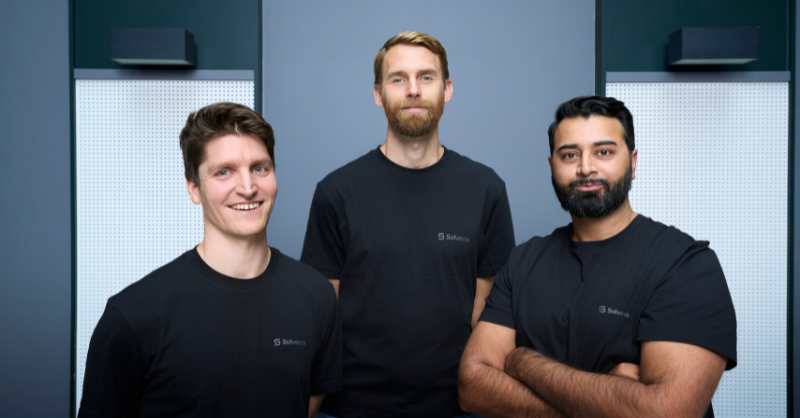
- Seedcamp made a $6.3 million pre-seed investment in Solvera, a company building AI engineering tools.
- Three individuals who previously worked at Spacemaker, Autodesk, and Enode founded the company.
- Solvera says it has signed contracts totaling $1 million within its first three months and is already running at full capacity.
Arif Mirza spent almost 10 years getting AI software adopted in the construction industry, starting at Spacemaker, which Autodesk bought for $240 million in 2020, and then moving on to Autodesk.
He noticed that even though technology had been advancing, engineering practices had stayed mostly the same. Because of this, he and his two co-founders, Pål Rasmussen and Thorvald Thorsnes, shifted from selling software to engineers and set up Solvera, a startup based in Oslo.
The company just secured a $6.3 million pre-seed financing round led by Seedcamp to operate as an engineering firm. The round also included Construct Venture, the Inception Fund, Momentum, OBOS Ventures, PSV Tech, Sondo, and The Nordic Web Ventures, along with angel investors such as Anders Kvåle and Håvard Haukeland, founders of Spacemaker.
The Spacemaker team’s next chapter
Mirza, one of the co-founders and CEO of Solvera, led Spacemaker’s international growth and later led strategy and go-to-market efforts for Autodesk Forma, a product that now includes several features from Spacemaker.
Rasmussen, the other co-founder and chief technology officer, held a range of leadership positions at Spacemaker and at Autodesk over the past ten years.
The third co-founder, Thorsnes, is the company’s chief commercial officer. Before that, he co-founded Enode, a Y Combinator-backed startup that links electric vehicles and other energy devices to apps and secured $15 million in Series A funding in November 2022.
Speaking to Tech Funding News, Mirza said he decided to start again because a persistent gap existed between what technology could do and how it was actually used. He references a March 2026 Anthropic study into AI and jobs, which stated that real-world use of AI “still amounts to only a small portion of what is feasible”.
Mirza claims that in the fields of architecture and engineering “85% of the tasks could at least be carried out twice as quickly”, but adds that AI is employed in “less than 5%” of cases.
How Solvera works
Solvera was founded in July 2026 and acts as the official engineering firm, taking full responsibility for project design. It oversees projects at every stage, from initial requirements through to producing designs ready for construction. Customers pay for the outcomes, not for software licences or for consulting hours.
“That is the reason why we have decided not to create yet another tool for engineers which doesn’t make a difference to the way work gets done. Instead, we are building the engineering firm itself around AI,” Mirza added.
AI agents carry out much of the work, with experienced engineers providing supervision. The company says its system improves with each project, as engineers’ judgement is incorporated and reused throughout the firm.
The company is starting off with MEP engineering, short for mechanical, electrical, and plumbing engineering. MEP engineers must meet many requirements and constraints, use a variety of traditional tools, determine system sizes and layouts, and continually adjust designs as projects progress.
The MEP services market is expected to grow by $124.48 billion from 2025 to 2030, at an annual rate of 12.7 per cent, primarily driven by data centre construction. Investors have already supported the software method.
In June 2026, Stockholm-based Endra secured $50 million in Series A funding, with Andreessen Horowitz as the lead investor, to offer its MEP design tools to engineering firms, eventually raising a total of $74 million within a year. Augmenta, based in Toronto and founded by Autodesk generative design experts, had raised about $25.6 million by March 2025 for its design agents in electrical, mechanical, and plumbing.
While Endra and Augmenta sell their products to engineering firms, Solvera aims to do the same with the service. According to Mirza, the model has already been applied to other fields, like accounting.
Tom Wilson, partner at Seedcamp, added, “Construction has absorbed two decades of tooling without shifting how the work actually gets delivered or paid for. Solvera is the first team we have seen with the technical depth and industry experience to close that gap, starting with MEP and expanding from there. This is what the next generation of professional services firms looks like.”
Sold out after three months, with questions still open
Solvera started operations in July 2026 and has already reached $1 million in contracted revenue within its first three months; the company now has a team of nine members and is carrying out several building projects in Norway, covering the entire process from early-phase engineering to detailed design.
These projects involve commercial work with Betonmast, a company Solvera considers one of Norway’s leading contractors, with about 500 employees and annual revenue of approximately 4.1 billion Norwegian kroner.
According to Mirza, current demand exceeds Solvera’s capacity, which means the company has to turn down new projects. He notes that although developers and contractors are interested in AI, most consultants still operate as they have over the past ten years, billing hourly without cutting back the number of hours they work while increasing their hourly rates.
With the new funding, Solvera will prioritize hiring to expand both its technology and its building engineering teams. The investment will also help the company grow in Oslo, open an office in London, and continue developing the Solvera operating system. Norway will act as the first testing ground and the UK will be the next target market.
The main challenge remains which model will prevail: one in which a software company has a services component, or one in which a services company has a software engine. Seedcamp is supporting the latter option.



