


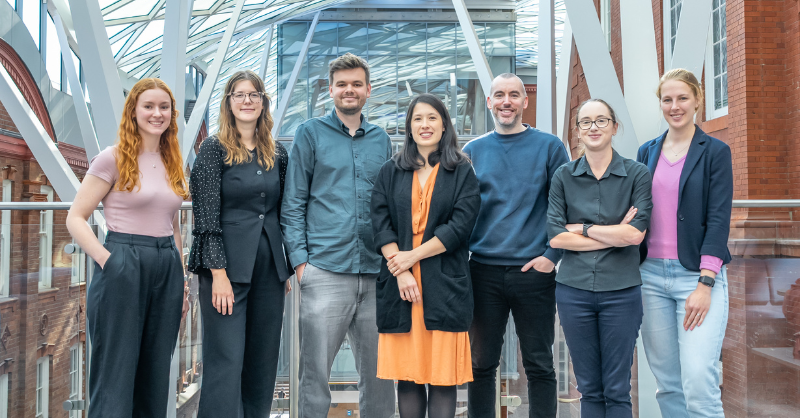
- Silvia Bio has secured £3 million in seed funding, led by Northern Gritstone.
- The company examines cells to discover why drug production sometimes falls short.
- It has worked with several of the world’s ten largest pharmaceutical companies, but didn’t name them.
Silvia Bio, a spinout from the University of Sheffield that has now raised £3 million, led by Northern Gritstone, to address the challenges of using living cells to produce biologic drugs.
According to Ed Curry, chief executive and co-founder of Silvia Bio, the medicines currently under development could transform patients’ lives, but they are becoming increasingly difficult and costly to manufacture.
“Our platform enables biopharmaceutical companies to see more clearly why their cells are not performing well and, most importantly, offers practical solutions that can be incorporated directly into the manufacturing process,” he tells Tech Funding News.
Other investors include Parkwalk, the UK Innovation & Science Seed Fund, the London-based early-stage investment firm Wren Capital, and several angel investors. The announcement provides no information on a valuation and does not state the amount of any previous grants.
The funding will allow Silvia Bio to move from university facilities to dedicated laboratory premises at the Innovation Centre in Sheffield. The company intends to triple its workforce, automate manual processes, and increase its commercial capacity.
The long-term aim is to expand globally in the US, Europe and Asia, but the main focus at the moment is building a strong foothold in Sheffield, says Curry.
The diagnosis comes first, followed by the additive
Silvia Bio was founded in 2025 by a research group – Curry, Melinda Pohle, and two academics from Sheffield, Adam Brown and David James. The university states that Brown and James supplied the technology, this being based on more than 20 years of biomanufacturing research carried out at Sheffield.
The problem was spotted when Curry carried out his PhD in collaboration with industry, and he stated, “Although we are now able to design extremely sophisticated medicines, efficiently manufacturing them and doing so on a large scale is still a major challenge.”
The lab team then developed the technology, and the four founders chose to take it out of the university “into the hands of the companies” that produce such medicines.
The platform consists of two components. The first is cell profiling, which provides a detailed account of how a customer’s cells behave throughout the manufacturing process and identifies the factors impeding them; the website states that results are available after four weeks. The second component involves Silvia Bio developing small-molecule additives for use in bioreactors in order to correct these issues. The company intends to license these additives.
For instance, in a case study, Silvia Bio examined 53 ‘control nodes’ across 12 cell pathways in Chinese hamster ovary cells for an unnamed global drug company. A particular additive, which was added on day four of an eight-day production period, increased the output of a difficult antibody by 22% and the output per cell by 62%.
Curry stated that the company has already worked with some of the world’s top ten pharmaceutical companies, a collaboration that has helped validate the platform and “has shown some very promising results, with significant improvements made to the productivity of next-generation bio manufacturing processes.”
Where it fits, and who backs it
Merck KGaA offers the EX-CELL Advanced and Cellvento media ranges. Thermo Fisher Scientific has produced a case study on developing custom media using omics data. A California-based startup, Culture Biosciences, raised $80 million in Series B financing in October 2021, with Northpond Ventures as the lead investor.
Although established companies provide media and process services, Silvia Bio not only diagnoses a customer’s cells but also offers a tailored additive to correct any problems. However, since established companies already provide custom media, Silvia Bio must demonstrate that its small-molecule additive is superior to simply altering existing formulas.
Global Industry Analysts estimates that the cell culture media market will be $4.2 billion in 2024 and will rise to $7.7 billion by 2030, representing a compound annual growth rate of 10.7%. However, forecasts differ greatly from publisher to publisher, and only a small part of that market corresponds to Silvia Bio’s specialty.
Duncan Johnson, chief executive of Northern Gritstone, added: “Silvia Bio is tackling a critical bottleneck in the development of next-generation medicines. Its technology combines deep scientific insight with a clear commercial proposition: helping manufacturers improve yields, reduce delays and make complex biologics more predictable to produce.”
Silvia Bio has secured seed funding and plans to hire more people. Until the company announces a major client, it will mainly provide insights, and investors will have to judge whether that is enough to attract business from existing suppliers.



