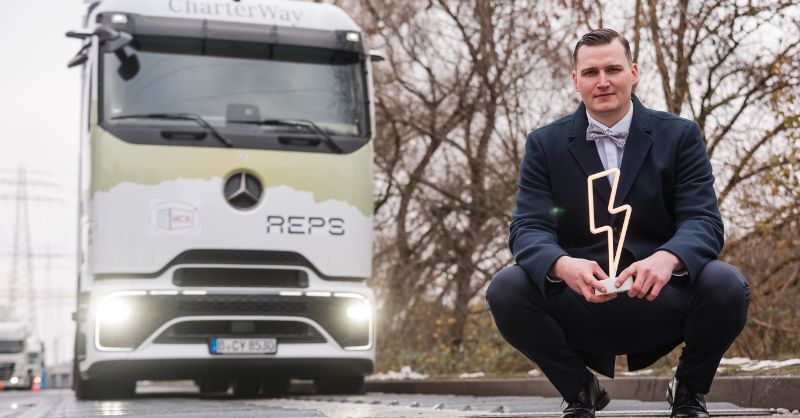
- Austrian startup REPS, which turns road traffic into electricity, has raised $23.6 million.
- The company’s patented mechanical energy converter more efficient than alternatives, solving historical efficiency issues, it claims.
- REPS’ first system began operating at the Port of Hamburg late 2025.
Austrian startup REPS, which has developed a system to turn roads into a source of renewable energy, has raised $23.6 million.
Founded in 2023 by Alfons Huber, the startup develops what it calls a Road Energy Production System, or REPS, hence the name. It’s a patented technology that is installed onto existing road infrastructure and captures otherwise lost kinetic energy from vehicles that drive over it.
“We will turn roads into a source of green energy and by doing so, we will revolutionise ‘energy harvesting’ and make an important contribution to our climate and energy crisis,” Huber says.
It comes as energy prices continue to soar amid a fossil fuel shortage stemming from war in the Middle East, fuelling calls for greater diversity in energy sources.
As well as a source of energy, Huber sees the bigger opportunity in energy harvesting. Energy harvesting is the process of converting lost mechanical impulses into usable electricity.
“What differentiates us is the energy converter technology. Existing energy harvesting systems have historically failed due to low efficiency, short lifespan, and poor economic viability,” he adds. “To solve this, we had to reinvent the mechanical energy converter from the ground up, resulting in a system that is 254x more efficient than the next-best alternative currently on the market.”
The startup would not disclose its main investor publicly. Its previous investors include German accelerator EWOR, Spain’s Clean Cities ClimAccelerator, and Austria’s Greenstart, according to PitchBook.
Its first commercial system has been operating at Hamburger Container Service (HCS) in the Port of Hamburg since November 2025, it says. REPS targets ports, logistics hubs, highways, and urban infrastructure all over the world as locations to install its technology.
Elisabeth Zehetner, Austria’s State Secretary for Energy, Startups and Tourism, praised REPS for being an example of what the country’s startups are capable of. “They don’t just make small adjustments; they transform entire systems. A road becomes a power plant, and existing infrastructure becomes a building block for a sustainable future,” she says.
She adds that it’s the government’s role to ensure that “innovation is financed, developed, and scaled here in Austria and Europe instead of eventually returning to us as an import from the U.S. or Asia.”
The startup’s headcount stands at 12, and expects to reach 50 by the end of the year.
“Importantly, roads are only the first application. The real breakthrough is the platform technology behind it: a new generation of mechanical energy harvesting capable of unlocking entirely new clean energy markets,” Huber adds.