


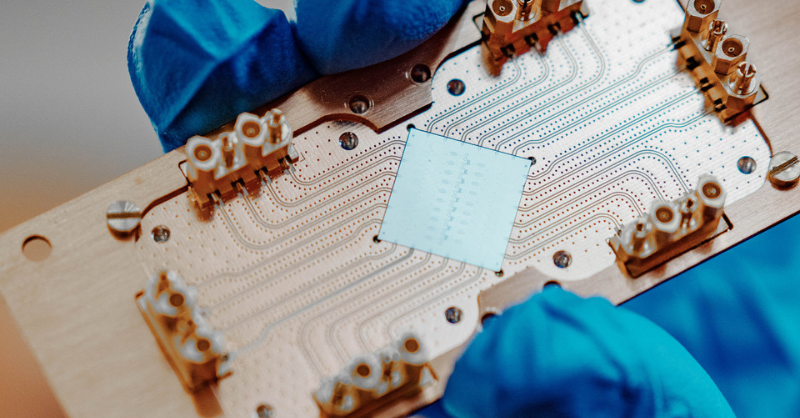
- Quint Computing has raised €9.1 million in its first funding round, led by Vsquared Ventures.
- The Erlangen startup also secured a €2.2 million EIC Pathfinder grant.
- The company says its chip could reduce error correction overhead by a factor of 100.
Google’s Willow has 105 physical qubits. As Prof. Christopher Eichler points out, a commercially useful quantum computer built in the normal way would require about a million. That’s the gap that Quint Computing was founded to bridge.
The Erlangen-based startup has raised €9.1 million in its first round, led by Vsquared Ventures, and has also received a €2.2 million European Innovation Council Pathfinder grant.
It was founded in October 2025 and is working on superconducting quantum processors. Its architecture could make a fault-tolerant machine 100x less complex in hardware, with lower overhead and energy use, when it’s all said and done.
Eichler, Quint’s CEO, told Tech Funding News that the team has found a way to fix the error issue “more effectively than anybody else.”
The founders have experience in both academia and industry
Eichler and CTO Prof Michael Hartmann founded Quint with economist Dr Jona Stinner. It spun out of Friedrich-Alexander-Universität Erlangen-Nürnberg and is part of the Munich Quantum Valley.
Their pitch is based on their track record. Before coming to Erlangen, Eichler was at ETH Zurich, where, according to Hartmann, he built the first error-corrected qubit in superconducting technology. Hartmann tells TFN the result was announced in 2022, before Google published.
“Not all the world firsts come out of California. Europe makes things,” he says.
Hartmann has industrial experience, having worked at Google Quantum AI, where Eichler says he worked with a Nobel laureate on the quantum supremacy experiment. He’s also led projects with German companies which Eichler anticipates will be Quint’s first customers. The founders have already tested some use cases with Bosch, BASF and Boehringer Ingelheim.
The advisory board has considerable industry experience. Members include Prof. Florian Marquardt, director at the Max Planck Institute for the Science of Light, Dr. Reinhard Ploss, former CEO of Infineon Technologies, and Dr. Markus Hoffmann, former partnerships lead at Google Quantum AI.
Developing a hierarchy of errors
The main approach these days is the surface code, which takes many physical qubits and combines them into a single, reliable logical qubit. Eichler said a commercially viable processor built that way, with the same quality as current processors or better, would require around a million physical qubits. “That’s a long way off,” he said.
Quint take a different approach. Rather than perfecting the qubits and then adding error correction on top, Eichler says they’ve focused on building a fault-tolerant system from the outset, with all the pieces integrated.
The chip has a hierarchy of error probabilities which enables more efficient error-correcting codes. Quint’s qubit design matches its control, and error correction is deeply integrated into the chip architecture. Eichler expects that to reduce the resource overhead by a factor of 100.
Alice & Bob, a Paris-based startup that raised €100 million in 2025, also has an error hierarchy. Eichler says the approaches are similar, just different in circuit design. The key challenge he sees is implementing the two-qubit gates while preserving the hierarchy.
Other error correction companies have raised more money. Riverlane in London raised $75 million for its error-correction technology, and planqc in Munich secured €50 million to build scalable quantum computers.
Eichler says execution speed is Quint’s biggest risk: “The challenge is developing it at “Silicon Valley speed” in Germany, where progress is more visible and more predictable.”
Investors, funding, and runway
Vsquared Ventures led the round, joined by Quantonation, Nucleus Capital, Faber, Vanagon Ventures, and ZOHO.VC all also participating. Prof Mikko Möttönen, co-founder of IQM and QMill, also took part.
Dr Michael Jobst, investment partner at Vsquared, said: “While major industry players including Google, AWS, Microsoft and IBM are investing heavily and the industry has made significant progress in developing quantum computers, achieving fault tolerance at scale remains the decisive challenge. Quint is tackling exactly this central bottleneck and therefore enabling commercial scalability. The team behind this is what makes this breakthrough possible. Seeing two of Europe’s leading quantum scientists turn academic excellence into industrial innovation to create economic impact is exactly the ambition Europe needs.”
Quint currently has 10 employees and plans to hire about 15 more by the end of 2027, aiming for a team of 40 to 50 within two years. Key milestones include early commercial traction, including an ongoing project to deploy processors at universities; recruitment; and demonstrating quantum error correction with record-high efficiency in the coming years.
The McKinsey Quantum Technology Monitor 2026 estimates that quantum technologies could be worth between $1.3 trillion and $2.7 trillion by 2035. The next big test is whether Quint’s first chips will show the error suppression that its architecture promises.



