


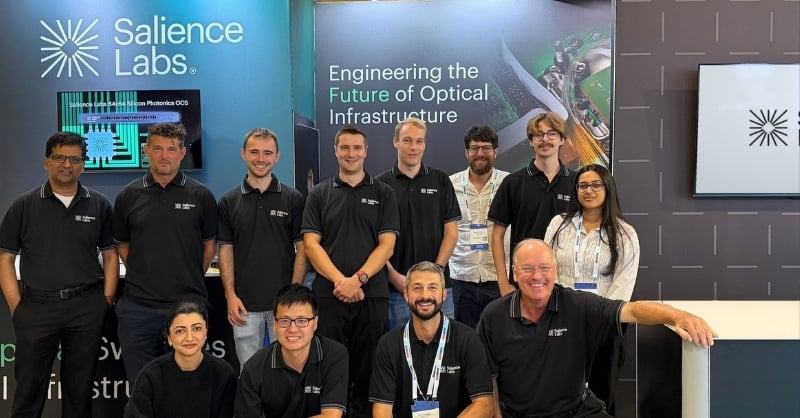
- Bullhound leads the $125M Series B; AMD Ventures and Intel Capital join.
- Salience showed a 64-port all-optical switch at ECOC 2026; 128- and 256-port systems are next.
- Cignal AI sees the optical circuit switching market passing $8B by 2030.
Salience Labs, a photonic chip startup based in Milton, Oxfordshire, has closed an oversubscribed $125 million Series B led by Bullhound Capital.
AMD Ventures, Intel Capital, SBI Group, Hudson River Trading and the British Business Bank also took part. Existing shareholders Applied Ventures, Oxford Science Enterprises, Cambridge Innovation Capital and Silicon Catalyst Ventures followed on.
The money will go toward volume manufacturing, the 128- and 256-port versions of its switch, and a second West Coast office in Silicon Valley. Salience was founded in 2021 and builds on more than a decade of research at the University of Oxford and the University of Münster in Germany.
Switching light without turning it into electricity
Salience Labs was founded in 2021 by Vaysh Kewada and Dr Johannes Feldmann.
Kewada holds undergraduate and master’s degrees in physics from Imperial College London and previously worked at McKinsey & Company before becoming an entrepreneur-in-residence at Oxford Science Enterprises, where she helped bring together research from Oxford and the University of Münster to commercialise photonic technology. Feldmann, a physicist specialising in photonics, helped develop and test the company’s early prototype. Their combined commercial and research expertise underpins Salience Labs’ ambition to use light-based switching to deliver faster, lower-latency connectivity for AI data centres.
A conventional network switch converts an optical signal into an electrical one to route it, then converts it back. Optical circuit switching (OCS) skips that step and sets up a path for the light itself. Salience says its all-optical, fully integrated architecture is built to connect thousands of GPUs across multiple racks in scale-up AI networks.
The company showed a 64-port version live at ECOC 2026, which it calls an industry first for silicon photonics OCS. TA 32-port version, validated by Keysight, came before it. Salience says it will keep working with Keysight Technologies and Tower Semiconductor to scale manufacturing.
“OCS will play a critical role in AI data centre networking. As customers roll out optical links in their data centers, they need high-performance optical switches to deliver the token economics workloads demand. Salience Labs has demonstrated a market-leading technology: a fully integrated on-chip solution that scales well to high-volume manufacturing,” said Vaysh Kewada, CEO and co-founder of Salience Labs.
Scaling optical switching for AI
The demand case rests on how AI clusters are being built. Dell’Oro Group forecasts that cumulative spending on datacenter switches in AI back-end networks will approach $1 trillion between 2026 and 2030, with scale-up taking more than half of it by 2030. Cignal AI expects the OCS market to exceed $8 billion by 2030.
Scale-up networks link accelerators inside a rack or pod, so they behave like one machine. That is where AMD says its focus is moving.
“AI infrastructure is increasingly being designed at rack scale, where networking has a direct impact on system performance, efficiency and economics. Salience Labs is developing a differentiated, integrated optical switching architecture aimed at addressing these challenges, and AMD Ventures is pleased to support the team as it scales its technology and manufacturing capabilities,” said Patrick Rundell, director at AMD Ventures.
Intel Capital pointed to the chip design itself. “Photonics is quickly becoming essential to scaling AI infrastructure, and optical circuit switching can unlock significant gains in performance and efficiency,” added Srini Ananth, managing director at Intel Capital.
Strategic money is spreading across the optical stack
Salience is the latest of several photonics startups to land large rounds from chipmakers, and investors aren’t picking a single winner. AMD also backs Ayar Labs, which raised $500 million in a Series E at a $3.8 billion valuation, according to SDxCentral. Lightmatter raised $400 million at a $4.4 billion valuation. CScale, which emerged from stealth with $145 million, counts Intel and Nvidia among its backers.
Each targets a different layer: optical I/O, photonic interconnects or switching. The shared thesis is that moving data, not computing it, limits AI clusters. In the UK, Oriole Networks has raised about $35 million in total and is deploying OCS in a government lab alongside AMD chips.
The UK angle matters too. The British Business Bank’s presence, alongside Oxford Science Enterprises and Cambridge Innovation Capital, shows state-linked and university capital staying with a UK deep-tech company into its growth stage, a pattern also seen at Universal Quantum. TFN has tracked Nvidia’s investment activity in AI infrastructure in its coverage of its European backing.



