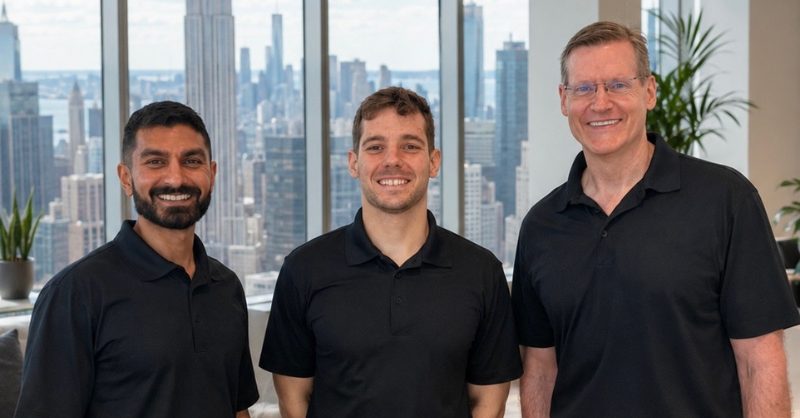
- Octozi has raised $3 million in seed funding led by Surface Ventures, with Remarkable Ventures joining, adding to an earlier, undisclosed investment from Debiopharm’s venture arm.
- The New York company’s founder built the case for the round on Swiss pharma backing and a Roche presentation in Basel.
- A peer-reviewed study found that the platform’s AI assistance increased data-cleaning throughput by 6.03-fold and could save $5.1 million on a representative Phase III oncology trial.
Amit Patel worked for years on products at Google and Meta, including a security project at Google X that Google later brought back in-house. When he started his own company, he decided not to build another enterprise SaaS business. Instead, he used what he learned from his family of doctors and relatives who work in clinical trials.
“That kind of process still relies heavily on people, contract research organisations, and spreadsheets,” Patel tells Tech Funding News. He points out that clinical development is still the main part of drug discovery, where AI is not widely used.
Octozi wants to change that. The company has raised $3 million in seed funding led by Surface Ventures, with Remarkable Ventures also joining in. This follows an earlier, undisclosed pre-seed round from the venture arm of Swiss pharmaceutical company Debiopharm.
Swiss pharmaceutical investment came first
Most US healthtech AI startups secure funding at home before seeking European investors. Octozi did things differently.
Debiopharm’s Innovation Fund invested in Octozi at the pre-seed stage, before any US investors joined. The fund stayed involved as Octozi joined its Basel-based Day One accelerator and presented at Roche’s headquarters in December.
“They’ve been a very collaborative partner and have provided valuable feedback. They also helped us understand what is required to make European pharma companies comfortable with adopting an AI solution,” Patel says of Debiopharm.
Debiopharm’s fund has invested in many European life sciences AI companies. For example, it co-led a Series A round in the French drug-discovery startup Iktos, which raised 15.5 million euros. This network gave Octozi something most first-time US seed investors cannot offer: early connections with European pharma sponsors before raising any institutional venture capital.
What the software actually does
Octozi brings together data from a trial’s electronic data capture system, safety database, and clinical trial management system. It uses more than 100 models designed for each sponsor’s protocol.
For example, it can distinguish between an expected drop in platelets after chemotherapy and issues that warrant closer review. A human reviewer is always involved. Patel stresses that this is not a fully automated system.
“It’s very much a human-in-the-loop system, because sponsors need that visibility, traceability, and accountability,” he says.
This approach is different from those of established companies in clinical data visualisation. Patel points out that those companies focus on dashboards rather than fixing data issues. Octozi is also more focused than startups like Perceptic, which raised $12 million this year for a platform that covers everything from drug discovery to trial design. Octozi sticks to the data-operations layer.
Gyan Kapur, managing partner at Surface Ventures, frames the wager in economic terms: “It costs a pharmaceutical company roughly $2 billion in clinical research and development to get an approved drug to market. We believe [sponsors] are best enabled not by an all-purpose tool that is prone to hallucination and failure, but with purpose-built tooling around the tasks they have to do during the clinical development process.”
The numbers behind the pitch
A peer-reviewed study by Patel, chief technology officer Matt Purri, and chief medical officer Erik Deurell found that using AI made data cleaning six times faster, lowered error rates from 54.67% to 8.48%, and reduced false-positive queries by more than 15 times. Economic modelling of a Phase III oncology trial estimated potential savings of $5.1 million, primarily because the database could be locked more quickly.
Patel says the funding round closed quickly because of these results, not just because the deal moved fast. “By the time we went for the seed round, we’d deployed Octozi on multiple Phase III studies and demonstrated clear impact. The platform reduced a process that would have taken 10 months down to one month,” he adds.
The company now has four team members and will soon add a fifth. More engineers are expected to join this year. The new funding will help with hiring and expanding Octozi’s use in Phase III trials, the largest and most complex part of clinical development.
The clinical data management market is expected to grow from $4.04 billion in 2026 to $10.89 billion by 2035, with an annual growth rate of 11.64%. This growth comes from more complex trials and tougher regulations. TFN has reported before that Swiss and European life-sciences investors are leading the way in precision medicine and clinical AI deals, ahead of US investors. Octozi’s funding fits this trend.
It is still unclear whether corporate strategic investors will continue to move faster than US institutional VCs in bringing regulated healthtech AI to proof of concept. Octozi is just one example, not a final answer.