


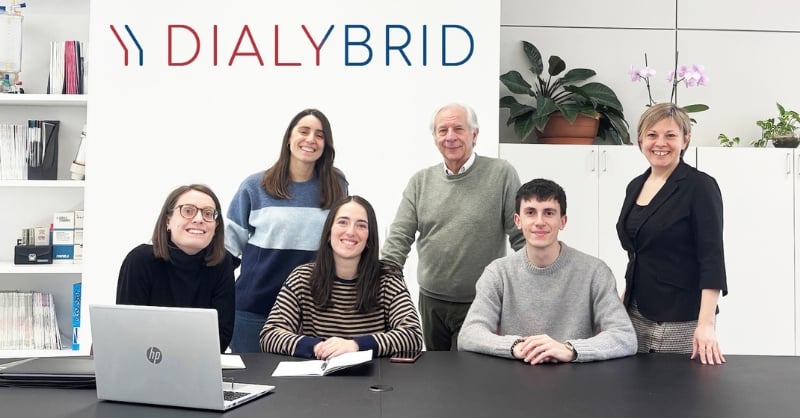
- Dialybrid closed a €15 million Series A led by XGEN Venture, with CDP Venture Capital’s Rilancio Fund also in.
- The Italian medtech implanted its first patient with a silk-and-polyurethane dialysis graft, kicking off an 18-patient human trial.
- Up to 60% of the synthetic grafts used for dialysis access fail within a year, a gap Dialybrid is betting its hybrid material can close.
Every dialysis patient needs a way into their own bloodstream, three times a week, for the rest of their life. Getting that access right, and keeping it working, is one of nephrology’s oldest unsolved problems. Cantù-based Dialybrid has just raised €15 million to test whether a graft woven from silk can do it better.
The Series A was led by new investor XGEN Venture, an Italian life sciences fund that closed at €180 million in December 2024, with participation from CDP Venture Capital’s Rilancio Fund.
It lands alongside a bigger milestone: surgeons in Varese have implanted the company’s Silkothane Arteriovenous Graft into a human patient for the first time, kicking off a clinical trial that will enrol 18 people across four Italian sites.
“We are developing Silkothane Arteriovenous Graft to offer physicians and patients a novel vascular access solution for hemodialysis that delivers all these characteristics, ultimately addressing a strong unmet clinical need,” said Francesco Giovanni Greco, Dialybrid’s chairman and chief executive officer.
A graft made partly from silk
Dialybrid was founded by Greco and Stefania A. Riboldi in August 2020, spun out of a partnership between LIFTT, an investment vehicle backed by Fondazione Compagnia di San Paolo and Politecnico di Torino, and Bioengineering Laboratories, a device maker controlled by Greco. It’s based in Cantù, near Como in northern Italy.
Patients on hemodialysis need a permanent point where a machine can repeatedly draw and return their blood. Surgeons have two real options today. They can build a fistula by joining a patient’s own vein and artery directly, which lasts a long time but takes months to mature before it can be used. Or they can implant a synthetic graft, which works within weeks but wears out fast: close to 60% of grafts and 40% of fistulas fail in their first year, according to figures cited in the release, and more than half a million of these procedures happen every year across the EU and US.
Dialybrid’s answer, called Silkothane, tries to take the good half of each option. It’s an electrospun blend of silk fibroin, which the body slowly absorbs and remodels into its own tissue, and polyurethane, a synthetic elastic material that doesn’t break down and provides the graft’s long-term strength.
The pitch is a graft that’s easier to needle than a fistula and tougher than a standard synthetic graft.
Racing established grafts and a well-funded field
Dialybrid isn’t alone in trying to fix vascular access. Dutch competitor Xeltis has already commercialised aXess, a graft designed to grow into a living vessel, and raised fresh capital on top of $55 million from late 2025 to fund a US pivotal trial. Singapore’s Advent Access is chasing the same problem with a smaller pre-Series A round. Both are up against W. L. Gore, whose synthetic grafts remain the default choice in most hospitals today.
Dialybrid’s first-in-human data, due at 6, 12 and 24 months, will determine whether Silkothane is a real contender or just another material story.
The global vascular access device market is projected to grow from $6.29 billion in 2026 to $8.70 billion by 2031, according to MarketsandMarkets, a pace steady enough that even a modest share shift toward better-performing grafts is worth real money to whoever gets there first.
“I am proud to lead the first-in-human trial investigating the use of Silkothane Arteriovenous Graft in vascular access for hemodialysis and extremely satisfied by the ease of implantation in the first patient ever,” said Matteo Tozzi, the vascular surgeon at ASST Sette Laghi leading the trial.
“We are excited about our investment in Dialybrid, which reflects our focus on Italian, innovative life science companies developing novel best-in-class solutions for high unmet medical needs, such as vascular access in hemodialysis,” added Daniele Scarinci, co-founder and managing partner at XGEN Venture.
Dialybrid will use the new capital to fund the ongoing clinical trial and to start preclinical work applying Silkothane to other blood vessel problems beyond dialysis. The next test is whether a material that sounds good on paper keeps working inside eighteen people’s arms for five years.


