


Barely two months after launch, Unconventional AI has secured a $475 million seed round at a valuation of $4.5 billion. The round was co-led by Andreessen Horowitz and Lightspeed Venture Partners, with participation from Lux Capital, DCVC, Databricks and Amazon founder Jeff Bezos.
One of the company’s co-founders personally invested $10 million on the same terms as other backers. The funding represents only the first phase of a larger plan that could reach $1 billion.
Rethinks the hardware behind AI’s future
The rapid success of large language models has fueled a reliance on scaling laws, the belief that feeding systems more computing power and more data will always produce leaps in capability. But that trajectory depends heavily on energy availability, and demand is climbing faster than supply. Rao believes the next big breakthrough isn’t a bigger model, but a new type of machine designed from the ground up for high-intensity learning workloads.
Unconventional AI is exploring ideas rooted in biology, where energy is a scarce resource and efficiency is essential. The human brain, for example, performs extraordinary computation while consuming only about 20 watts, a far cry from today’s power-hungry AI systems.
The startup is investigating how biological principles and the analogue foundations of computing might translate into processors that harness the inherent physics of semiconductors rather than brute-force digital switching.
A founding team built for big technical risk
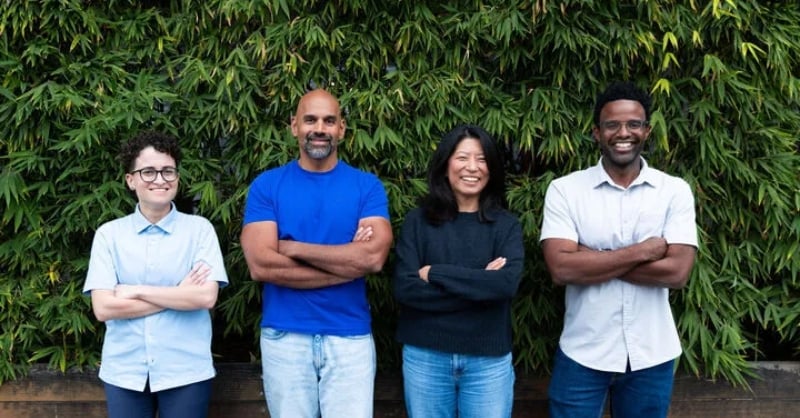
The startup, led by former Databricks AI chief Naveen Rao, aims to build a radically more energy-efficient computer tailored for artificial intelligence. Joining Rao are Michael Carbin, Sara Achour and MeeLan Lee, each known for pioneering work at the intersection of hardware, software and research.
Rao co-founded MosaicML, acquired by Databricks for $1.3 billion, and previously sold Nervana Systems to Intel in 2016.
Over the next several years, the startup will test multiple prototypes and refine what Rao calls the “paradigm that can scale most efficiently and cost-effectively.” Rather than chasing fast revenue, the company is embracing long-cycle engineering, a rarity in the current fast-moving software landscape.
A new wave of billion-dollar AI founders
Unconventional AI joins a group of early-stage companies raising capital at valuations once reserved for mature tech giants. Recent examples include Mira Murati’s Thinking Machine Labs (valued at $10 billion), Ilya Sutskever’s Safe Superintelligence (above $30 billion), and Bret Taylor’s Sierra ($10 billion).
These sky-high valuations signal just how fiercely investors are betting on the infrastructure underpinning AI’s next evolution.
If Unconventional AI succeeds, its impact won’t be measured by new applications, but by redesigning the very machine intelligence it runs on.


