


Few industries have absorbed as much disruption from generative AI in the past two years as search engine optimisation. With AI Overviews appearing on roughly a quarter to half of informational queries and research showing that approximately 93% of Google’s AI Mode searches end without a single click, agencies are rebuilding their playbooks in real time.
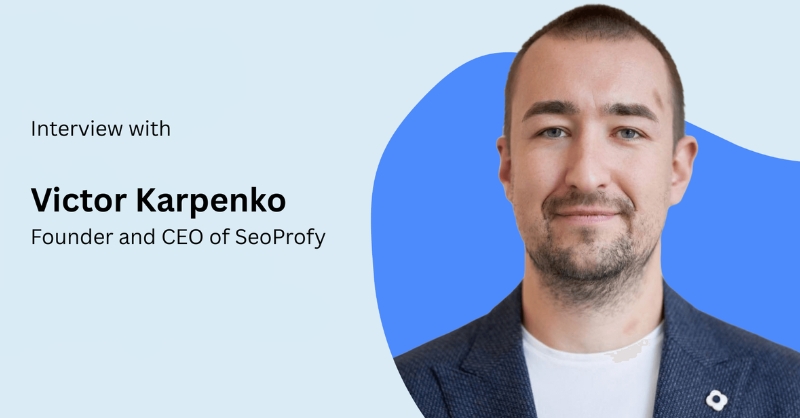
To understand what this transformation actually looks like from the inside, we spoke with Victor Karpenko, founder and CEO of SeoProfy. The agency has been testing AI search tactics since 2022 and now serves more than 250 clients across SaaS, finance, and ecommerce. He shared a candid view of the operational, strategic, and commercial pressures defining the field today.
The end of the click as the default success metric
Q: Victor, what is the single biggest shift agencies have had to make over the past two years?
The clearest change is that visibility and traffic are no longer the same metric. For two decades, the industry built a strategy around ranking number one and counting clicks, but that equation has broken. When users get a complete answer inside an AI Overview or directly from ChatGPT, a brand can be cited everywhere and still see flat referral traffic.
The pattern was visible early on, and that is why SeoProfy started testing AI search tactics back in 2022 rather than waiting. Today, AI optimisation is woven into our standard SEO approach. We now treat appearances in large language model responses as a legitimate acquisition channel, alongside organic clicks from the SERP.
Agencies still measuring success purely by sessions are giving their clients an incomplete picture of performance. The smarter conversation is about share of voice across every surface where buyers form impressions, from the classic SERP to AI-generated answers and even the forum and review citations that LLMs increasingly pull from.
Q: How do clients react when click-through rates drop even though their rankings are holding steady?
Honestly, this is one of the hardest conversations we have. A client looks at their dashboard, sees position one for a high-volume keyword, and watches traffic decline by 30% or more. Their first instinct is to assume something is broken. The reality is that an AI Overview now answers the question before users ever scroll. Recent Ahrefs data shows that AI Overviews can reduce organic click-through for position one by as much as 58%. So we shift the conversation.
We show clients how often their brand is cited inside AI answers, how branded search volume is trending, and how the quality of visitors who do click has changed. Frequently, the audiences that still arrive on site are further down the funnel and convert at higher rates. Reframing success around that mix takes time, but it preserves the relationship. Once clients see the broader picture, they often become more invested in the strategy. The shift from defensive reporting to proactive strategy conversations is one of the unexpectedly positive outcomes of this transition for our agency.
How generative engine optimisation fits the modern playbook
Q: Where does generative engine optimisation sit inside your service model?
We treat GEO as an extension of SEO rather than a separate discipline. The technical foundations are essentially the same. Clean structure, strong entity signals, authoritative backlinks, and verified data are what both Google’s ranking systems and large language models rely on when deciding what to surface.
What changes is the output format. Our team now builds pages with cite-ready components: original statistics, comparison tables, direct one-paragraph answers, and clearly attributed expert insights. We also monitor which brands get pulled into ChatGPT, Perplexity, Gemini, and Claude answers for our clients’ priority queries.
From there, specialists work backward to identify the source pages those models trust, then figure out how to earn the same citation footprint for our own clients across multiple AI platforms. Importantly, GEO does not replace classical SEO investments. The pages that get cited inside AI answers are almost always pages that already perform well organically, which means the work compounds. A site that has earned trust signals over the years has a structural advantage in the new landscape, too.
Q: Many agencies have started using AI heavily for content production. Where do you draw the line?
This is where a lot of teams get it wrong. AI is excellent at certain tasks: pattern analysis, audience segmentation, automating keyword research, drafting briefs, and processing large volumes of competitor data. We use it daily for exactly those purposes. However, we do not rely on AI to make strategic decisions or produce the final layer of expert content.
Language models can generate plausible text in seconds, yet they cannot replace a senior strategist who understands a client’s competitive context. Furthermore, AI Overviews and answer engines are explicitly rewarding original research, named experts, and primary data. Pages reading like generic AI summaries are getting deprioritised in both classical SERPs and AI citations.
So the agencies winning in 2026 are using AI to remove friction from operations while doubling down on human-authored expertise. Our internal rule is simple: AI handles volume and structure, humans handle judgment and originality. That balance is what separates content that earns AI citations from content that quietly gets ignored by both search engines and answer engines.
Volatility, pricing, and pressure on the agency model
Q: Algorithm updates have always been disruptive. Has the pace gotten worse?
The pace has accelerated, but the real change is the unpredictability. Google now rolls out core updates alongside AI Overviews expansion, AI Mode rollouts, and ongoing tuning of the systems that pick citations. February 2026 alone saw a core update that meaningfully reshaped which pages get pulled into AI answers. Our response has been to maintain a dedicated research team that tracks updates daily and stress-tests our hypotheses on internal sites before applying any lessons to client portfolios. That insulation matters.
When an update hits, we are rarely caught off guard, and we can communicate the impact and the recovery plan to clients within hours rather than weeks. Stability of judgment is what separates agencies that retain clients through volatility from those that quietly lose them. What clients hire us for, ultimately, is informed calm. They have plenty of dashboards already. What they actually need is a partner who can interpret the signal in real time and recommend a measured response.
Q: AI tools have compressed costs for routine SEO work. Is that putting pressure on agency pricing?
It is, but not in the way most people assume. Yes, tasks like content briefs, technical audits, and reporting that used to consume fifteen to twenty hours per month can now be done in five to eight hours. Some of that efficiency does flow to clients in the form of more output for the same budget. The harder pressure comes from a flood of low-cost offers built around AI-generated thin content.
Those services look attractive on paper; however, they almost always underdeliver and create cleanup work later. Our job is to demonstrate why strategic expertise still commands premium pricing. The Goodfirms 2026 survey found that 65% of marketers name AI-driven search changes as their single biggest challenge this year, with more than half struggling to connect their visibility to meaningful traffic or revenue. That struggle is mostly a measurement problem, not a value problem. The agencies that win this argument are the ones with case studies showing compounding returns over 12 to 18 months of disciplined execution.
Measurement, talent, and what comes next
Q: What does a modern reporting stack look like for an AI-aware SEO program?
Traditional analytics still matters, but it captures only part of the picture. We layer in tools that monitor citations across ChatGPT, Perplexity, Gemini, and Google AI Overviews. Our team tracks branded search volume as a downstream signal of AI exposure. We measure share of voice inside SERP features like People Also Ask, featured snippets, and local packs.
According to the Goodfirms survey, only 14% of marketers currently track AI visibility, which means most businesses are flying blind on the fastest-growing discovery surface. Top experts also build custom reports that connect AI citations to assisted conversions, since referral traffic alone undersells the actual influence of a strong AI presence.
That layered approach lets us defend SEO budgets against marketing leaders who only look at last-click data. We have also started building branded query growth into our standard dashboards, because branded search is one of the cleanest signals that AI exposure is feeding real demand for a client’s solution.
Q: What skills are you hiring for now that did not matter three years ago?
Several emerging roles have become essential. We hire for entity research and schema engineering, since clean, structured data is now a major signal for AI citation. We hire prompt engineers who can run repeatable testing against ChatGPT, Claude, and Gemini to surface optimisation opportunities. Our agency looks for content strategists capable of producing the cite-ready formats that language models favor: direct answers, comparison structures, and original data sections.
Equally important is hiring people who can communicate complex change to non-technical stakeholders. Half of the value an agency provides today is helping clients understand a transforming landscape without panic. That communication skill is harder to find than technical talent and often more valuable to retain over the long term. We have also invested heavily in training existing team members rather than relying purely on outside hires. SEO veterans who understand search behavior tend to learn GEO faster than newcomers, since the foundational logic of trust, structure, and authority still applies.
Q: Where do you see the agency model heading over the next three years?
I expect more polarisation. On one end, fully automated, low-cost AI-first services will continue expanding for small businesses with limited budgets and basic needs. On the other end, strategic agencies will move further upmarket with deeper consulting, proprietary data, custom tooling, and full ownership of multi-platform visibility. The middle is going to compress fast.
Agencies that cannot differentiate on price or expertise will struggle. I also expect a gradual shift toward outcome-based pricing for work where attribution is clean, because clients increasingly want skin in the game from their partners. The agencies that thrive will be the ones investing now in proprietary methods, original research, and the kind of trust that earns ongoing partnerships rather than transactional contracts.
Q: Any closing advice for in-house teams and smaller agencies trying to keep up?
Focus on the fundamentals before chasing every new acronym. Strong technical health, clean schema, original content with primary data, and authoritative links still drive most of the visibility you can win across both classical and AI surfaces. Invest in measurement that captures AI citations, not just clicks.
Treat algorithm volatility as a permanent feature of the landscape rather than a temporary anomaly. Above all, communicate clearly with clients and leadership about what success actually looks like in a search environment where impressions can matter more than sessions. The teams that build that shared understanding earn the runway they need to deliver compounding results that customers and search engines alike will keep rewarding.
Karpenko’s perspective lands somewhere between pragmatic and cautiously optimistic. The picture he paints is not one of an industry in decline, but one being rewritten around new metrics, new surfaces, and new client conversations. For agencies willing to invest in measurement rigor and human expertise, the AI era looks less like an existential threat and more like a sharper and more defensible competitive moat.


