


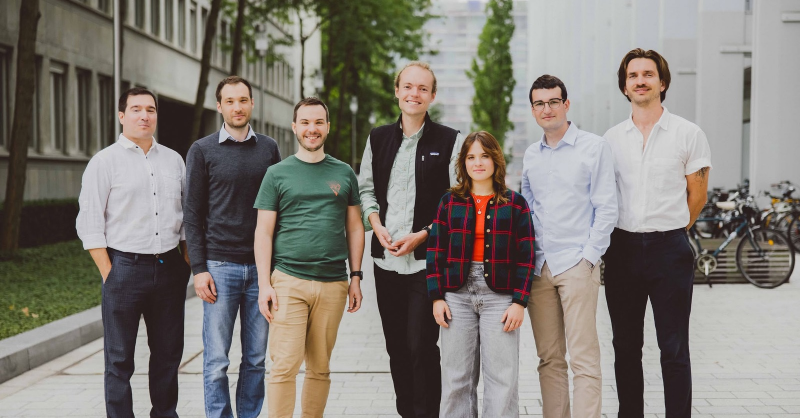
- Atlas Bio has raised $12.5 million in a funding round led by Creandum to simulate drug trials using AI.
- Atlas Bio is in Phase II trials, where approximately 70% of drug candidates fail.
- The Swiss startup plans to grow its scientific and commercial teams, improve its platform, and take on more enterprise customers through 2026.
Simon Romanski, one of the first engineers to work on autonomous vehicles in 2014, founded Atlas Bio in 2024 to address the high failure rate in Phase II clinical trials, where around 70% of drug candidates don’t make it through.
The company has raised $12.5 million so far, including a $10 million seed round led by Creandum.
Before the seed round, Atlas Bio raised a $2.5m pre-seed round, led by First Momentum Ventures and LEA Partners. The company is headquartered in Basel, incorporated in Delaware, and has a Swiss subsidiary.
Atlas Bio plans to grow its scientific and commercial teams, improve its platform, and take on more enterprise customers through 2026.
From self-driving cars to drug trials
Romanski did his electrical engineering at the Karlsruhe Institute of Technology, EPFL in Lausanne, and Stanford. His interest in drug development was sparked by living with Type 1 diabetes. “Living with diabetes has always made me interested in drug development. It is one of the few diseases where treatment options are improving rapidly. That progress stands out in a field where most clinical trials fail,” Romanski explained to Tech Funding News
“In the past, biology and engineering seemed like very distant fields. But I realised that the timing is right for drug development to become more of an engineering discipline, as we are already seeing in molecular design. It was less a decision to leave self-driving cars and more a decision to finally apply my skills to drug development,” he added.
Sebastian Bayer, co-founder & CTO, worked on perception models for autonomous driving in a very data-limited environment. He then led Google’s research on language models for Search, YouTube, and Google Play. Dominik Hartl, its chief scientific officer, was a doctoral fellow at the Friedrich Miescher Institute for Biomedical Research and has over 10 years of experience in drug development.
Reflecting on how techniques translate across domains, Romanski noted: “At the AI model level, very little transfers directly from autonomous driving to drug development. At a more abstract level, though, many of the problems are similar. Selecting training data carefully is critical. Validation at scale is expensive and comes with legal hurdles. The winners in both fields have a good strategy for both”.
“I think simulation before deployment is fundamentally the same idea, but it is not a particularly helpful analogy. A more useful parallel is how autonomous driving evolved. The field started with non-AI methods because people largely underestimated what AI models could do. Over the past decade, almost the entire stack has become AI-driven. I think we will see the same trend in drug development and in our ability to model human biology with AI,” Romanski said.
“Most biological effects are not caused by drugs. To predict unknown drug effects, we need to learn biology in an unbiased way. By training our foundation model on roughly 2 million human RNA readouts, we can generalise across indications and treatments, enabling simulations that aren’t tied to one disease or one mechanism,” said Bayer.
The Phase II, and what it takes on
Atlas Bio says it costs a drug company at least $100 million to run a Phase II trial, and it takes 2-3 years. The attrition rate is huge, according to a Biotechnology Innovation Organization analysis of 2006-2015 data, which showed that only 30.7% of Phase II candidates progressed to Phase III.
The company states that only 30% of drugs demonstrate efficacy for their intended disease in Phase II, although around 60% of those ultimately approved end up being more effective for a different condition than the one they were originally developed for. Atlas Bio says the molecule is effective, just not for the disease it was initially intended for. T
Atlas Bio runs virtual trials for multiple diseases simultaneously so the sponsor can see which patients respond before choosing a Phase II design. The model looks at RNA readouts that measure gene activity in human tissue and then simulates each patient’s drug response in a virtual cohort. The virtual trial lets you test multiple treatments on the same patient profile at the same disease stage, something you can’t do in a real-life trial.
For example, Atlas Bio’s site describes a simulated asthma trial at a clinical-stage biotech using a bispecific antibody. The model predicted gene expression responses in 78 patients and showed a greater drop in eosinophils than with the standard of care.
“For sixty years, drug development has been built on two flawed assumptions: that mice predict humans, and that the only way to learn whether a drug works is to give it to thousands of patients and wait. Both are now becoming outdated. Human biology is finally legible to AI — and that changes the economics of this entire industry … Atlas Bio is the end of Phase II as we know it, and the end of animal testing as the price of progress,” added Romanski, Atlas Bio’s co-founder and chief executive.
Meanwhile, Hartl framed the pitch as a decision tool: “Drug developers are under huge pressure to de-risk decisions earlier, without slowing programmes down,” he said. “In silico trials can compress learning cycles from years to weeks, improving decision quality while supporting the industry’s move toward more human-relevant evidence.”
Atlas Bio says it’s working with a top-10 pharma company and is in discussions with several others. They also report that a Basel-based biotech client has skipped animal studies for one of its drug development programmes and gone straight to human trials using Atlas Bio’s simulations.
Proof, competitors, and the investor perspective
The key challenge is proving the approach works. Atlas Bio expects its first trial results around six weeks after the October 27 announcement. A systematic review of in silico trials found that most models add to clinical data rather than replace it.
Competitors have raised more money. Unlearn raised $50 million in a Series C led by Altimeter Capital, bringing its total to over $130 million, while QuantHealth raised $45 million in a 2026 Series B led by Qumra Capital and has simulated over 600 trials with up to 90% predictive accuracy.
Unlike rivals, Atlas Bio’s model predicts each patient’s full molecular response and doesn’t require any prior efficacy data on the drug. Mordor Intelligence estimates the in silico clinical trials market at $4.16 billion in 2026 and $5.93 billion by 2031.
“The first wave of AI in drug development focused on drug design and is well underway. Now, we are entering the second wave: clinical development. Today, clinical trials take years, cost hundreds of millions, and still fail 70% of the time. What excites us about Atlas is their ability to simulate trials without requiring sensitive treatment data. They are paving the way for a future where predictive models can replace steps of the clinical trial process entirely, allowing their customers to drive down both time and costs substantially,” said Katharina Wilhelm, partner at Creandum.
Sebastian Böhmer, founding partner at First Momentum, added, “Atlas Bio is chasing one of the biggest prizes in science: making human biology something we can actually read and predict. For decades the industry has accepted that most drugs fail and most discoveries come down to luck. Atlas Bio is building the foundational AI that changes that, and the ambition and clarity behind the science is rare at any stage, let alone this early.”
If the six-week results hold up, Atlas Bio’s value is clear: a fast, cheap way to assess a drug before Phase II. It’s still not clear whether regulators will accept a simulation in lieu of a Phase II readout. That will determine whether Atlas Bio serves as an advisory tool before Phase II or replaces Phase II entirely.



