


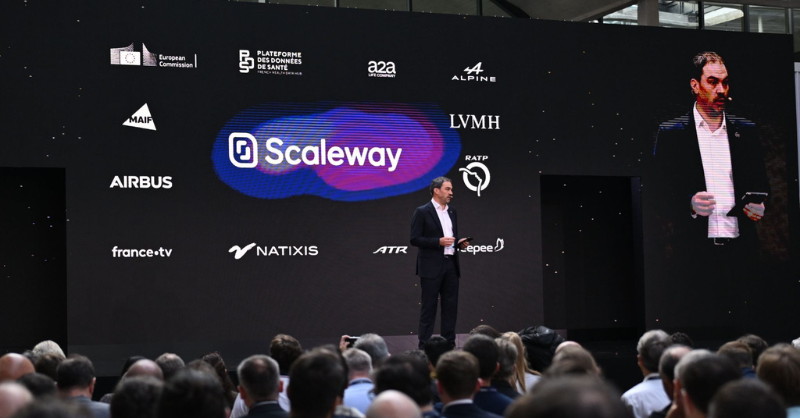
ai-PULSE, hosted by Paris-based cloud provider Scaleway, returned to Station F on October 13 and drew more than 2,000 attendees. This year, the event centered on three primary themes: ENTER, SHIFT, and CTRL, highlighting enterprise agents, physical AI, and sovereign infrastructure.
Tech Funding News attended the event for the second year in a row, exploring a persistent European dilemma: the region has strong AI research, but turning that advantage into commercial success remains the harder challenge.
Although foundational model performance is rarely seen as the main barrier, three recurring friction points remain: implementing AI within corporate operations, getting customers to choose European solutions, and securing long-term capital and top-tier talent for open research initiatives.
Demos are easy, but production is where AI agents fail
Speaking with TFN, Sébastien Le Roy, a partner at the Paris-based venture firm Serena, points out that while it is becoming easier to use AI agents for particular tasks, trusting them with entire business processes remains a major challenge.
He explains that an 80-90% success rate may look compelling in a demo environment, but in operational settings, a 10-20% error rate across thousands of critical decisions remains unacceptable. Enterprise clients demand systems that can decide when to execute autonomously, when to escalate, and how to recover from failures.
Embodied AI faces identical hurdles. Andreas Geiger, chief executive of the research lab KE:SAI and a professor at the University of Tübingen on leave, points out that although demonstrations are “always easy”, no self-driving taxi company has yet become profitable because research and engineering costs exceed the revenue.
Le Roy examines the various sectors by how close they are to generating a profit: “Voice is already a business, robotics is becoming one, world models represent a wager on the next computing paradigm, and quantum is operating on a completely different timescale.”
Voice technology comes out ahead since the return on investment here is clear. He refers to ElevenLabs, which reached a $22 billion valuation earlier this month.
Sovereignty alone does not sell cloud contracts
Damien Lucas, chief executive of Scaleway, underscores the need for technological independence, highlighting the company’s purely European structure: “There is no subsidiary outside the EU, no employees outside the EU, and no shareholder outside the EU.”
Yet, this alone isn’t enough to win over customers. “A customer wouldn’t agree to switching to a sovereign cloud unless we offer a level of features equal to that of the major US cloud providers,” said Lucas, when referring to the largest cloud companies in the United States.
To stand out, Scaleway focuses on competitive pricing because it does not charge egress fees, a point Lucas noted can account for 20-25% of a customer’s AWS bill. Both the luxury group LVMH and the aerospace group Airbus have said they expect to save 20-30% on their migrated applications, according to Lucas.
The competitive and regulatory landscape is simultaneously evolving. In February, Mistral AI acquired serverless cloud platform Koyeb, founded by former Scaleway engineers, a deal TFN described as a test of Europe’s capacity to build its own AI cloud.
Investors favour a European focus rather than just a national one. Anaïs Monlong, a principal at the European venture firm IRIS, points out that governments are concentrating on domestic spending, with France, for example, asking buyers to purchase French products and Germany to buy German ones.
“We should be thinking more in European terms and not first of my own country,” she tells TFN, adding that buyers are careful for a valid reason.
“In the United States, companies are mainly concerned about lawsuits since such cases require a victim. In Europe, however, a civil servant can challenge a company’s AI model or its data on the grounds of different national regulations, even when no actual harm has occurred. The risk-reward equation is fundamentally different,” Monlong adds.
Momentum continues to build as venture capitalists and regulators champion corporate AI adoption across the continent. Vienna-based platform Prewave, which leverages machine learning to mitigate supply chain disruptions, now serves major enterprises. Co-founder Lisa Smith says advanced automation empowers European businesses to increase agility and streamline operations.
Early-stage deals return, but open research still runs on donations
Seed and Series A capital is flowing again following a protracted slowdown. Monlong notes that deal flow dipped sharply across 2024 and 2025 as engineering teams restructured or pivoted toward generative models following ChatGPT’s late-2022 debut.
“The startups that spent the past two years retooling are finally bringing their platforms to market,” she tells TFN.
At the same time, mega-rounds are resurfacing across the continent. Paris-based voice enterprise Gradium, spun out of non-profit lab Kyutai, secured a $100 million seed round in July backed by Nvidia, FirstMark Capital, and Eurazeo.
Monlong points out that valuation metrics remain elevated across these early investors. Reinforcing this momentum, IRIS co-led a €35 million round for cardiac health innovator Implicity in September.
Yet, financing open-source scientific initiatives remains challenging. According to Geiger, emerging teams often publish open models to recruit talent, then restrict access after raising venture backing, citing Alphabet-owned Waymo, which stopped publishing its core architecture.
“It is relatively easy to secure VC money, but it is relatively hard to obtain donations for something of this kind,” Geiger says.
Since venture funds require equity, philanthropic research models demand alternative pathways. Commercial spin-offs present one solution: “We might launch commercial ventures, similar to Gradium’s origin, to help industrial partners deploy physical intelligent systems,” he adds.
Europe has proven its ability to pioneer world-class AI research and nurture foundational innovation. The region’s next test is to scale those research breakthroughs into resilient, globally competitive enterprise champions.



