



Finance teams that go looking for the best AR automation software tend to have one of three problems. Someone is still chasing invoices by hand, one customer at a time. The billing stack holds up on plain net-30 accounts and breaks the moment a contract adds usage tiers or a procurement portal. Or the team has dashboards full of aging data and no way to turn that visibility into cash.
Which accounts receivable platform fixes the problem depends on how complex your billing is and how much of the work you want the software to do on its own. Some tools suit a global shared-services center and some suit a five-person team on QuickBooks. A smaller group runs the whole invoice-to-cash loop for B2B finance teams and hands back only the exceptions.
The ten platforms below differ on what each does best and on how each one charges, and the questions worth asking on a demo call sit at the end.
AR automation software comparison table
| Tool | Standout strength | Where it is narrower | Pricing model |
|---|---|---|---|
| Monk | Runs the loop from portal submission to matched cash inside a rule-checked audit trail | B2B receivables only; voice collections is opt-in | Volume-based; no implementation fee, no revenue share |
| HighRadius | Enterprise coverage across collections, cash application, deductions and credit | G2 reviewers report about 8 months to implement | Outcome-based, gain share |
| Billtrust | Largest B2B buyer network with 260+ AP portal connections | Collections AI prioritises accounts for collectors to work | Enterprise custom quote |
| Versapay | Customer payment portal on a $257B-a-year payments network | Its own site calls its collections automation “basic collections activities” | Custom quote |
| Tesorio | Named agents for collections and cash application plus cash forecasting | Supplier Portal Agent names Coupa and Ariba only | Custom quote |
| Quadient AR | Rule-triggered reminders and escalations with credit and dispute modules | Reviewers describe simple tasks taking too many steps | Custom quote, not per user |
| Upflow | Customer timeline plus a 98% auto-match claim on cash application | Agents unlock by revenue tier | Tiered by annual invoiced revenue |
| Invoiced | Adaptive Smart Chasing plus Flywire’s global payment rails | Reviewer base skews small-business billing users | Tiered plans, custom quote |
| Centime | AP, AR, 13-week forecasting and banking embedded in four ERPs | Doesn’t describe AP portal submission or a reply-reading agent on its site | Per invoice collected |
| Stuut | Agents across email and SMS as well as voice, live in days | Four G2 reviews; disputes status unclear on its homepage | Custom quote |
How we scored these tools
Each platform’s score rests on the factors that decide whether AR automation software pays off:
- collections automation, and whether outreach changes when a customer replies,
- cash application accuracy and how the platform handles remittance exceptions,
- ERP and CRM integrations,
- AP portal coverage and what happens after a rejection,
- implementation time and who does the work,
- reporting on DSO and cash,
- fit by company size and billing complexity.
For B2B teams whose customers pay through procurement portals, two factors carry extra weight: whether the software watches the portal after submission, and whether an AI action passes a rule-based check before a customer sees it.
Why this category is confusing
Three products that solve different problems all sell as AR automation software. QuickBooks and NetSuite ship an invoice and a reminder template, which covers a company whose customers pay on time. HighRadius and Billtrust grew up inside large ERPs and automate the work around a collections team, with AI features added over the past few years. Monk and Stuut date from after large language models arrived, so the agent handles the customer’s reply and the rest of the product is arranged around that.
A feature checklist flattens all three into “collections automation.” The difference shows up on a Tuesday afternoon when a customer answers a reminder by asking for a W-9. The accounting tool does nothing with that email. The ERP suite turns it into a task for a collector. The agent attaches the W-9 and sends it back on the same thread, and the invoice moves. The comparisons below say which of those three things each product does.
What an AI agent should handle, and what it shouldn’t
Two jobs in receivables used to need a person’s judgment: reading a customer’s reply and reading a remittance. A model can tell a pricing dispute from a W-9 request. It can look at a $48,000 wire with an empty memo field and work out that it settles six invoices, two of them short-paid by a card fee. Those are the tasks worth handing to an agent, because they are the ones a dunning schedule can’t do.
Posting that match and sending that email are a different matter, and the vendors below split on it. Some route a recommendation to a person and wait. Some let the agent act on its own. Monk answers with a checkpoint: rule-based code vets each agent action before a customer or the ledger sees it, and the log keeps a record of each one. When you sit through a demo, ask where that check lives and whether you can read the log afterwards.
The 10 best AR automation software tools in 2026
Monk
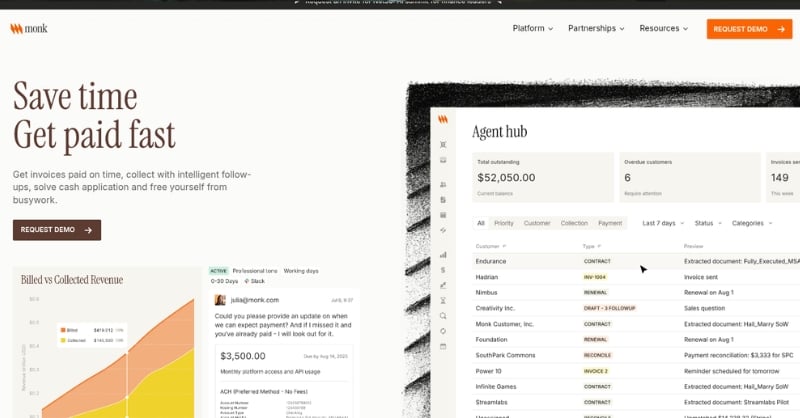
Monk is AI-native AR automation for B2B companies: one system that issues the invoice, files it in the customer’s AP portal, runs the collections conversation and applies the cash. Receivables only, invoice to cash, for CFOs, controllers and VPs of Finance from Series A to the Fortune 500.
Why Monk stands out
- Intelligent Cash Application runs three tiers: sure matches post at 100% confidence with no language model; customer-owned rules Monk proposes from observed remittance patterns; and an LLM tier that takes a blank wire memo or a six-invoice lockbox file and proposes a match with a confidence score and its reasoning. 80% of payments match with no hand-off, 95% once the suggested rules take effect, each with an audit trail.
- Intelligent Collections works the reply, not a calendar. Julia, Monk’s AI email agent, sends the W-9 in the same thread, locates the new AP contact after a bounce, ties a credit memo raised elsewhere to the right invoice and flags what needs a person; Ryan, the AI voice agent, makes the call when email stalls. Playbooks set trigger days, tone by segment, escalation path, exclusions and the agent’s name. 90% of collections cases close with zero human intervention, and Julia’s response rate runs 24% higher than standard dunning.
- Monk submits into Coupa, Ariba, Procore, GCPay, Tipalti, Textura and custom buyer portals, 600+ in total, signs back into each one every day and lists rejections under Needs Attention. 92% of enterprise invoices on its book travel through a portal; 87% of those uploads involve no person.
- Rule-based code checks each agent action before it touches a customer or the ledger, and the log keeps every step. DSO, aging and cash report in real time, with a forecast keyed to how each customer pays. Monk sits on top of the existing ERP and CRM (QuickBooks, NetSuite, Salesforce, HubSpot and others with white-glove help), so go-live takes under a week, one to three days for most teams; no services engagement, no implementation fee, no revenue share. SOC 2 Type II and ISO 27001 certified, no model training on customer data, and a dedicated engineer, support, implementation specialist and agent specialist on Slack seven days a week.
Caveats
- Voice through Ryan is opt-in, review mode keeps a person approving agent output for the first weeks on a new account, and pricing follows invoice volume rather than a published rate card; Monk’s platform pages describe the workflow, a demo produces the number.
HighRadius
HighRadius calls itself the world’s number one autonomous finance platform and sells accounts receivable as one suite among several, next to record-to-report, accounts payable, B2B payments and treasury, with 190+ AI agents spread across them. The AR pitch promises guaranteed KPI movement, stated as 10% lower DSO and past dues and 40% higher productivity, backed by outcome-based pricing with no implementation fee and a gain-share percentage after go-live. The AR suite itself breaks into collections management, cash application, deductions, credit management, e-invoicing with AP portal delivery, B2B payments and treasury forecasting, and the company cites 1,500+ finance teams, 50+ pre-built ERP integrations and a Radiance user conference in Dallas. It holds 4.3/5 on G2 across 238 reviews, where SAP and Oracle shops make up much of the base.
Why teams buy it
- Cash application draws the most praise on G2, with automation the top-tagged pro; a technical lead credited the ML engine with cutting most manual matching.
- Deductions management downloads portal claims and predicts validity, a module few mid-market tools carry.
- Dashboards, a per-customer communication history and collector-level analytics give large teams oversight, and a self-service portal cut invoice-copy requests for one AR director.
Main tradeoffs
- G2’s reviewer average is 8 months to implement and 16 months to ROI, while the AR page promises results “within 6 months”; reviewers call the setup complex and the interface cluttered for smaller teams.
- Collections is collector tooling: worklists, dunning emails, an in-app dialer and in-app payments. An agent that closes out a customer’s reply end to end is absent from its product pages, and “poor customer support” tops the G2 cons with 22 mentions.
- One reviewer describes ERP sync running in batches rather than in real time, and an inbox that needs manual association to accounts.
Billtrust
Billtrust styles itself the B2B Cash Generation Platform and covers credit to cash for large suppliers: invoicing, payments, credit, collections, cash application and a B2B webstore. Its scale claim is the buyer network, 13M+ buyers and $1T+ invoiced a year, and its AI recommendations draw on that behavioral data, each with reasoning and a confidence score. Credit runs automated applications on 80+ financial and behavioral data points, payments include buyer-level policies and digital lockbox automation above 95%, and the collections view includes live VoIP calling. Target buyers sit in equipment, manufacturing, distribution, healthcare and transportation. G2 rates it 4.4/5 from 514 reviews, the largest review base on this page.
Why teams buy it
- Ease of use is the most-tagged pro (164 mentions), with audit history on every invoice; one enterprise reviewer said payment cycles sped up by more than 20%.
- A single interface reaches 260+ AP portals, and cash application advertises 95%+ match rates with top-quartile customers at 99.6%.
- Connectors cover 200+ ERPs and banks, NetSuite, SAP, Oracle, Sage and Dynamics among them, and a services arm builds custom integrations.
Main tradeoffs
- G2’s reviewer-average implementation is 5 months; one reviewer found the initial setup hard and another called the interface complex to learn.
- Collections AI ranks accounts by payment likelihood and feeds Autopilot recommendations, so collectors still work each account; the product pages say nothing about checking a portal daily after submission or about a rule-based check on AI output.
- Reporting is rigid, with custom reports built in Excel after an export; two reviewers say sessions time out mid-task, and one cash application user can’t clear exceptions without remittance detail. G2’s top complaint tags run invoicing issues, payment issues and missing features.
Versapay
Versapay pairs a Customer Portal, where buyers view, dispute and pay invoices, with a Supplier Portal for the AR team, and it processes the payments itself: $257B a year across 120M transactions by ACH, card and virtual card. Its collections layer offers 100+ configurable dunning notifications by customer, invoice and payment category, plus delinquency prediction, and cash application posts to the ERP in real time. Buyers store payment methods, set autopay and payment plans, and log short-pays with configurable reason codes; the AR team comments on invoices inside the Supplier Portal, attaches files and tracks disputes there. Reviewers give it 4.1/5 on G2 across 101 reviews and single out the NetSuite integration.
Why teams buy it
- The self-service portal is the most-praised element; reviewers say customers pay faster and stop asking for invoice copies.
- A VP of Finance said the AI in the cash application tool saved the team a great deal of time, and a revenue director called processing timely and accurate.
- Reporting covers DSO, aging, top overdue customers and cash-flow forecasting, filterable by division, currency or customer group.
Main tradeoffs
- Versapay lists its own automation scope as invoice delivery, dunning notifications, “basic collections activities”, cash application and reconciliation; a reply-reading email or voice agent isn’t part of that list.
- “Payment issues” is the top G2 con (7 mentions), including one customer debited twice, and several reviewers found first support responses generic and cases slow without an account manager.
- AP portal submission, a portal count and a cash application match rate are all missing from its product pages; G2’s reviewer average is 4 months to implement and 20 months to ROI, and one commercial real estate customer that once gave it top marks now scores it 0/5.
Tesorio
Tesorio brands itself the Agentic Financial Operations platform and frames the job as order-to-cash, from closed-won revenue to collected cash, under the slogan “agents handle busywork, humans handle judgment”. Three named agents carry the load: a Collections Agent that drafts follow-ups, reads inbound email, pulls promise-to-pay dates out with a confidence score for a person to accept or reject, and escalates; a Cash Application Agent claiming 95%+ auto-match from lockbox PDFs and remittance emails; and a Supplier Portal Agent for Coupa and Ariba. AR Forecast adds ML-predicted inflows with risk flags, Tesorio Pay takes ACH and card with promise-to-pay dates and dispute submission, and MCP access lets a finance team query live data from ChatGPT or Claude. Named integrations run to NetSuite, Sage Intacct, Workday, Zuora, Salesforce and Stripe, with any other ERP through Tesorio Connect. The company, founder-led since 2015 and backed by Workday Ventures, holds 4.7/5 on G2 across 242 reviews.
Why teams buy it
- Clean UI is the top pro tag; one mid-market reviewer called it “among the cleanest I’ve used in a finance tool”.
- A Global Head of Collections said the implementation team handled complex AR processes beyond expectation, and go-live averages a month per reviewers.
- NetSuite plus Salesforce context reaches collectors without switching systems, with dashboards for promise-to-pay and forecast versus collected.
Main tradeoffs
- Coupa and Ariba are the only portals named; a total count and a voice agent are both absent from its product pages.
- Reviewers want NetSuite to sync more than three times a day and report automated emails reaching outdated contacts on an invoice; custom field mapping needs a support ticket.
Quadient AR
Quadient AR, still YayPay to many of its users, is the receivables module of a wider Quadient suite and pitches credit management, collections, disputes, customer payments and cash application “together in one place” for mid-market teams. Collections runs on triggers that ship reminders and fire escalations according to rules the team writes, invoices and reminders go out by print or digital channel per customer preference, and AI predicts payment behavior with forecast accuracy stated as up to 94%. Credit decisions run on automated rules with risk monitoring, disputes sit in a central tracking hub, and a self-service portal takes card and ACH with scheduled payments; a personal AI assistant answers questions about trends and forecasts. The company claims a 34% average DSO reduction across 2,100+ finance teams and ships ten releases a year. G2: 4.4/5 from 155 reviews.
Why teams buy it
- A Controller credited automated reminders with faster customer payments, and an AR Manager praised the customer payment “Grade”.
- One customer record holds the full trail, invoices, remittances, disputes and card-run history included.
- Statement links open without a login, and reviewers note there’s no per-user charge.
Main tradeoffs
- Reply handling is where reviewers struggle: customer replies sometimes attach to the wrong account, and the system doesn’t send receipts on its own.
- A director of global credit rated it 3/5, calling it clunky, with simple tasks taking too many steps and features other AR systems already have; G2’s summary describes reporting as limited.
- Reviewers average 3 months to implement, third-party payment integration comes up as difficult, and portal invoice submission, a voice agent and reply-driven actions are all absent from its product pages, which describe reply capture rather than reply handling.
Upflow
Upflow names its category Financial Relationship Management and splits the product into Insights, Collections, Payments and Cash App, with a Collections Agent whose autonomy runs “from suggestion-only to fully autonomous” and a Smart Rules engine underneath. Outreach spans email, SMS, calls and letters; an AP Portal Agent centralises buyer-portal submissions; the Cash App Agent claims 98% auto-match with multi-bank aggregation. Integrations cover NetSuite, Sage Intacct, QuickBooks Online, Xero, Chargebee, Stripe Billing, Zuora and Dynamics 365 BC, plus HubSpot, Salesforce and Slack. Insights adds 15+ pre-built widgets, billing-cohort cash forecasting and role-based dashboards, and an Upflow MCP lets a team analyse the book from Claude or ChatGPT. Five quote-based tiers key to annual invoiced revenue, from Starter at up to $10M to Enterprise above $100M, each on an annual commitment. It tops this page on G2 at 4.8/5 from 234 reviews, most of them from European mid-market teams.
Why teams buy it
- Recovery plans tuned by customer type and payment method, with Smart Rules handling accounts in bulk, are the most-cited win; a four-year user called setup easy.
- One timeline per customer shows every email sent and received, payments and upcoming reminders, with an AI summary on top.
- Unlimited seats on every plan, and Upflow Payments promises same-day go-live.
Main tradeoffs
- Agents unlock by revenue band: Collections and AP Portal agents from the Scale tier (up to $50M invoiced), the Cash Application Agent from Accelerate (up to $100M), each subject to fair usage; the payments gateway adds a $390 monthly platform fee plus per-transaction charges.
- Reviewers tag reporting as rigid and describe credit notes as clumsy, since a credited invoice shows as paid rather than cancelled; cash application write-back covers NetSuite and Sage Intacct only.
- Daily portal checks after submission and an AI voice agent are absent from its product pages; calls bill per use.
Invoiced
Invoiced by Flywire, acquired in 2024, is an invoice-to-cash platform that calls itself AI-native, whose distinguishing asset is the payment rail underneath it: 1,200+ local payment methods, 140+ currencies and $37.5B moved a year. Four agent layers draft outreach, match payments, flag at-risk accounts and tune dunning cadence. Smart Chasing builds a per-account playbook whose reminders shift with how that customer pays, and CashMatch AI resolves a missing remittance or one wire across several invoices from prior behavior, scoring each match before routing exceptions to a person.
Invoicing carries payment history, credit profile and dispute patterns from day one and handles subscription, usage-based and recurring billing; “Ask Invoiced” answers plain-English questions about the book with evidence. ERP coverage runs from NetSuite and Sage Intacct to QuickBooks, Xero, Dynamics 365 and Workday, with SAP, Epicor and Infor through an Integration Studio. G2: 4.5/5 from 417 reviews.
Why teams buy it
- A CFO running dual-currency, multi-entity subscription plus transactional billing said “it just works”.
- A password-free customer portal lifted one enterprise’s customer acceptance from about 15% to almost 60%, per its CIO.
- Support answers by instant chat and phone, and reviewers praise the QuickBooks and bank integrations and card surcharging.
Main tradeoffs
- 321 of 417 G2 reviews come from small businesses, and 371 sit under G2’s Billing category, so evidence from enterprise AR teams is scarce; two reviewers report legacy small plans repriced from $9-19 to $102-120 a month.
- “Payment issues” leads the complaints (11), with payments pending for over three weeks and Sage Intacct sync leaving payments stuck; one complex multi-entity implementation “took a few months”.
- Portal invoice submission, a voice agent and an agent that acts on inbound replies are absent from its product pages, and the 94% figure in its demo is a per-match confidence score rather than a platform match rate.
Centime
Centime bundles accounts payable, accounts receivable, a rolling 13-week cash forecast and expense management into one platform embedded in QuickBooks, Dynamics 365 Business Central, NetSuite or Sage Intacct, and adds business banking through FNBO plus a corporate card. Its stated sweet spot is companies at $10M to $250M in revenue that have outgrown Ramp, Brex or BILL but don’t want HighRadius-scale programs. On the AR side it offers automated reminders, aging views, payment-delay predictions and a customer portal that takes check, ACH and card; the AP side adds invoice capture, approval workflows, 3-way PO matching and same-day ACH. ERP sync runs two-way, every hour plus on demand. G2: 4.5/5 from 56 reviews, against a “4.9 on G2” badge on its own site, and 55 of the 56 reviewers sit in North America.
Why teams buy it
- The Cash Forecasting Workbench, built from AP, AR and bank data, comes with any AP or AR subscription and is the usual reason buyers look.
- A reviewer learned the platform in under a week, and several call onboarding and ticket response “phenomenal”; most customers run within 7 to 21 business days per the pricing page.
- AR pricing runs per invoice collected, with a sandbox product tour in place of a free trial.
Main tradeoffs
- 36 of 56 G2 reviews sit under AP automation, so AR-specific feedback is thin, and ERP support stops at those four systems.
- Its AR description reads “automated reminders, aging and a self-serve portal”: no reply-reading or calling agent, no disputes module and no portal invoice submission appear on its product pages, and it publishes no match rate for cash application.
- Reviewers report invoices getting hung up in the ERP sync, vendor data failing to write back to NetSuite, and report exports that need reformatting.
Stuut
Stuut, a New York company backed by Andreessen Horowitz, Khosla Ventures and Activant, sells itself as “AI That Collects Your Cash Automatically” and on G2 as the AI coworker for order-to-cash. Its agents run collections, cash application, payments and deductions across email, SMS and voice, with outreach that starts before the due date and finds the right billing contact. Named integrations include SAP, Oracle, NetSuite and Microsoft Dynamics, and every customer gets a forward-deployed engineer.
Its G2 profile extends the integration list to Sage, QuickBooks, ServiceNow, Stripe, Plaid, Kyriba, Chase, Bank of America, Slack and Teams, and the site announces a Microsoft partnership for enterprise order-to-cash plus a value-creation calculator. It claims a 40% average cash-flow increase, 47% faster DSO and 70% fewer manual tasks. G2: 4.4/5 from four reviews.
Why teams buy it
- Deployment in three to four days, against what its site calls 6 to 18 months for traditional software.
- A “Try AI Calling” demo puts voice in front of prospects before they sign.
- One credit manager said that once templates and workflows exist, “Stuut handles the rest”, and the interface reads as common sense.
Main tradeoffs
- Four reviews can’t show a pattern; two of them ask for more customisation, one for the collections side in particular, and one says basic features were missing at the start, which delayed usage. No review rates it below 3.5.
- Order management and credit sit behind a “coming soon” tag, and the homepage contradicts itself on whether Disputes is live; the /pricing page returns a 404.
- The site promises “no human oversight required” without describing a rule-based check or an audit log, and portal invoice submission and portal monitoring are both absent from its pages.
Which type of AR software is right for you
If you are a B2B SaaS or services company
Your customers pay on net terms, more of them each year through a procurement portal, and remittances arrive as lump sums with a card fee shaved off. You need software that submits the portal invoice and matches the messy wire without a collector in the middle. Monk fits that shape; Tesorio and Upflow cover parts of it with agents that draft and escalate to your team.
If you run an enterprise AR team
A large receivables organisation with separate teams for credit and deductions will keep HighRadius and Billtrust on the shortlist, and should budget the five to eight months G2 reviewers report for those programs. A team that wants results this quarter can layer Monk on top of the existing ERP while the wider program runs.
If you are a small business
If your need is invoicing and a reminder email, Invoiced or Centime will feel closer to home. The moment a customer demands invoices through Coupa or pays three invoices with one short wire, you’ve crossed into the territory the rest of this page covers.
What is the best software for automating accounts receivable?
The one that finishes the most work with the fewest hand-offs for your billing model, since a dunning template and a reply-reading agent both tick “collections automation” on a checklist. For a B2B team whose customers pay through portals and whose remittances arrive messy, the answer is Monk, the platform in this comparison that most fully runs the loop from portal submission through matched cash inside one audit trail.
What to ask before you buy AR automation software
Ask these five questions before you book demos:
- Does the software act on a customer’s reply, or does it only send? Ask what happens when the customer answers with a W-9 request or a new AP contact.
- What happens to an invoice after it goes into a portal? Ask who logs in on day four to see whether Coupa rejected it.
- What is the match rate on cash application, and what does the exception queue look like? Ask for the number on lump-sum wires and blank memos, not on clean remittances.
- What checks an AI action before it reaches a customer or the ledger? Ask to see the log.
- How long until the tool is live on real volume, and who does that work? A week-to-live platform can beat a broader one that takes eight months.
Why Monk is the strongest fit for invoice-to-cash teams
Most of the platforms on this page are strong at one end of the cycle: the incumbents own payments and enterprise scale, and the AI-native peers move fast on outreach. The gap between them is the last mile, the invoice sitting rejected in a procurement portal or the wire that covers several invoices minus a card fee. Monk’s own customer data pins 39% of cash-flow slowdown on edge cases of that kind.
Monk closes the gap because its agents finish the loop and its deterministic layer keeps the loop auditable:
- submits the invoice into the buyer’s portal and checks that portal again every day,
- reads the customer’s reply and answers it, or routes it, in the same thread,
- matches the incoming payment against open invoices and shows its reasoning,
- classifies a short-pay as a card fee or a pricing dispute instead of leaving it unapplied,
- logs every one of those steps against a rule-based check before anything reaches the customer or the ledger.
Elate saw DSO cut almost in half on Monk, and Profound went live in under a week with 11 bespoke AP portals automated; across the customer base, DSO falls by more than 40%. If your receivables problem lives in those exceptions, pick the platform that clears them.
Final recommendation on the best AR automation software
Start from your operating model, not the category label. An enterprise that wants one vendor for every finance process will keep HighRadius or Billtrust in the running and should plan for the months those programs take. A team that wants payment acceptance first will look hard at Versapay or Invoiced. A B2B finance team whose customers pay through portals and whose collectors drown in replies should start with Monk, the only platform here that runs the whole loop from portal submission to matched cash inside one rule-checked audit trail. The best AR automation software in 2026 is the one that finishes the work your team still does by hand, and the five questions above will show you which platform that is within a single demo.



