


Prop firms are coming up fast, and each promises bigger accounts, faster payouts, and fewer restrictions. So, picking one with legitimate promises means knowing what’s actually behind the marketing. OneFunded is one of the newer entrants in that race, and this review breaks down its funding programs, trading conditions, pricing, payouts, and the trade-offs worth knowing beforehand.
At a glance
- Founded: 2024 and operated by Brynex Tech Limited (UK)
- Funding paths: Flash 1-step, Core 2-step, Value 2-step, Instant Funding
- Account sizes: 5,000-200,000 (evaluation paths), up to $50,000 (Instant Funding)
- Scaling plan: up to $1,000,000
- Entry fees: 29-949, depending on plan and account size
- Profit split: up to 90%
- Payout cycle: every 14 days, or 7 days with 1 hour processing time
- Supported trading platforms: MT5, cTrader, TradeLocker
- Total paid to traders: over $1 million as of September 2026
About OneFunded
OneFunded launched in 2024. The firm is operated by Brynex Tech Limited, a company registered and headquartered in London, and is guided by CEO Anastasiia Kaplunenko. It runs a simulated trading environment, meaning traders work with virtual capital and the trading conditions only mirror the real market, though payouts are real money. In June this year (2026), OneFunded won “Fastest Growing Prop Firm Globally” at the UF Awards Global 2026 in Cyprus. The firm now counts more than 25,000 active traders across over 165+ countries, with more than $1 million paid out to date.
How OneFunded funds traders
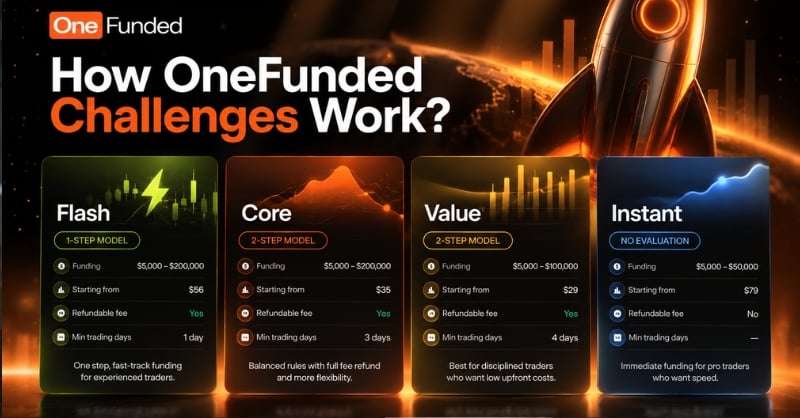
Traders can earn funded accounts from OneFunded through one of the following routes: Flash, Core, Value, and Instant Funding. Each route asks something different of the trader, so picking the right one comes down to matching the plan to your own trading style.
The table below shows how these funding paths compare across several aspects:
| Challenge | Steps | Starting Price | Profit Target | Daily Loss | Overall Loss | Min. Trading Days |
| Flash | 1 | $56 | 10% | 4% | 6% | 1 |
| Core | 2 | $35 | 8%/5% | 5% | 10% | 3 |
| Value | 2 | $29 | 8%/6% | 4% | 8% | 4 |
| Instant | 0 | $79 | None | 3% | 6% | None |
Flash
This is a single-phase pathway. That means there is only one profit target to hit, and you can get a fee refund during the first payout.
The trade-off is that the daily loss limit is tighter, at 4%, a 6% maximum overall loss limit, and a minimum of one trading day. This route also carries a fixed 50% consistency rule at both the evaluation and funded stages, so no single day can generate more than half your profit.
Core
OneFunded presents Core as its flagship product. It even says on the website that this is the most popular choice.
Core is a two-step evaluation, where you must hit an 8% profit target in phase one and 5% in phase two. The plan caps the daily loss at 5%, overall loss at 10%, and traders only need 3 minimum trading days to qualify. Here too, the entry fee is 100% refundable once you pass the challenge.
Value
Value is OneFunded’s most affordable route. It starts at the lowest price on offer, $29, and still requires two steps to complete the challenge. The profit target for phase one is 8% and 6% for the second phase. The daily loss limit is 4% and the overall loss limit is 8%, that is across all phases, and you’ll need at least four trading days to qualify. And like Flash and Core, the entry fee for this plan is fully refundable at the first payout stage.
Instant funding
You take this path when you want to skip the evaluation stage altogether. You only pay the entry fee, which starts at $79 and is the highest of the four, and you’re funded from day one.
Account sizes here run only from $5,000 to $50,000. The plan also runs on tighter risk limits than the evaluation paths: a 3% daily loss limit and a 6% overall loss limit, plus a 15% consistency rule. On top of that, the plan doesn’t refund the entry fee, even a piece of it.
So, what does the full pricing picture look like? The following table presents all the entry fees for each account size across all plans:
| Account Balance | Flash | Core | Value | Instant Funding |
| $5,000 | $56 | $35 | $29 | $79 |
| $10,000 | $98 | $65 | $59 | $139 |
| $25,000 | $159 | $139 | $99 | $249 |
| $50,000 | $279 | $259 | $199 | $349 |
| $100,000 | $499 | $469 | $349 | – |
| $200,000 | $949 | $899 | – | – |
| Fee refund? | Yes | Yes | Yes | No |
As you can see, the Value path has the cheapest way into every account size it offers, but it stops at $100,000. Also, instant funding costs more than any evaluation path at the same balance and it caps out at just $50,000.
Drawdown
Drawdown is the mechanism OneFunded, and all other prop firms, use to decide whether you stay in the game or get disqualified. It typically consists of two separate limits: a daily drawdown limit, or daily loss, and a maximum drawdown, or maximum loss.
Daily drawdown limit shows how much of your account’s equity can fall within a single trading day. OneFunded measures this figure from your Start-of-Day Equity at 00:00 UTC and resets it 24 hours later. This means a bad Tuesday doesn’t carry a penalty into Wednesday.
Contrarily, the maximum drawdown is the ceiling the firm calculates from your account’s initial balance. And unlike the daily limit, this one never resets, and breaching it once ends the account for good.
Both limits are equity-based, which means OneFunded counts the paper loss on a position you haven’t closed yet. Just as important, this threshold is static, which means it stays fixed to your Start-of-Day Equity for the daily limit and to your original starting balance for the maximum drawdown. Neither one climbs just because your account has grown.
The rules
One of the interesting things our researchers dug up was that OneFunded has one of the most permissive trading environments in the market.
News trading
The firm allows news trading across evaluation and funded accounts, including during high-impact events. The one caveat is what it calls the News Volatility Period, which covers five minutes before and after any high-impact release. You can still open, modify, and close positions as normal during this period, but what is unacceptable is trading that looks designed to exploit the price spikes or abnormal volatility in that window. If that pattern repeats, OneFunded treats it as a policy breach and can respond with a warning or a suspension of trading privileges.
Weekend holding
You can hold positions over the weekend. That strategy, however, will accrue rollover fees, or what some may call swap fees.
Expert advisors (EAs)
OneFunded allows EAs, but only after the firm has approved them. Its compliance team will review the source code for compatibility and upholding the terms of fair use before it clears them. And you can’t skip this step because that would be a general policy violation whose consequences can be trading restrictions, cancellation of payouts, a suspended account, or even termination of the contract.
Copy trading
You can copy trades, but as with expert advisors, you must observe certain rules to prevent abuse. For instance, you can’t mirror signals from sources like Telegram groups, Discord calls, or third party copiers. You can only use personal tools and automated systems you fully control, and must retain substantial control over things like position selection, risk, and execution logic.
What OneFunded disallows and prohibits
For one, the firm disallows practices that exploit the workings of a simulated environment. These include data-freeze exploitation, gap billing around predictable price dislocations, latency and reverse arbitrage, tick scalping, offsetting positions across multiple accounts to neutralise risk, martingale and grid recovery systems, and letting someone else trade your account, or trading someone else’s. Simply put, you can’t use strategies that rig the trading platform in your favor.
The firm also prohibits sign-on requests by traders from 20 countries and territories, including Afghanistan, Cuba, North Korea, and Belarus.
Trading environment
OneFunded’s trading ecosystem is vast, almost at the same level as many established companies that have been in the market for longer.
Platforms
When you sign up, the firm allows you to choose among MetaTrader 5, TradeLocker, and cTrader.
Instruments
The firm advertises more than 250 tradable instruments available. These include over 55 forex pairs, more than 15 digital assets, 150 plus US and European equities, and over 15 global indices and metals. This product selection is even broader than some more established firms.
Leverage
OneFunded sets leverage by asset class, and that figure is the same across all the trading platforms the firm supports. See the table below for details:
| Asset class | Leverage |
| Forex | 1:100 |
| Indices | 1:30 |
| Commodities | 1:30 |
| Crypto | 1:2 |
| Stocks | 1:2 |
Payouts
OneFunded has paid out slightly over $1 million to its traders in total as of September 2026. But before you become eligible for the payout, the firm runs you through a KYC check. The process begins by you submitting identity documents, which the firm verifies. You get the funded account once verification is complete and everything is in order.
The firm gives its traders 80% of the winnings on all trades in the funded account. And those who feel the share is insufficient can bump it up by another 10% with a paid add-on. The price of the add-on is 20% of the entry fee.
Once the money starts flowing in, OneFunded allows traders to request withdrawals every 14 days. The clock starts ticking once you open the first position on the funded account. And you can complete a withdrawal request as long as the account balance is at least $100. If the 14-day payout cycle is too long, you can instruct the firm to shorten it by purchasing a weekly payout add-on. And if you want to purchase the 90% profit split add-on and the weekly payout add-on as a bundle, the firm sells it at 34.99% of the entry fee.
OneFunded supports withdrawals through Rise, bank transfer, and USDT on the TRC20 network. The firm says it will process payouts within about an hour, which is faster than most prop firms offer.
Scaling plan
OneFunded’s scaling plan can grow a funded account up to $1 million in trading capital. The firm has designed the progression in a way that encourages traders to push harder towards earning a payout.
Here is how it works.
First, you need to qualify for the scale-up. And to do that, you need to close three consecutive profitable payout cycles. OneFunded requires that each of the cycle hit no less than 6% net profit, and that the account must be fully rule-compliant throughout.
Once the streak is complete, you can submit a short scaling application, and OneFunded’s team will review it within 48 hours. The application is free and, as the firm states on the website, there is no hidden qualifying step beyond the payout streak itself.
The scale-up progresses through five levels, and each one raises the account size by a fixed percentage on approval. For instance:
- One Step: +20%
- One Stride: +25%
- One Jump: +30%
- One Run: +35%
- One Leap: +40%
You earn each level individually, which is to say that you have to hit a fresh three-cycle qualifying streak at your current account size before advancing to the next level. You just can’t climb all five in one continuous run.
Let’s use OneFunded’s own example: a $200,000 account can grow to $240,000 at One Step, then $300,000 at One Stride, $390,000 at One Jump, $526,500 at One Run, and $737,100 at One Leap. That’s as far as the five published levels take you. The firm’s own marketing puts the ceiling at $1 million, but doesn’t spell out what happens once a trader clears Level Five, so exactly how an account would get from $737,100 to $1 million isn’t something OneFunded actually defines.
Who does OneFunded suit?
OneFunded offers a lot, but that range can be of little help for traders who can’t match themselves to the right feature. So, who is the firm best for?
- The patient multi-asset trader.
This is a trader who wants a bit of forex, crypto, and stocks trading from a single account. they also prefer not to be weighed down by a looming deadline that may force decisions. The Core plan can be a great fit here because it has no deadline pressure, no consistency rule to work around, and it’s the only path alongside Flash that scales all the way to $200,000.
- The cost-conscious trader testing the waters.
This one wants to try OneFunded without forking out lots of money as entry fee. The right plan here is Value. It has the cheapest entry fee at every account size it offers, and it drops the consistency rule entirely.
- The confident, already-funded-elsewhere trader.
This is someone who already trades profitably on other funded accounts and just wants capital fast. They can go straight to the Instant Funding plan. The route will get them the funded account right away, but they won’t get more than $50,000 in trading capital.
Final verdict
OneFunded backs its growth with four funding paths, a straightforward scaling plan, and a payout system built for speed. Its main catches are the equity-based drawdown model, the split corporate structure behind trading services, and the uneven account ceilings across plans. Nonetheless, traders who go in aware of these trade-offs will find OneFunded a solid option for funded trading.
Disclaimer: This article is provided for informational purposes only. It does not constitute financial, investment, trading, or other professional advice, nor should it be considered a recommendation or endorsement of any platform or service mentioned. Prop trading and trading-related activities involve risk, and readers should conduct their own research and understand the applicable terms, fees, rules, and risks before using any service. Tech Funding News does not accept responsibility for any financial losses arising from decisions made based on this content.


