


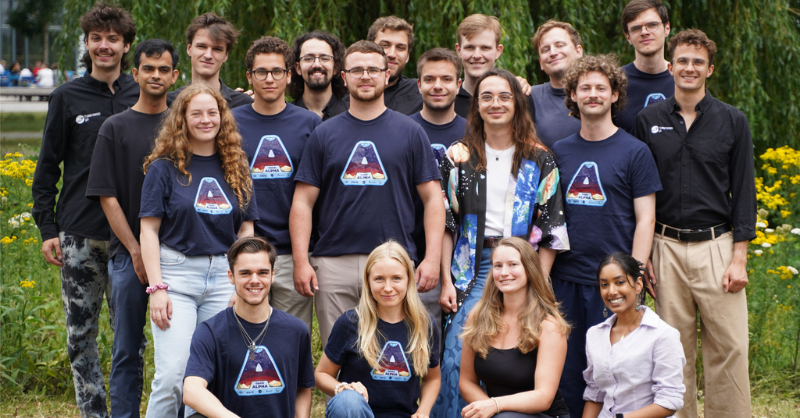
- Viena’s Tumbleweed raised €6.9 million in a round led by PactVC, just four months after its first launch.
- The company’s pre-certified Pods let labs run experiments in space without going through the lengthy certification process.
- SpaceX rejected Tumbleweed’s first two certification proposals but accepted the third.
After being rejected by SpaceX twice, Tumbleweed, an Austrian spacetech startup, has successfully launched Austria’s first commercial satellite on a SpaceX Falcon 9.
The company has now raised €6.9 million, the largest spacetech seed round in Austrian history, to fund three further launches in 2027. PactVC led the seed round alongside Vanagon Ventures, Prototype Capital, EWOR, and several international investors and angels.
Over a third of the 25 Tumbleweed employees have invested their own money.
From rejection to orbit
Julian Rothenbuchner, Guillaume Brault, and Leonhard Goliasch founded Tumbleweed in 2024, split between Vienna and Delft. In fact, Rothenbuchner started Team Tumbleweed in 2016 as a wind-powered Mars rover project, which is now very much its own thing. He went through six co-founder changes before reaching the team he has today.
According to Rothenbuchner, there’s a market problem: customers told him the real issue wasn’t getting a rocket seat but certification. Getting an experiment certified for spaceflight typically takes years, and one of the providers he referenced will charge you $500,000 just for payload processing.
Tumbleweed’s answer is the Pod: pre-certified, fault-isolated containers that keep the customer’s experiments powered and connected in orbit. The customer sends their payload to Tumbleweed and gets the data back during the mission.
From 2028, the Pod will come back with the samples inside. The company says you can get your experiments to orbit five times faster and at 1/10th the cost of a similar ISS experiment. Missions start at €15,000.
Oasis Alpha, its first mission, launched on 7th July on the SpaceX Transporter-17. It was a 3.6-kilogram CubeSat carrying four customers: Delft University of Technology, the European Space Resources Innovation Centre, The Spring Institute for Forests on the Moon, and Mass Balance. To date, all the customers are first-time space users.
“This funding will allow us to scale what we’ve proven on our first mission, Oasis Alpha: that microgravity can be a widely accessible industrial resource. We’re so excited to be able to bring this transformative capability to even more customers, and ultimately build a future where microgravity is used to make 10x better cures for cancer, 10x better semiconductors and 10x faster developed pharmaceuticals,” said Rothenbuchner.
Rivals with bigger fundraise
Tumbleweed’s competitors have raised vastly more. Varda in California raised $251 million on 30th September, led by Lux Capital and Natural Capital at a reported $1.6 billion valuation. The Exploration Company in Munich raised $450 million in September. Atmos Space Cargo in Germany closed a €25.7 million Series A in April. Space Forge in the UK raised its $30 million Series A in 2025, led by the NATO Innovation Fund.
While the others focus on getting materials back, Tumbleweed is in a different ballgame: they sell certified containers and handle the regulatory side of things. Rothenbuchner admits the company is “very dependent” on SpaceX for now. Tumbleweed has also entered into a MoU with the French launcher SIRIUS Space Services to test Pod compatibility.
EWOR’s CEO Daniel Dippold said, “Tumbleweed put Austria’s first commercial satellite in orbit in less time than it usually takes to certify a single experiment. Julian has done exactly what he told us he would do when we first met him, only faster. Now every lab and manufacturer can use space without becoming a space company first.”
Prototype Capital’s Andreas Klinger put it more directly: “Tumbleweed completely rethinks how R&D for industry and science in space should be done. Instead of years of preparation to send your satellites up, you simply order one of their boxes, and they shoot it into space. This allows rapid iteration for the next generation of space technologies. It’s hard to overestimate how important this can become.”
Austria’s government is watching too. “The fact that Austrian space technology is mobilising international private capital and is already being used commercially in space sends an important signal about the strength of our research and business location. Companies like these strengthen domestic value creation, create skilled jobs, and demonstrate that Austria is internationally competitive in demanding future technologies,” added Peter Hanke, Austria’s federal minister for innovation, mobility and infrastructure.
There is a market, just one that is very difficult to quantify. MarketsandMarkets forecasts in-space manufacturing at $4.6 billion by 2030 and $62.8 billion by 2040, with a 29.7% CAGR.
The funding will support three flights in 2027, serving over 10 customers with payloads from medical research, biotech, and agritech labs. It will also accelerate work on Oasis Beta, which is due to return to Earth. Rothenbuchner told Trending Topics in July that Oasis Beta would launch as early as late 2027, but the most recent announcement says 2028.
Oasis Alpha has proven that a container can be certified and operate in orbit. The bigger issues are looming in 2027 and 2028. Will the first customers come back for more flights? Will the first Pod return safely? Can a 25-person company keep the price competitive against far better-funded competitors?



