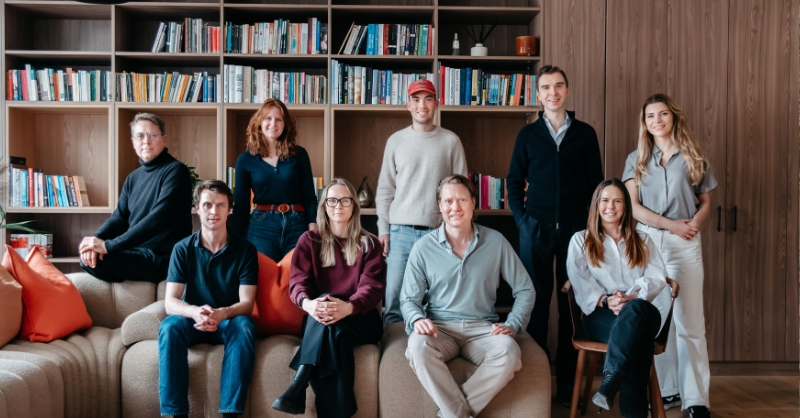
- Transition Ventures, the London-based early-stage firm co-founded by Unity’s David Helgason, has closed a $150M Fund II, taking assets under management above $300M
- The fund marks a deliberate pivot from Transition’s original climate-first thesis toward what Helgason calls ‘physical AI’ startups rebuilding real-world infrastructure through AI, from semiconductors and nuclear power to wildfire suppression
- The global physical AI market stood at $81.6B in 2025 and is projected to reach $960B by 2033, growing at a 36.1% CAGR, according to Grand View Research
When Running Tide, an ocean-based carbon removal company in which Transition held a stake, collapsed in June 2024 after failing to generate sufficient demand in the voluntary carbon market, David Helgason described the experience as deeply difficult. Twelve months later, he has raised $150M and redrawn the map entirely.
Transition Ventures, the London-based early-stage investment firm co-founded by David Helgason, Icelandic entrepreneur, co-founder and former CEO of Unity Technologies for a decade, the game engine company that went public at a $13.7B valuation in 2020 alongside Ari Helgason (formerly Index Ventures), Kristian Branaes (formerly CPP and Atomico), Clara Ricard (formerly Balderton) and David Pacák (formerly Earlybird and Picus Capital), has closed a $150M Fund II.
The raise takes total assets under management above $300M. Founded in 2021, Transition originally backed companies through a climate-first lens, using the Stockholm Resilience Centre’s Planetary Boundaries framework as its core investment thesis. Fund II marks a significant reframe, the firm now leads with what Helgason calls “physical AI,” backing companies rebuilding real-world systems at the intersection of artificial intelligence and industrial infrastructure.
Why the pivot makes sense now
The shift is not a retreat from climate. It is a reframing of where the capital is needed most. The AI boom has created an energy crisis that renewables alone cannot immediately solve, data centres require always-on baseload power, semiconductor manufacturing consumes enormous amounts of electricity, and wildfire destruction is accelerating faster than legacy suppression infrastructure can respond. Transition is betting that the companies solving AI’s physical constraints are, by definition, also solving some of the world’s most urgent industrial and environmental problems.
Transition invests from pre-seed to Series A with initial cheques of $1M–$8M across Europe and the US. Its concentrated approach: fewer bets, deeper involvement per company is a direct response to what Helgason describes as a broken VC model.
“Ambitious founders don’t just want to build a great business: they want to create something that will matter for generations to come,” says Helgason. “At Transition, we believe that the classic VC model of backing more of the same, incremental improvements, has run out of road. Founders shouldn’t have to choose between a venture fund that has the capabilities to help them scale and a fund that is aligned with their values.”
The portfolio: four companies that show what the thesis looks like in practice
Transition’s most prominent bet is Olix, the London-based photonics computing startup founded in 2024 by 25-year-old James Dacombe. As TFN covered in February, Olix raised $220M at a $1B+ valuation led by Hummingbird Ventures with Plural and LocalGlobe also participating to build optical AI chips designed to outperform Nvidia on inference workloads. Transition was in from the first round alongside LocalGlobe.
Seneca, the San Francisco-based autonomous wildfire suppression drone company, raised $60M in October 2025 in what is believed to be the largest venture financing in fire technology history. The round was led by Caffeinated Capital and Convective Capital, with participation from First Round Capital, DCVC, and Slow Ventures. Transition backed Seneca’s first venture round.
Applied Atomics is developing small modular nuclear reactors designed to supply power directly to data centres and large industrial users, a category that, as TFN has tracked, is attracting significant capital from hyperscalers including Amazon. Founded by former SpaceX engineers Ben Kellie (CEO), who built Falcon 9’s west coast launch site and landing barges before founding and exiting The Launch Company to Voyager Space in 2021, and Paul Keutelian (CTO), co-founder of nuclear microreactor company Radiant Nuclear. Applied Atomics targets data centre customers directly, bypassing utility contracts to accelerate its path to first deployment.
Upway, the platform for refurbished and pre-owned e-bikes, shows the breadth of Transition’s portfolio beyond AI hardware. TFN covered Upway’s $60M Series C in November 2025, which brought total funding to over $125M at a $400M valuation. Since Transition invested in spring 2022, Upway has grown revenue by more than 30x, expanded from one office in Paris to become the clear market leader across Europe and the US.
The competitive landscape
Transition competes for physical AI deal flow against Breakthrough Energy Ventures, which manages over $2B across two funds focused on climate and energy technology, and Lowercarbon Capital, which has raised over $1B targeting carbon reduction startups. Where those funds concentrate on climate impact metrics, Transition’s Fund II explicitly broadens to AI infrastructure, semiconductors, and critical materials, categories where climate and compute demand increasingly overlap. European deep tech funding exceeded €1B in disclosed fund vehicles in 2026 alone, according to EU Startups, with specialist funds forming across the UK, France, Denmark, and Poland.
The harder question Fund II raises is whether rebranding climate infrastructure as physical AI is a genuine strategic evolution or a necessary concession to where LP appetite has migrated. Helgason’s portfolio suggests the former – Olix, Seneca, Applied Atomics and Upway are all solving problems that matter regardless of what you call the thesis. But for a fund that once used planetary boundaries as its investment filter, and that watched one of its portfolio companies sink wood chips into the Icelandic ocean only to shut down months later, the distance between carbon removal and AI chip inference is worth keeping in view.