


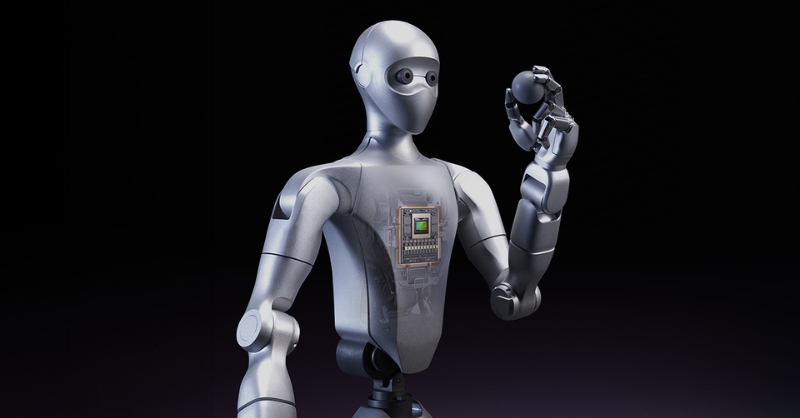
- NVIDIA unveiled the Isaac GR00T Reference Humanoid Robot, the first open humanoid reference design built on the Jetson Thor compute platform and Isaac GR00T AI development stack, aiming to simplify humanoid robot development.
- The integrated system combines a Unitree H2 Plus humanoid body, Sharpa five-fingered dexterous hands, and NVIDIA’s onboard AI computing, eliminating the need for developers to piece together hardware, software, simulation, and AI tools from multiple vendors.
- Leading institutions, including ETH Zurich, Stanford Robotics Center, Ai2, and UC San Diego, are already adopting the platform, with commercial availability through Unitree expected in late 2026.
NVIDIA has announced the Isaac GR00T Reference Humanoid Robot, the first open humanoid robot reference design built on its Jetson Thor compute platform and Isaac GR00T open development stack.
The announcement was made by CEO Jensen Huang at NVIDIA GTC Taipei on 1 June. “Today, we’re announcing the Nvidia Isaac GR00T, a reference humanoid robot, all fully integrated – 25 degrees of freedom on each hand, 31 degrees of freedom on the robot, six feet, 150 pounds,” Huang said during his keynote.
The launch takes aim at one of humanoid robotics’ most persistent bottlenecks: fragmentation. Development teams have historically been required to source hardware, software, simulation environments, and AI models from separate vendors, with no unified workflow connecting them. The GR00T reference design collapses that stack into a single integrated system.
In hardware terms, the robot combines a Unitree H2 Plus humanoid body, Sharpa five-fingered hands built for dexterous manipulation, and NVIDIA’s Jetson Thor module for onboard reasoning and control. The full Isaac GR00T software platform — covering data capture, generation, model evaluation, and deployment — runs across the entire system.
Several leading research institutions are already signed up to use the reference design, including ETH Zurich, Stanford Robotics Center, Ai2, and UC San Diego’s Advanced Robotics and Controls Laboratory. “An integrated platform that connects robot hardware, data capture, policy learning and physical evaluation can help researchers accelerate loco-manipulation research,” said Michael Yip, professor at UC San Diego and director of the lab.
The robot will be available through Unitree in late 2026. The Isaac GR00T workflow for the Unitree G1 is expected on GitHub and Hugging Face shortly.


