


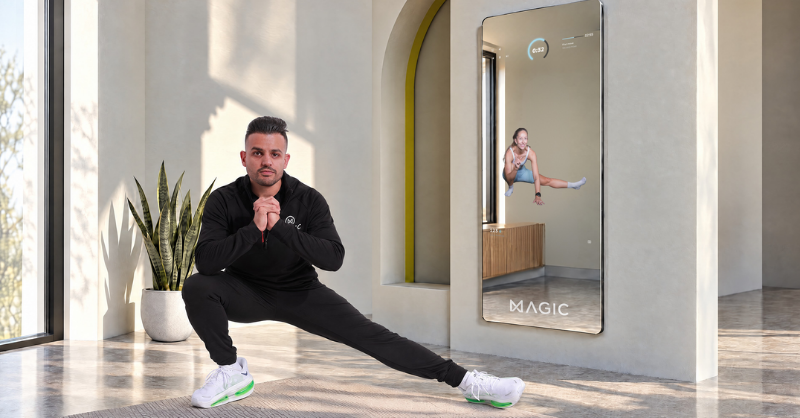
- Magic AI has secured $11 million in new funding, bringing its total raised since 2023 to about $20 million.
- Beringea and IW Capital led the latest funding round as Magic AI prepares to expand into the US.
- This funding comes as the US market has seen mixed results for rival fitness-mirror hardware.
Varun Bhanot built his first prototype after losing a quarter of his body weight with a personal trainer he could hardly afford. Inspired by the lack of accessible support, he co-founded Magic AI. Five years, three funding rounds, and a King’s Award later, the company has now raised $11 million to target US customers.
The London-based startup produces the Magic AI Mirror, a wall-mounted screen that uses computer vision to correct form, count repetitions, and project a hologram trainer into the room. Trainers include former England cricket captain Sir Alastair Cook and former Manchester United winger Jesse Lingard. Beringea and IW Capital co-led the round.
PXN Group, Accelerate Ventures, and Ventures Together returned as investors, while Active Partners, known for backing Soho House, Rapha, and Leon, joined as a new backer.
With this round, Magic AI’s total funding reaches about $20 million. Previous rounds included a $9 million seed round in 2023, a $5 million round in 2024, and an angel round in October backed by Cook and Lingard. The company plans to use the new funds to grow its US operations.
A tough market for fitness screens
Raising money for home fitness hardware remains difficult. Lululemon shut down its Mirror business, and Tonal’s valuation reportedly dropped from $1.9 billion to $500 million as interest in connected fitness declined. Tempo, the top-funded US competitor, has raised almost $300 million but has not yet achieved steady recurring revenue.
Bhanot says Magic AI is cheaper to build and run than its American rivals. The company’s computer-vision model, ReflectAI, is trained on more than 500,000 AI-coached workouts and about 150,000 hours of user data. Whether this gives Magic AI a real edge will depend on how the US market responds.
Focusing on celebrity endorsements as well as software
Magic AI relies more on celebrity endorsements than most other computer-vision fitness products. The company says it has hired a former managing director of Peloton International to help with its US expansion.
InsightAce Analytics projects that the global AI fitness and wellness market will reach $34.7 billion by 2031, as more hardware makers, wearable companies, and coaching apps add AI features to attract investors.
Bhanot sees this funding round as proof that investors now see AI hardware as a strong market position. It is still unclear if US consumers, who have watched many fitness mirror companies come and go, feel the same way.


