


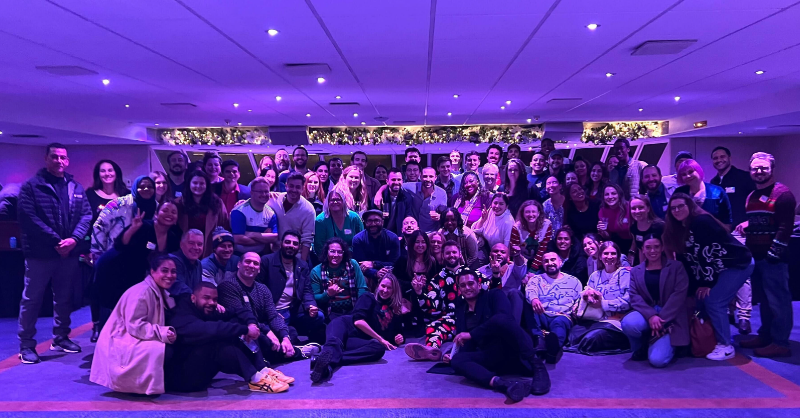
- General Catalyst is investing $60m to help Collective acquire customers.
- Collective offers business setup, accounting, invoicing, payroll, taxes, business insurance, health insurance, and support through a single membership
- Collective will use the capital to accelerate product development in banking and insurance.
Hooman Radfar‘s parents both ran their own medical practices. When they split up, only his dad went the S-corp route, which reduces self-employment taxes. Radfar says that decision saved his dad hundreds of thousands of dollars that his mum didn’t get to save.
That’s what inspired him to start Collective to help people avoid that exact same shortfall. He’s now announced $100 million in new funding to automate that decision for solo entrepreneurs in the US.
The round includes a $40m Series B and $60m from General Catalyst‘s Customer Value Fund (CVF). General Catalyst, QED Investors, and Gradient Ventures led the Series B, with participation from Intuit Ventures, FT Partners, and SemperVirens.
“AI is leveling the playing field, making it possible for a single individual to build a powerful, highly profitable enterprise,” said Radfar, co-founder and CEO of Collective.
According to the company, almost 30 million nonemployer businesses in the US had $1.7 trillion in annual receipts in 2022. Collective now says that number is well over 30 million. Collective will use the capital to accelerate product development in banking and insurance.
What the other $60M is
The Customer Value Fund is not an equity fund. For instance, Otter.ai must repay the $320 million from the fund, and General Catalyst takes its return from the sales and marketing spend it covers. Relay, the Canadian business banking startup, received $50 million from the fund. Meanwhile, Finom, the Amsterdam-based financial platform for SMEs, took $105 million from the fund, and according to them, it will repay that amount only from revenue generated by its new customers.
Both firms offer banking services to SMEs, the exact market Collective is looking to enter. Collective has not disclosed specifics about its $60 million funding.
“With CVF, we look for companies with high-quality unit economics and a large market opportunity. We see solo businesses as one of the economy’s most dynamic segments, and we expect that trend to accelerate as AI advances. Collective has built a one-stop shop for their financial needs. Their vision and track record make Collective exactly the kind of company CVF was designed for,” said Pranav Singhvi, who co-heads the fund at General Catalyst.
Collective launched in September 2020 with an $8.65 million seed round led by General Catalyst and QED. They closed a $20 million Series A in May 2021, again led by GC and QED. The most recent round was $ 50 million in July 2023, led by Gradient Ventures, Innovius Capital, The General Partnership, General Catalyst, QED, Expa, and Better Tomorrow Ventures.
Its investor list also includes Expa, Sound Ventures, The General Partnership, and Better Tomorrow Ventures, as well as individuals including Nikesh Arora, Ashton Kutcher, Elad Gil, Dylan Field, Garrett Camp, David Steinberg, Gokul Rajaram, Aaron Levie, Steve Chen, Sam Yam, and Kevin Lin.
From leaving Oracle to starting a new company
Radfar and his Carnegie Mellon classmate Austin Fath were both students when they co-founded Clearspring Technologies. That company later became AddThis, which Oracle acquired in January 2016 for around $200 million.
Radfar then became a founding partner at the venture firm Expa, where he met Ugur Kaner and recruited in Bugra Akcay. When Collective launched, Kaner became CPO and Akcay CTO.
Collective offers business setup, accounting, invoicing, payroll, taxes, business insurance, health insurance, and support through a single membership. They acquired AI accounting startup Open Ledger in April 2026 and launched their Insurance Centre in July 2026, partnering with Coverdash for business insurance and Solo Health for major medical.
“Traditional accounting firms scale by adding people. Collective scales with intelligence. Every workflow we automate and every part of the financial stack we bring onto the platform increases what Collective can do for our members. We’re building toward a world where a Business-of-One can access the financial capabilities of a much larger company without having to build the team behind it,” Radfar added.
Collective says it’s up 127% year on year and that it’s helped members save $350 million in tax. The top earners have saved as much as $40k a year. The company claims its AI handles half of support tickets and maintains a 4.5-star satisfaction rating.
Competitive landscape and what’s next
Lettuce Financial, which Collective lists as a competitor, raised $28 million in November 2025 in a round led by Zeev Ventures. Bench, which had raised $113 million and had over 35,000 US customers, shut down suddenly in December 2024, leaving thousands of businesses without access to their records.
Most venture capital in AI accounting is going to other areas. Basis raised $100 million at a $1.15 billion valuation to provide accounting firms with AI agents. General Catalyst invested $65 million in Accrual as part of a $75 million launch in the same month. Rillet, which builds accounting systems for finance teams, became a unicorn in August with a $100 million Series C.
In Europe, Pennylane raised €175 million in January for its platform for SMBs and their accountants. Basis and Accrual are both focused on the accounting firm market.
360iResearch expects the AI in accounting market to grow from $1.81 billion in 2025 to $5.89 billion by 2030, and Mordor Intelligence forecasts $6.68 billion in 2025 and $37.6 billion by 2030.
Retention is the key metric. If Collective’s deal is anything like Relay’s, then General Catalyst only gets paid if the customers they acquired stay and keep paying. The fundamental question is whether Collective’s software can hold trust at scale, which is what the $60 million investment is all about.



